Before the television adaptation, before the Calvin Klein campaign, before Tell Me Lies became a cultural obsession dissected across TikTok and late-night group texts, there was a girl growing up in Upper Westchester, spending summer days at the country club and watching boats drift across the Sound.
That girl was Carola Lovering.
And the emotional terrain of this region. Its privilege, its pressure, its intimacy, its drama would one day become the backdrop for the stories that made her a phenomenon.
“This part of the world has always been home to me,” she says. “Even when I’ve lived elsewhere. My family is here. My closest friends are here. And as a writer, I’m constantly drawn back to it because I know it so intimately, its people, its class distinctions, its emotional undercurrents.”
In Tell Me Lies, Lucy’s hometown of Cold Spring Harbor mirrors Bedford in subtle but unmistakable ways. The lazy summer days at the tennis club. The ease and boredom of adolescence. The familiar ritual of meeting at the pool. The scene where Lucy and Stephen take a boat out onto Long Island Sound one summer night feels almost autobiographical to anyone who has grown up in Fairfield or Westchester County.
Readers recognize it because they’ve lived it.
And that intimacy, the specificity of place is part of what gives Lovering’s work its quiet power.
The Story That Changed Everything
Carola didn’t always know she would become a novelist. As a teenager, she loved writing and reading, but she wasn’t someone with a crystal-clear career trajectory.
That changed in the aftermath of an on-again, off-again toxic relationship during and after college.
When it finally ended, she was devastated. Confused. Unmoored. Overwhelmed by emotions she didn’t know how to process.
A friend suggested she write about it.
So she did.
What began as catharsis became Tell Me Lies, a raw, psychologically complex exploration of obsession, humiliation, longing, and the kind of love that fractures your sense of self.
“I think many people have been in Lucy’s shoes before,” she says. “Or at least know someone who has. It’s often the most humiliating, shameful experiences that tap into our deepest vulnerabilities and that’s what connects us as humans.”
That emotional honesty is precisely why audiences can’t look away.
The television adaptation didn’t just expand her readership, it ignited fandom. As a consulting producer, Lovering was closely involved in season one, visiting the set and watching her characters take physical form. Seeing Grace Van Patten as Lucy and Jackson White as Stephen felt surreal.
“I truly cannot think of a more perfect Lucy or Stephen,” she says. “Their casting is a huge part of what makes the show.”
By season two and especially season three the response reached another level. Social media engagement exploded. The discourse deepened. And when the two leads appeared in a Calvin Klein campaign, it crystallized something.
“It felt iconic,” she says. “That was a moment where I realized this was bigger than I imagined.”
Yet what makes Tell Me Lies culturally relevant isn’t chemistry or glamour. It’s restraint.
The show does not glorify toxicity.
“We all know Stephen is toxic and that’s the point. You’re not supposed to root for him and Lucy,” she explains. “I grew up watching shows that arguably glamorized certain unhealthy dynamics. I don’t think that was healthy for my generation. I’m glad Tell Me Lies shines a light on toxicity instead of ignoring it.”
Why We Can’t Look Away
Part of what makes Tell Me Lies resonate so deeply is that it captures a generational shift in how we talk about love.
For decades, pop culture romanticized dysfunction. The brooding bad boy. The push-pull dynamic. The woman who endures emotional chaos because the chemistry is electric. Those narratives weren’t presented as cautionary tales, they were presented as destiny.
Lovering’s work disrupts that.
Stephen is magnetic, yes. But he is also manipulative. Lucy is intelligent and self-aware, yet repeatedly pulled into a dynamic that erodes her confidence. The tension isn’t about whether they’ll end up together, it’s about whether she’ll survive herself inside the relationship.
That distinction matters.
In a post-therapy, post-#MeToo, emotionally literate culture, audiences crave stories that reflect the complexity of desire without romanticizing harm. They want to see the mess without pretending it’s aspirational. Lovering gives them that.
And perhaps no setting is more fertile ground for that kind of storytelling than the tri-state area.
This region, Westchester, Fairfield County, the commuter towns just outside Manhattan exist at a fascinating intersection of affluence and insecurity. Achievement is expected. Image is curated. Social hierarchies form early and harden quickly. Summers revolve around country clubs and tennis courts. Friendships are intimate, but reputations are fragile.
There is privilege here, certainly but also pressure.
That emotional landscape of ambition, comparison, longing, and the fear of falling short seeps into Lovering’s fiction. The boats on the Sound, the poolside afternoons, the quiet, tree-lined roads: they are beautiful, yes. But they are also stages upon which identity is performed and tested.
Readers from this area recognize the subtext immediately.
They know the feeling of wanting something or someone who threatens their stability. They understand how easily external polish can mask internal unraveling. They see themselves in Lucy not because her circumstances are extreme, but because her vulnerability feels familiar.
By anchoring her novels in places she knows intimately, Lovering achieves something rare: specificity that becomes universal.
She writes about Bedford and Cold Spring Harbor, about tennis clubs and shoreline summers but she’s really writing about the universal ache to be chosen, to be seen, to matter.
And that’s why we can’t look away.
The Personal Layer
Success has changed her career but not the work itself.
“There are more eyes on my writing now,” she says. “And yes, success has boosted my confidence. But it hasn’t made the process any less daunting.”
There are no shortcuts in writing.
The joy, she explains, is in the work itself. The quiet hours at her desk, the frustration, the breakthroughs. Even when drafting feels clunky or agonizing, she feels grateful that this is what she gets to do.
At the moment, she’s navigating a new chapter in more ways than one. She welcomed her third baby in December and is on what she calls a “self-imposed maternity leave” in quotes, because writers don’t really get to turn off.
When she’s actively drafting a novel, her days are structured. Kids to school. Coffee. Emails. Then the manuscript. A thousand words a day, if possible. She writes until she hits her word-count goal or reaches a natural stopping point, closing her laptop around five when her children return home.
Writing is not a hobby.
“It’s very much a full-time job,” she says. “A job I happen to love, but a job nonetheless.”
To protect her creativity amid Hollywood attention and social media noise, she follows advice from her agent: start writing the next thing.
“Keep yourself busy creating,” she says. “That’s the best way to tune out the noise.”
When she needs to reset locally, she heads to Kaia Yoga in Darien, takes long walks near her home, or attends author events at Athena Books in Old Greenwich, Barrett Bookstore in Darien, and Elm Street Books in New Canaan, independent spaces that keep the literary community alive.
Her hometown, she says, is “community-oriented.”
That word feels fitting.
What’s Next
Her fifth novel, Whiteout, will publish next winter. Set in Aspen, it explores motherhood, marriage, and mental health. Suspenseful, but not quite a thriller.
“I’ve been working on it since 2023,” she says. “I can’t wait to finally share it.”
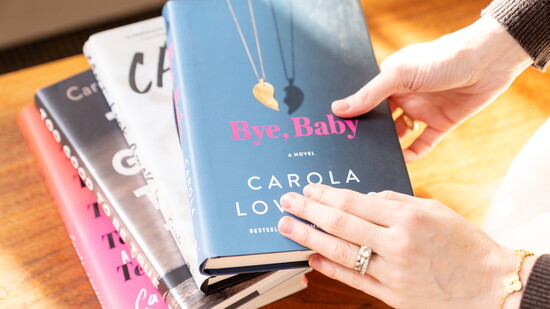
Meanwhile, her novel Bye, Baby is currently in development for the screen—another potential cultural ripple.
Despite the scale of her success, she approaches new projects the same way she always has: trying to improve with each book.
At this stage of her life, raising three young children, she feels especially called to explore motherhood and how parenting reshapes marriage.
The emotional complexity never disappears. It simply evolves.
And perhaps that is what defines Carola Lovering most: a refusal to look away from what’s uncomfortable.
Her advice to young writers growing up here is simple, and powerful:
“The thing you are most afraid to write. Write that.”
Because vulnerability breeds relatability. And relatability breeds connection.
From Bedford to Greenwich to Darien, her stories echo with the tension and tenderness of this region. The tennis courts. The country clubs. The Sound at dusk. The marriages under pressure. The ambition. The longing.
She writes what we’re ashamed to admit.
And in doing so, she transforms shame into art.
On Writing Fearlessly
“The thing you are most afraid to write. Write that. So often what we’re most scared of sharing is exactly what people want to read. Vulnerability breeds relatability. Break through your shame and create art from it.”