Restaurant trends, be they sensational, viral, and possibly paradigm-shifting, have a reputation for beginning in New York or Los Angeles. After a few laps around the sun, they finally filter their way down to mid-sized cities like Charlotte, creating a washed-out version of the original.
But not in the Carolinas. At least, not anymore.
Spending a weekend at The Food & Wine Classic in Charleston proved that regional, local and place-based trends are making waves in dining culture.
The seminars and off-the-cuff conversations at this star-studded Carolina-based food festival made clear that the Carolinas region is not a secondhand, copy-cat New York but its own trend-setting entity. Chefs who embrace the Carolinas’ Piedmont, Lowcountry, or Appalachian identity are ushering in a new era of dining.
The recent Michelin Guide recognized Asheville’s Ashleigh Shanti from Good Hot Fish, and Graham House from Luminosa for their Appalachian technique and western North Carolina ingredients. Vern’s in Charleston, one of the few one-star recipients, is, at its core, a neighborhood bistro. Here in Charlotte, Supperland’s Michelin nod is a testament to the timeless allure of a southern steakhouse that isn’t pretending to be anything but itself—grand, decadent and Charlottean.
While attending the festival, I listened to local chefs and food personalities at seminars and in off-the-cuff conversations who take pride in Southern cuisine. Award-winning Rodney Scott, one of South Carolina’s most notable pitmasters, walked guests through how to build the ultimate meat n’ three plate, while Manheet Chauhan, a recognizable chef and Chopped judge, taught attendees how to fuse Indian spice with lowcountry cuisine.
Leaving the festival, I didn’t just have a full stomach. I had a sharper understanding of the drinking, dining and hospitality trends bubbling up in the Carolinas region. Here are four trends shaping how locals will eat and drink in 2026—and maybe, just maybe, New York or LA will catch on soon.
TREND ONE: THE REIMAGINED OYSTER
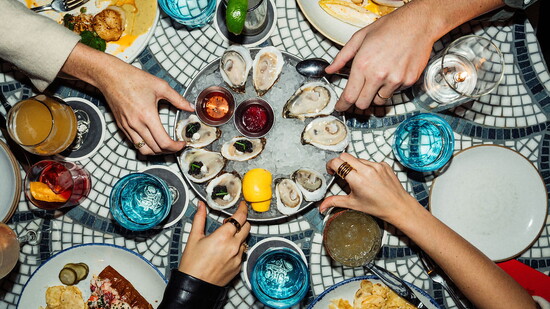
At the festival’s Grand Tasting, oyster dishes dominated. Some were garnished with tuna crudo, green onions and fried shallots, others with a simple shallot mignonette like those at the Lowcountry Oyster Company stand.
But the oyster iteration that caught me in my tracks came from Chef Bailey Campbell at 167 Raw in Charleston: a clean, meaty bivalve doused with a Guinness mole mignonette. It was unexpected—smokey, rich, bitter, bright and salty all in one slurp, a full meal’s worth of flavors in a singular oyster.
Chefs are exploring new ways to prepare oysters because there are both more oysters available and more discerning customers.
“Advancements in oyster farming technologies have sprung a wide variety of grow-out methods and helped produce higher quality oysters,” Campbell says. “As chefs, we have triple the oyster variety to choose from.”
Interacting with guests daily, he notices more educated consumers opting for oysters, too.
“They’re understanding the differences in flavor,” he says. “And they appreciate the sustainability and importance of oyster farming.”
Fanciful twists on oysters exist beyond Charleston, too. At Michelin-recognized Nanas in Durham, a buttery, green onion foam floats atop wood-grilled oysters. At Seraphine, also in Durham, Dragos-style oysters arrive by the trayful, swimming in garlic butter and Parmesan with bread for sopping.
Even oyster and drink pairings are evolving. At the festival, beer educator Anne Becerra and Lowcountry Oyster Company’s Trey McMillan showcased how Belgian saisons, witbiers and even stouts can amplify briny, creamy, or mineral notes.
As oysters prove to be a promising canvas for culinary experimentation, diners can expect the rise of the reimagined oyster in 2026 across the Carolinas.
TREND TWO: THE RETURN TO NOSTALGIA
The most impactful moment at the festival this year was listening in on a live recording of the Tinfoil Swans podcast, featuring Phil Rosenthal of Somebody Feed Phil on Netflix.
Rosenthal discussed the opening of his first dining concept—a retro diner named “Max & Helen’s” in honor of his parents. His feelings of nostalgia shone through as he recounted trying every milkshake in LA and developing his late father’s “fluffy eggs” for the menu.
And with a packed diner every day since its opening, nostalgia has proven to be a powerful tool for the restaurant’s success, too.
Nostalgia is manifesting across the Carolinas as well in taste, design and feeling.
At Hello, Sailor in Cornelius, the mid-century design and playful menu of popcorn shrimp and blackened catfish evokes the feel of a day by the water as a child. In Asheville, Ashleigh Shanti at Good Hot Fish makes the type of Appalachian food her grandmother and aunts made for her as a child—chow-chow. The restaurant space, with vintage magazines and art stringing the walls, is a warm nod to the past, too.
At Nanas in Durham, chef-owner Matt Kelly redesigned the 1992 institution in 2023, paying homage to the restaurant’s namesake: a nana. With warm, woodsy tones, low ceilings and midcentury flair, this homestyle Americana restaurant “is designed to make the guest feel comfortable and special,” Kelly says.
Walk into the women’s bathroom and you’ll see a collection of vintage pearls, glasses and postcards. It’s impossible not to smile.
“Nana’s is a place that welcomes you back to the basics of close community and an incredible meal,” Kelly says. “That's what we want to honor here.”
TREND THREE: THE MARTINI AS A PERSONAL PREFERENCE
At the festival, Tiffany Barriere, a renowned master mixologist seen on Netflix’s Drink Masters, hosted a “Decoding the Martini” seminar. The takeaway: the martini is personal, sometimes a rite of passage, and it is as relevant as ever.
“It’s whatever you like,” Barriere told the crowd. “There are no dos and don’ts to a martini.”
Casey Raven Swanson, lead mixologist at Table in Asheville, sees this comeback as “a return to the basics, the classic gin or vodka martini, a slightly dirty as opposed to a filthy martini,” Swanson says, referring to the intensity of olive flavor.
Swanson serves a Mojo Martini at Table. It’s a savory, herbal, even garlicky martini with vodka, mojo vermouth and extra-virgin olive oil.
“My goal with the Mojo Martini was always to bring a little bit of my culture to Table… but to also create something that could be a bridge for the filthy martini drinker to find something new,” Swanson says.
More than a trend, the martini and its many iterations—be it dry, dirty, savory, shaken, stirred, or caffeinated—are reflections of personal identity and taste.
Barriere referenced that at her seminar, too. She said her martini-loving grandmother told her: “When you become a woman, you’re going to order a martini because you’re ready to know yourself.”
Around the Carolinas, we are seeing personal, whimsical, confident takes on martinis. In Durham, try Alley Twenty Six’s clean martini with a twist paired with their signature caviar tater tots. In Charlotte, sip Rada’s San Sebastian martini, with a Basque pepper and anchovy oil.
TREND FOUR: THE DYNAMIC DUO: PIZZA AND NATURAL WINE
Proving it’s never too early for pizza and wine, Charleston restaurateurs Miles White, Femi Oyediran and Anthony Guerra hosted a seminar at 10 a.m., where they unpacked how natural wine and pizza have become one of the most magnetic pairings in the Carolinas. White and Oyediran own Graft, a beloved bottle shop and wine bar, in Charleston. And with Guerra, they just opened the adjacent pizzeria Tutti, creating a natural-wine-and-pizza corridor on Upper King Street.
While Guerra clarified that “natural wine has never really been defined… it’s a very hip, modern term,” he distilled its appeal: minimal intervention, no overload of fake dyes, limited sulfur. It can be a high-acid, chuggable Beaujolais or a nutty, minerally skin-contact wine.
There’s a simple formula as to why this combination is so enticing.
“Wine and carbohydrates are great,” Guerra says. “Wine and cheese are great. Therefore, wine plus carbohydrates, plus cheese are great.”
And this delicious mathematical formula is proving itself across North and South Carolina.
Guerra also serves this dynamic duo at the Oakwood Pizza Box and St. Pierre Wine Shop and Bar he founded in Raleigh. Here in Charlotte, you’ll see it at Pizza Baby, with its funky wine list and easy-eating pies. You can find it in the Belmont neighborhood, too, where locals order Bird Pizzeria takeout and head over to Substrate, a true neighborhood wine bar that spins vinyl and hosts DJs on the front patio. The Bird-to-Substrate pipeline is the real deal—a one-size-fits all solution for date night, girls night and even a solo night.
“Pizza always attracts these trendy things as if they’re brand new,” Guerra says. “2Amys [in DC] has been doing this for almost 25 years. It’s only new that people are paying attention to it.”
The rise makes sense. As dining gets pricier, diners are gravitating toward what is accessible, and at the end of the day, pizza is food for the people.
If there’s a unifying thread running through these trends, it’s this: the Carolinas are no longer inheriting dining culture, they’re creating it. Across the region, chefs, bartenders and restaurateurs are looking at what is right in front of them: land, lineage and community, and leading with that.
So whether it’s at a jam-packed, foodie-weekend in Charleston or a long road trip through the Carolinas, these restaurant trends are building Carolinian food culture one oyster, one martini, one slice and one bit of nostalgia at a time.
"The Carolinas are no longer inheriting dining culture, they’re creating it. Across the region, chefs, bartenders and restaurateurs are looking at what is right in front of them: land, lineage and community, and leading with that."