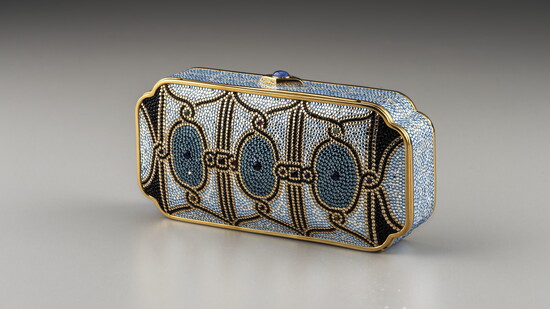
At first glance, the works in Brilliant by Design: The Handbags of Judith Leiber look playful. A dolphin covered in Swarovski crystals. Frogs with bejeweled crowns. A crystal-encrusted watermelon slice. But upon closer observation, something else emerges: exquisite craftsmanship, relentless innovation, and the remarkable story of the woman behind them.
Opening at The Mint Museum in October and running through July 2027, the exhibition is curated by Bridget Kerr, the museum’s Fashion Fellow. For Kerr, 28, who came to Mint in 2024 after completing the museum studies program at the Fashion Institute of Technology in New York, the exhibition quickly became more than a display of luxury handbags.
“It’s a celebration of the life and work of Judith Leiber through her handbags, with more than 130 objects on display,” Kerr says. “They’re magical, whimsical, and the closer you get, the more you can see.”
The exhibition will pair Leiber’s handbags and accessories with 20 objects from the museum’s fashion collection, adding context to these pieces.
“It helps answer the question, ‘What might you have been wearing when you carried a Judith Leiber purse?’” Kerr says.
Before curating the exhibition, Kerr admits she never considered herself “an accessories person.” Like many, she saw handbags as additions to outfits rather than standalone works of art. But studying Leiber changed her perspective.
“The attention to detail makes them more than a purse to carry around,” Kerr says. “They’re objects to be appreciated.”
Leiber built her reputation on whimsy and experimentation. Her bags gave women permission to inject color and personality into fashion long before it became mainstream. One of Kerr’s favorites is a bag made from shells, produced between 1998 and 2000, near the end of Leiber’s tenure at Judith Leiber Handbags, Inc.
“She introduced shell bags in 1976 and kept trying to improve them,” Kerr says. “Shells are fragile and hard to work with. Was it the savviest business decision? Maybe not. But she wouldn’t sacrifice creativity for the sake of the business.”
That mindset defined Leiber’s career. She understood every stage of handbag construction and experimented with materials most designers would never consider. In the 1970s, she produced a famous acrylic plexiglass purse. She worked with virtually every legal exotic skin available at the time. Even her now-iconic crystal-covered metal bags were improvised after metal frames arrived covered in tarnishes. Rather than scrap them, Leiber visited New York’s jewelry district, bought Swarovski crystals and covered the flaws.
The designer ran her handbag company for more than three decades, but her personal story is even more compelling. A Holocaust survivor originally from Hungary, Leiber emigrated to the United States with her husband after World War II and continued working into her 70s.
“As I started doing research,” Kerr says. “I discovered this movie-worthy life.”
The exhibition expanded after a collector’s family gifted the handbags to the museum with one condition: The Mint would create an exhibition around them. A publication was always part of the agreement, though its scale evolved as Kerr dug deeper into Leiber’s story and became immersed in the world she built. The result is a forthcoming book by Yale Press written by Kerr, that will be released alongside the exhibition.
“My first full year here was research, research, research,” Kerr says.
Ultimately, she hopes visitors leave understanding that fashion exhibitions are about far more than luxury items.
“You don’t have to have a degree in fashion or an education in art to appreciate these objects,” she says. “I want people to come in and learn about the life of a woman,” Kerr says. “When I first saw these bags at face value, I never would have imagined the woman behind them was a Holocaust survivor. Her legacy is very special.”