There are moments in history that seem almost impossible in hindsight.
Moments when ordinary people find themselves swept into something extraordinary, when a nation fixes its eyes on the horizon and decides to go farther than anyone ever has before.
The Apollo era was one of those moments.
For those who lived it, the moon wasn’t history yet.
It was a goal.
A challenge.
A question no one knew how to answer.
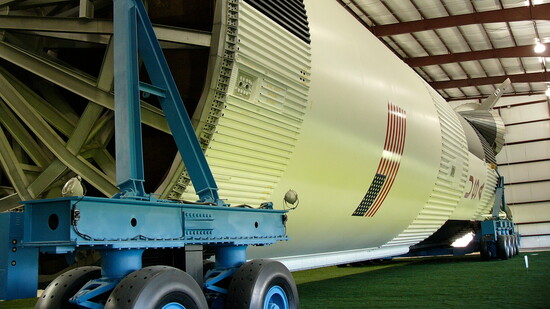
Standing a few miles from a Saturn V first-stage test firing at Marshall Space Flight Center in Huntsville, Alabama, Mit Landrum could feel the answer taking shape.
“The noise was not so much loud as it was simply energetic,” he recalled. “You could feel the awesome power of the rocket running through you.”
His clothes shook and vibrated as the engines came to life.
At the time, thousands of engineers, scientists, technicians, and dreamers were working toward what many believed was impossible, and among them was a young man from Farmington.
Fresh out of Washington University with a degree in Physics, Landrum joined NASA’s Propulsion and Vehicle Engineering Laboratory, where engineers were tackling one of the many challenges standing between humanity and the moon: keeping the Saturn V rocket from shaking itself apart.
The Saturn V remains one of the most powerful machines ever built, and Mit’s job was to help ensure its structural integrity during launch phase.
Yet despite the scale of the mission, the technology of the day was surprisingly simple by modern standards.
“The engineering that got us to the moon wasn’t done on computers,” Mit said with a laugh. “It was done with slide rules.”
Engineers filled the halls in white dress shirts and skinny ties, slide rules tucked into their pockets, solving problems by hand that would ultimately help send astronauts to the moon.
Mit had recently learned computer programming and quickly became fascinated with one of the few computers available. In one memorable race against a senior engineer armed only with a slide rule, he spent days programming a solution to a complex vibration problem, only to discover the senior engineer had solved it by hand just minutes sooner.
It was a different era. An era built on ingenuity, determination, and the belief that impossible problems were simply waiting to be solved.
For most people, helping send a man to the moon would be enough adventure for one lifetime.
For Mit, it was only the beginning.
Long before NASA, before Huntsville, before slide rules and Saturn V rockets, there had been another fascination quietly waiting in the wings.
Flight.
He had been fascinated by aviation since childhood. Growing up around veterans who shared stories of flight, he built model airplanes and dreamed of someday taking the controls himself. On January 2, 1967, he took his first flying lesson.
Nearly sixty years later, he is still learning.
For Mit, aviation has always been driven by curiosity—a desire to keep learning and understanding the world from a different perspective.
One of his earliest lessons came during a cross-country flight to Texas.
Still a relatively new pilot, Mit found himself battling weather that more experienced aviators had chosen to avoid altogether. Heavy rain battered the aircraft. Winds pushed him off course. Turbulence rattled the airplane as he repeatedly altered his route in an effort to navigate around a storm system that seemed determined to block his path.
The farther he flew, the worse the conditions became.
Visibility dropped.
Fuel dwindled.
And the options grew fewer.
Running low on fuel and surrounded by uncertainty, he did the only thing he knew to do.
He prayed to God.
A few moments later, through the weather, he spotted a ridge ahead. As he crossed it, an abandoned airstrip appeared below where he was able to land safely.
He recalls that when he climbed from the aircraft and checked the fuel tanks, he discovered there was virtually nothing left. The only fuel remaining was what sat inside the fuel lines themselves.
A nearby crop duster pilot helped him obtain enough fuel to continue his journey, but the lesson stayed with him long after the weather had cleared.
“Flying teaches humility,” Landrum said.
No matter how many hours you log, aviation has a way of reminding you there is always more to learn.
That same steady mindset would later serve him in boardrooms, community organizations, and eventually the mayor’s office. Whether working on moon rockets, navigating storms, leading organizations, or helping guide his hometown, Mit approached each challenge with the same belief: stay curious, stay humble, and never stop learning.
Today, he and his wife, Chris, still use aviation to stay connected with family, often flying to visit their children in other states.
Mit believes aviation continues to play an important role in communities like Farmington. “The airport is the off-ramp and on-ramp to the sky for Farmington,” he said.
After thousands of flights, and hundreds of thousands of miles, the airplane remains what it has always been for him: a bridge between people, places, and generations. And nearly sixty years after his first flying lesson, Mit Landrum still approaches aviation with the mindset of a student.
“You have to be a student of aviation your entire life,” he said.
Perhaps that’s the consistent theme throughout every chapter of his life; from moon rockets and airplanes, to business, public service, and family.
Not the destinations.
The willingness to keep learning, and the humility to know there is always more to learn beyond the next horizon.