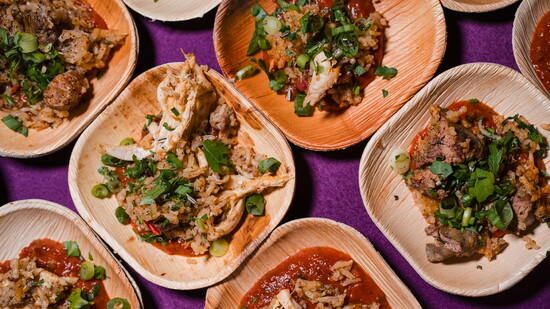
This spring, the Charleston Wine + Food Festival celebrates its 20th anniversary with the theme of “Past, Present and Future.” One of the events on their schedule that stands out from a historical perspective is the Dine on a Mat experience, which honors the African ancestors of the enslaved people who built this beautiful city and contributed their culinary knowledge to the Lowcountry culture. Held at the International African American Museum on March 6th, Dine on a Mat will be presented by Chef Fatmata Binta in collaboration with Charleston’s own Chef Bintou N’Daw.
Hailing from Freetown, Sierra Leone, Chef Binta is a modern nomadic chef and Fulani culinary ambassador, recognized globally for her work in promoting indigenous African ingredients and sustainable food systems. Her accolades include the Basque Culinary World Prize, the Best Chef Rising Star Award and recognition as a Rockefeller Foundation Fellow.
As the owner of Bintu Atelier, the only African cuisine-inspired restaurant on the peninsula, Chef Bintou is originally from Senegal and has lived in France, the West Indies, various African countries and New York City. With extensive experience as a caterer and personal chef for A-list celebrities, Chef Bintou launched restaurants and bistros in New York City. Now she has landed in Charleston, where she feels a connection to her roots and to the city’s crucial history.
According to Chef Binta, the Dine on a Mat event was inspired by the Fulani way of life where food, family and community are deeply connected. “In Fulani culture, sharing a meal is an act of respect, storytelling and togetherness,” she explained. “I wanted to bring that philosophy into a modern dining experience, where guests can connect, reflect and celebrate culture around a shared mat.”
She elaborated, “We’ve brought Dine on a Mat to Ghana, Africa, Europe, Washington D.C., New York City, Charlotte and now Charleston. Guests are drawn to the experience because they seek more than just a meal, they want connection, cultural insight and a space to slow down. Many are travelers, food enthusiasts and curious minds who appreciate the Fulani values of hospitality and community.”
During the Dine on a Mat event, guests can expect carefully crafted stews, millet, heritage drinks, Africa’s underutilized ingredients like Fonio, African Locust Bean, Baobab and locally inspired flavors, all served in a way that encourages sharing and conversation. “Every dish tells a story of heritage, patience and care,” Chef Binta said. “Dine on a Mat is more than food. It’s a practice of community, patience and respect. It’s an invitation to step into a world where meals are shared, stories are passed on and connections are nurtured. Each gathering is an opportunity to experience Fulani values in a tangible and joyful way.”
For Chef Binta, the CHSWF is an ideal platform for sharing the Dine on a Mat experience as a way of introducing guests to an experience where food becomes a bridge between people and cultures.
“This is my third time attending the festival –the team is so wonderful that I feel I’m part of the family now,” she said.
The IAAM’s Chief of Marketing Officer, Ashlei Elise, also expressed excitement about partnering with CHSWF to uplift indigenous African people and the food, culture and traditions that stem from the transatlantic slave trade. Given that the IAAM is built on the historic site of Gadsden’s Wharf, the destination where roughly 100,000 enslaved Africans were brought to America for their knowledge of how to cultivate the land, the location for the event is significant. So is the timing. “It’s serendipitous that the IAAM is hosting Dine on a Mat on the eve of the United States’ 250th birthday,” she said. “Because highlighting the culinary experience and resilience of African American traditions shows how this culture shaped the story of America. We are doing our best to share that history through an unfiltered perspective.”
Visit https://chswf.org/events/dine-on-a-mat/ and iaamuseum.org to learn more.
Guests are drawn to the experience because they seek more than just a meal, they want connection, cultural insight and a space to slow down.