In 1929 the stock market crashed launching America into the Great Depression. In an effort to provide jobs to 16 million unemployed Americans, President Franklin D. Roosevelt began a series of new programs called the New Deal. One such program was formed in 1933 and helped sustain Utah during the Great Depression. It was called the Civilian Conservation Corps (CCC). The CCC program provided jobs to thousands of Utahns. For many young men the CCC saved them and their families from homelessness. Not only did this program bring hope to those in Utah during the Great Depression, but it has had lasting effects on Utah’s outdoor culture.
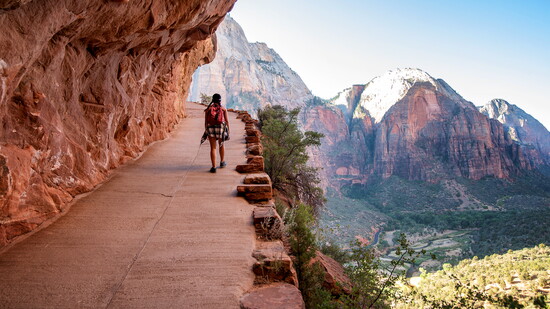
In May 1933, the first CCC camp opened in Utah. There were 30-35 camps functioning at the same time. Seven of those CCC camps in Utah worked with the National Park Service, mostly Zion and Bryce Canyon. The CCC left a legacy on Utah in many ways, but one of the most profound was the work done within our forests and national parks, in particular, Zion National Park. Within Zion the CCC’s projects included the switchbacks below the Mount Carmel Tunnel, the south campground amphitheater, the Court of the Patriarchs parking lot, and the Canyon Overlook Trail.
Kenneth Topham recalled working on building the Canyon Overlook Trail in the middle of winter with a 60 pound jackhammer near a cliff with a 1000 foot drop.
He said, “I don’t know how come I did that because I wasn’t very brave, there was about three or four of us hanging over that cliff running these hammers and drilling blast holes to make this road around a straight up cliff, but I don’t know how.”
When the CCC was disbanded in 1942 the Salt Lake Tribune wrote, “The CCC may be dead but the whole country is covered with lasting monuments to its timely service.”
The physical and mental health of people from all over the world has been enriched by the projects the CCC completed; and will continue to be felt as hikers, artists, and families relish in their adventures at Zion National Park.