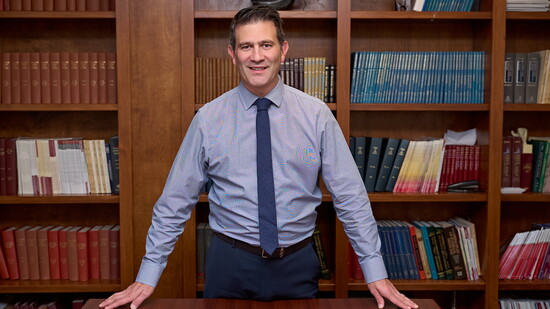
Dr. Clifford G. Rios, of Orthopedic Associates of Hartford, specializes in arthroscopic and reconstructive surgery of the knee and shoulder. A Connecticut native whose career in orthopedic sports medicine has brought him from South Windsor to the national sports arena and back home again. A graduate and class Valedictorian of the University of Connecticut, he earned his medical degree from UConn School of Medicine. Dr. Rios completed advanced subspecialty training in arthroscopy and orthopedic sports medicine at the UHZ Sports Medicine Institute in Florida, where he worked with elite athletes as a team physician for the Florida Panthers and Florida International University, and contributed orthopedic care to the Tampa Bay Buccaneers and members of the Jamaican Olympic Team. He is subspecialty board-certified in orthopedic sports medicine and currently serves as Director of Sports Medicine at the Bone & Joint Institute at Hartford Hospital. He is also head team physician for Trinity College and for Hall and Conard High Schools in West Hartford.
Q. What is arthroscopy and how does it differ from traditional orthopedic surgery?
A. Arthroscopy is a type of orthopedic surgery that uses small incisions and a fiberoptic camera to see within a joint space. The camera projects an image onto video monitors that allow the surgeon to see within an entire joint space, through an incision just a few millimeters in length. Oftentimes this affords more visibility of the joint than an open approach allows. Additional small incisions are used for instruments that can help manipulate and repair tissues without making larger incisions, thus lessening risk of injury to important structures. Arthroscopy can be performed on many joints, large, medium and small.
Q. What are the most common injuries or conditions you treat with arthroscopic techniques?
A. Many injuries to tendons, cartilage, ligaments, and meniscus can be treated with arthroscopic techniques. Some fractures can also be managed with arthroscopic assistance. More diffuse arthritis of large joints cannot be treated definitively with arthroscopy, and may require joint replacement in more severe cases.
Q. What advances in arthroscopy or sports medicine excite you most right now?
A. Arthroscopic instrumentation evolves continuously. Many injuries that used to require large, open approaches can be treated with arthroscopic modalities using newer, joint-specific instruments. New techniques continue to evolve and it is exciting to adopt a scientifically-supported approach to improve the care of common (and uncommon) sports injuries. There are also new rehabilitative approaches that allow more successful operative and nonoperative recoveries.
Q. How do minimally invasive techniques benefit patients?
A. Minimally-invasive surgery offers patients numerous benefits. Postoperative pain is generally less than with open procedures. The scars are very small and, oftentimes, are difficult to see 6-12 months postoperatively. Small incisions also reduce the risk of injury to nerves and blood vessels, a complication that is more prevalent with larger, open approaches. There is overall less soft tissue damage with arthroscopy as well, so this can hasten recovery.
Q. What misconceptions do people often have about orthopedic or sports-related injuries?
A. People often believe "sports" injuries are the traumatic ones we see on TV. Repetitive stress injuries related to sport are far more common, often due to inadequate training (mobility, strength, conditioning) and/or improper mechanics. Left undiagnosed and untreated, these overuse injuries can be more debilitating and require a more protracted treatment interval than the traumatic injuries. Most orthopedic ailments, particularly the overuse variety, can be treated without surgical intervention.
Q. How do you approach helping patients recover and return to the activities they love?
A. The first and most important aspect of the care of athletes and active adults is understanding exactly what it is they want to do. One of the first things I will ask any patient is "What is it that you want to do and how is your injury keeping you from doing that?." Once we have a diagnosis, a treatment plan can be tailored toward that individual's needs. Specific considerations are the movement patterns that an athletic activity requires, where in the season that athlete is, as well as with what intensity the athlete or active-adult is looking to participate. These factors dictate the interval of time I have to help that individual, and will affect my clinical decision-making.
Q. What role does prevention play in your practice?
A. Prevention plays a role in nearly every orthopedic injury. Unfortunately by the time most people come to me the problem has already occurred and we are working on a treatment plan. Once that individual has recovered to a satisfactory level, I will often leave them with preventative strategies to reduce the risk of recurrent injury related to their preferred activity. My work with the collegiate and high school programs that I cover involves preseason injury risk assessments, and we partner with the rehabilitative specialists at the Bone & Joint Institute at Hartford Hospital to identify athletes who are at higher risk for injury and implement pre- and in-season strength and conditioning programs for them. At one high school this approach helped reduce ACL injuries by 30. I would counsel patients that if you suspect an injury, earlier evaluation is key. We can identify and diagnose the injury and this early diagnosis with implementation of a treatment plan often leads to a much faster recovery than problems that are allowed to linger for weeks or months. At Trinity College we were able to greatly reduce the risk of injury in the men's ice hockey team (recent NCAA semifinalist) and there were no season-ending injuries in the men's basketball team (recent NCAA champions).
Q. How do you tailor care differently for elite athletes versus recreational patients?
A.Treatment plans vary depending on the intensity of the athletic activity. With the more elite athletes the treatment focuses heavily on finding safe ways to allow prompt return to activity. We often focus on functional rehabilitation whenever possible, aiming to allow continued participation while the athlete undergoes treatment. I may order advanced imaging (e.g. MRI) sooner, to rule in or eliminate certain diagnoses that would alter the treatment plan drastically. We often create a comprehensive health plan, engaging sports dieticians, strength and conditioning coaches, and sports psychologists. With recreational athletes we often have more time to allow for recovery and may suggest a longer period of convalescence. Time is the best healer of most things in orthopedics, and in most cases with recreational athletes it is very reasonable to take advantage of this.
Q.How do teamwork and collaboration (with physical therapists, trainers, or primary care physicians) influence recovery success?
A.This is the best part of being a sports medicine orthopedist. I have very strong collaboration with the athletic training staff, as they are the first responders for our athletes. They communicate with me whenever they suspect an injury. Once I evaluate the athlete, I can recommend a course of treatment and work with the athletic trainer as we return the athlete to sport. Similarly, I depend heavily on my physical therapy colleagues in the community. They help patients navigate the different stages of recovery from operative and nonoperative injuries, a process that often takes weeks to months. The athletic trainers and physical therapists have the clinical acumen to determine which athletes are progressing according to plan, and which ones may need an adjustment to their recovery. These specialists are an extension of the care I am able to provide and their treatment and communication is invaluable in treating sports injuries.