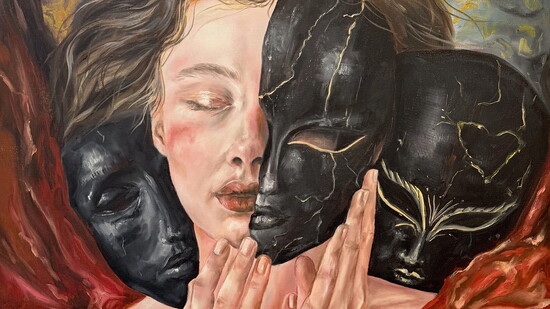
As a self-taught visual artist living in El Dorado Hills, Volha Naruta-Johnson creates textured pieces exploring the human experience—layered and imperfect. Her figurative oil series, “Being a Woman,” visits the often-pervasive tension between motherhood, career, and female identity.
Born in Belarus, Naruta-Johnson studied Cultural Heritage and Tourism at European Humanities University and has traveled to more than 40 countries. She has been a professional singer and worked in the field of psychology. All of which inform her art. “Some things cannot be processed through language alone,” she says. “Communication is one of our greatest gifts; we bring magic to each other’s lives. My way of doing that: painting.”
What drew you to explore contemporary womanhood in your work?
My work in psychology brought me close to women’s inner realities—themes of control, comparison, guilt, and the constant pressure to “be right.” I was living my own experience of becoming a woman, a wife, a mother. Contemporary womanhood, for me, is a lived tension between roles and essence, expectation and truth, rules and social games. That’s what I paint.
How do themes of motherhood influence your process?
Motherhood expanded me. It also confronted me asking: Who are you beyond being needed? I can work for hours, even days, forgetting to eat, to pause, to return to my body until something is complete. Motherhood doesn’t allow that kind of disappearance. It has been one of my deepest challenges. Yet it is my greatest happiness. My daughter is learning from who I am. What I want for her is not perfection, but truth. Not control, but an embodied freedom to experience what it means to grow into a woman. In my work, I return to that edge where devotion and autonomy are redefined moment by moment.
How has your international experience shaped your perspective as an artist?
I’ve lived inside cultures that seem to contradict each other—different religions, belief systems, and ways of seeing the world. Yet we are far more alike than we dare to believe. We carry similar questions, fears, longings. Discovering this freed me from needing to find perfect words. The language I work in now—through my art—is universal.
How has being self-taught influenced your relationship with your art?
I’m drawn to what I can’t do yet and seeing who I become. I’m very impatient and impulsive. It frustrates me. But if something doesn’t work, I look for another way. This has given me a sense of inner ground. Keep working. Keep searching. And stay on your own side.
Where do you find inspiration?
Honestly, it started with me complaining a lot. About juggling different roles. About the fear of aging. About feeling like I’m not a good enough mother. People would say, “I feel the same.” And suddenly we’d be laughing about the hardest things. People are my biggest source of inspiration.
What do you hope viewers get from your work?
A sense of recognition. A quiet inner “yes . . . I feel this.” And “I’m not the only one.”
How do you see your work evolving?
Within my series about women, a central character has begun to emerge who carries different emotional states, and she unfolds from painting to painting. I have a goal to grow technically. I’m publishing in major art catalogs such as “Arts to Hearts Project,” “Curatone.art,” and “Visual Art Journal.” I’m also moving toward larger formats and deeper series—work not just seen, but experienced.
Volha Naruta-Johnson - vola.artcall.org
Volha credits the EDH community with inspiring her art. “I’ve found real friendships, a deeply supportive community, and one of the most open and welcoming art associations I’ve experienced,” she says. “I feel invited—not just to exist, but to create. It makes me want to give back, to thank people by creating work that can live with them, becoming part of their personal space and story.”