We often hear about organizations and people building awareness around important causes, but it's the impact that awareness creates that's most profound. Samantha Standing, area director for the Western New York American Foundation for Suicide Prevention (AFSP), points to a story shared by one of the chapter's board members as an example of how education can change lives.
After learning about warning signs and mental health resources at a local health fair, one mother recognized signs of depression and potential risk in her 10-year-old daughter. She sought help early, and her daughter received support before the situation could escalate.
Today, the child is thriving and has developed healthy tools for managing her mental well-being. The anecdote serves as a reminder that mental health challenges can affect people of any age and that early intervention matters.
"You never know what someone is going through," Standing says. "Kindness, open conversation, and being there for somebody at the right time makes a world of difference."
Founded in 1987, the AFSP has become the nation's largest suicide prevention organization. "AFSP is a grassroots organization that focuses on eliminating the loss of life from suicide," Standing says. "We do that through delivering innovative prevention programs, educating the public about risk factors and warning signs, and reaching out to individuals who have lost someone."
While many people recognize the organization for its fundraising walks and awareness campaigns, AFSP also serves as one of the leading private funders of suicide prevention research in the United States.
The organization supports scientists and researchers studying the biological, psychological, and social factors that contribute to suicide risk. Research funded by AFSP helps inform best practices for prevention, intervention, and postvention efforts nationwide. Findings from those studies shape educational programs delivered in communities across the country, including Western New York.
Standing joined AFSP earlier this year after spending her career working in nonprofit organizations throughout the Rochester area. As the chapter's only staff member serving 17 counties, she relies heavily on a dedicated team of more than 200 volunteers. "When we say we're a grassroots organization, we mean it," Standing says. "There's no way we could do the work we do without our volunteers.”
Some volunteers have been involved with AFSP for more than a decade, becoming experts in areas ranging from event planning and fundraising to educational outreach and community advocacy. Many have personal connections to the cause through their own mental health journeys or experiences losing loved ones. Others work professionally as therapists, social workers, counselors, or healthcare providers.
"That's been really inspiring, to just see how dedicated people are to the work that AFSP is doing in the community," Standing says.
One of AFSP's most visible initiatives is its Out of the Darkness Community Walks, which bring together survivors, families, advocates, and supporters to honor lives lost and raise funds for prevention efforts. While the walks generate critical funding for AFSP's programs and research, Standing says they also create space for healing and open conversations about mental health.
Educational outreach is another cornerstone of AFSP's mission. The organization offers a variety of evidence-based programs available for schools, workplaces, community organizations, and healthcare providers, helping participants recognize warning signs, understand risk factors, and learn how to respond when someone may be struggling. Research done at the national level informs the content and approach of each program provided by the AFSP’s local chapters.
Among AFSP's most widely used programs is More Than Sad, a free educational initiative designed specifically for middle and high school communities.
The program provides separate presentations tailored for educators, parents, and students. Through age-appropriate videos and discussions, participants learn how to recognize signs of depression, identify concerns related to suicide risk, and connect young people with professional support. Equipping parents, educators, and youth to recognize symptoms of depression and seek help early remains a major priority for AFSP.
The organization also recognizes that certain professions face elevated risks. Construction workers, for example, experience significantly higher mental health risks than the general population due to a combination of factors that can include job stress, physical demands, financial pressures, and workplace culture.
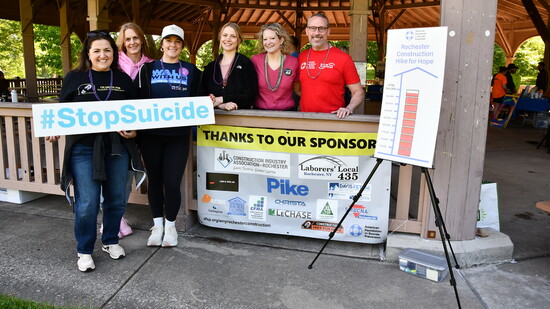
To address that challenge, AFSP Western New York partners with industry leaders and community organizations on Hikes for Hope events. These outdoor gatherings raise funds and awareness while encouraging conversations about mental health within the construction industry. By creating opportunities for workers and their families to connect in supportive environments, organizers hope to reduce stigma and increase awareness of available resources.
Throughout all of its programs, AFSP emphasizes a simple but powerful message: suicide is preventable. Standing encourages community members not to shy away from difficult conversations when they notice someone struggling.
"You can't be afraid to have conversations with people when you see that they're struggling," she says. "Let them know that there are people who care about them. There are ways that they can get support and get through whatever crisis they're currently dealing with."
For community members looking to get involved, AFSP offers a variety of opportunities. Whether through volunteering, fundraising, participating in an Out of the Darkness Walk, or simply learning how to support someone in need, every contribution helps advance AFSP's mission. In communities throughout Western New York, that mission continues to create conversations, connections, and hope.
If you or someone you know is struggling with thoughts of suicide, help is always available by calling or texting 998. Parents concerned about children can also call or text 998 on their child’s behalf to gain support and access resources to help their child. For more information, visit: afsp.org/chapter/western-new-york