“Oh, it was awful,” says Selena McAdams, lead designer and owner at Spruce, recalling one of her first design projects. “But it was all mine. Hunter green and yellow, blue ribbons feeding through cabbage roses. Decidedly 80s,” she says smiling. One year for Christmas, her mother presented a Spiegel catalog to redecorate her room. It was practice for her true calling. “It sparked something in me.”
That spark, ignited by a thick catalog and a teenager’s vision, has since evolved into a respected career characterized by tactile elegance and thoughtful curation. We sat down with Selena to discuss her business and approach to design.
Take us back to the years following that “decidedly 80s” bedroom project. How did you transition from a childhood interest into your career now?
Selena McAdams: It’s funny because I grew up with my nose in books. I only took one art class in high school. I’m from Nashville originally, and I went to the University of Memphis thinking I was heading into a law program. But the design program caught my attention.
I realized quickly that I loved the "touch and feel" of everything. I have a deep love for fabrics— even taking an outfit and translating that feeling into a room. I knew I needed to engage all my senses. I looked at commercial design and hospitality, but I knew I wanted to be with people and helping create home.
I ended up working at a European antique store called Grace Place owned by the lovely Grace Megel. It was a massive opportunity at a young age. I got to experience market and do the buying, which felt very natural to me.
I began taking on design projects and still have some of the same client relationships from those early days. I remember printing my very first business cards and cutting them out by hand. There was no online shopping back then. While working on projects, I was navigating sourcing and really just finding what I loved and figuring out how to get it here. Which brought me to opening Spruce, our shop, which was born over lunch at Huey’s over 18 years ago. It’s where my team and I office, but we also curate furniture, accessories, art, lighting and gifts. More than a place to shop, I wanted an access point for people in Memphis without going to market or who might not be working with a designer. Personally, having a retail space has broadened my eye and I really love the community aspect of retail. It has been incredible to watch the progress in the industry of design.
You’re known for a fresh and sophisticated aesthetic. How does this influence your design approach?
SM: I strive for a clean aesthetic. It is never excessive without a reason. Everything is very intentional and must serve a role; nothing is there "just because." Balance and layers – they are such buzz words in our industry. When I think about achieving those, and they are important – I start with mixing masculine and feminine with dressy and casual. Said another way, let’s not make it look like a showroom. Vintage and antique pieces anchor a space. Pattern play, scale and proportion are always considered. I might start with a rich, chocolate broad stripe on upholstery but also bring in a chintzy floral. Things aren’t always in the same lane. When thinking about textures it’s not just fabric. I think about the relationship that natural materials can have between raffia, burl wood or stone.
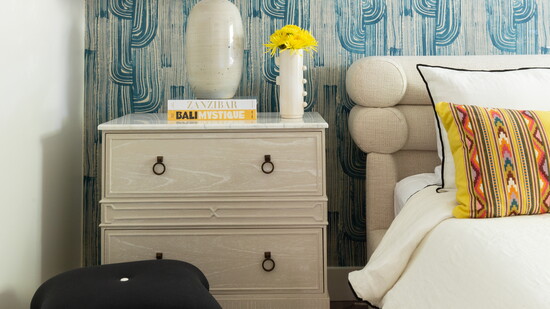
The furniture is thoughtfully pared down: streamlined silhouettes, tactile textures, correct proportions that prioritize function without sacrificing character. Accents arrive as punctuation rather than clutter: a single sculptural lamp, a curated collection of ceramics, or a carefully placed greenery moment that breathes life into the room. The result is a sophisticated, unfussy environment where every element has a purpose, every detail is considered, and the overall effect is eternally fresh.
Let’s talk about color. Do you have a specific philosophy on color combos or infusions?
SM: Color drenching is certainly a thing right now, but my client base generally wants "light and airy." In an initial consult, clients often lead with requests for pops of color. I think other designers might start with a color, but I almost always start with white. There was quite the backlash in the design community over the Pantone Color of 2026, Cloud Dancer, an ethereal white. But I think neutrals are an important place to start. I prefer leading you into a more colorful space rather than overwhelming you immediately.
For me, color plays off the scale of the space. For example, in older East Memphis homes, you often have lower ceilings. The rooms are smaller, but not necessarily cozy. That calls for the right neutral with colors that might ground or create a sense of place. Conversely, I made a ceiling dark in a project where the scale of the rooms was so large that the "human factor" was lost. By coloring the ceiling, we brought the room down to a livable scale.
Color works with contrast. You don't want the whole space to be in the same zone, or you never get that "aha" moment.
Why do you think design matters more than ever right now?
SM: Residential design dictates your mood. When you go into your house, you need to feel like it is your place. It can totally change your mental state. Your home can inspire you, make you feel calm, or make you feel answered. It makes all the difference in the world.
"Everything is very intentional and must serve a role; nothing is there just because"
"Accents arrive as punctuation rather than clutter: a single sculptural lamp, a curated collection of ceramics, or a carefully placed greenery moment that breathes life into the room."
"I think neutrals are an important place to start. I prefer leading you into a more colorful space rather than overwhelming you immediately."