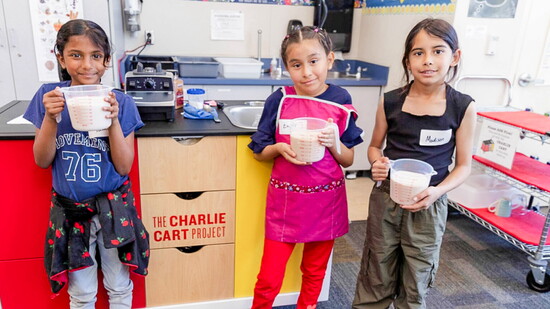
For some local elementary students, learning about food means more than reading about nutrition guides, plates, or pyramids. Instead, they get to do every step of serving a meal: shopping for ingredients, chopping vegetables, preparing the dish, and even cleaning up afterward.
Hill Country Family Services (HCFS) has brought the Charlie Cart Project into local schools, giving students access to a mobile kitchen designed for hands-on cooking and nutrition education. Bryce Boddie, executive director of HCFS, says the project is a natural extension of the organization’s work connecting local families with resources that promote stability and well-being.
The Charlie Cart itself is exactly what the name suggests: a complete kitchen-on-wheels containing all of the equipment needed to prepare food. “The Charlie Cart includes cooking utensils, pots and pans, bowls, and a small toaster oven,” Boddie says, “along with a sink that allows students to practice the entire process from preparation through cleanup.” It also comes with a curriculum designed to teach cooking and nutrition. HCFS partners with Boerne ISD to put the grant-funded carts to work. “I was honestly floored at how much they use these Charlie carts,” he says.
The partnership reflects a larger part of the HCFS mission. The organization was founded in 1985 by two school guidance counselors who saw students arriving at school without enough food and facing circumstances that made it difficult to focus in the classroom. Today, the organization provides food assistance, financial assistance, counseling, and connections to other community resources. Boddie says the Charlie Cart demonstrates what can happen when those community connections extend into the classroom.
One of the strongest examples of the Charlie Cart’s impact came during a Thanksgiving activity with students in Currington Elementary’s life skills class. The cart is housed at the school, and HCFS helps stock it through its food pantry, which operates like a client-choice grocery store complete with fresh produce, dairy, and meats to preserve community dignity. For their holiday project, the students visited the HCFS pantry to pick out their own ingredients. “This class needed dino nuggets, because you can’t have a Thanksgiving without dino nuggets,” Boddie says, laughing.
Fortunately, HCFS made sure to stock the pantry with that high-demand item and the other ingredients in advance for the students. For Boddie, the dinosaur nuggets were part of a much bigger moment. “We have folks that shop in the pantry every day,” he says. “But to see those kids and the joy in their eyes while shopping for the stuff they were about to cook, was amazing.”
Back at school, the students used the Charlie Cart to prepare their meal. “There are utensils in the cart, and they are actually chopping up vegetables. I think, ‘Wow! There’s somebody letting them do it, and they’re doing it well!’” Boddie recalls. “They were learning that skill, and it made my heart so happy to see.”
For Boddie, that story illustrates why food education can have an impact beyond simply learning how to follow a recipe. Cooking can create opportunities for children to build confidence, work together, and create memories around food—experiences not available in every household. He remembers learning through experiences with his own family and sees the same opportunity in a classroom setting. “That’s the opportunity that’s happening in the school,” he says. “Not just for the kids, but with teachers and staff that are working with these kiddos.”
The Charlie Cart Project is not limited to a single age group or type of student. While the life skills classes make extensive use of the carts at their schools, the carts can be moved to any classroom. HCFS has also seen the equipment used by adults with disabilities at the Mitchell Learning Center. That flexibility is part of what makes the project a useful community resource.
Boddie emphasizes that giving people choices—whether at the pantry or in the kitchen—is an important aspect of preserving dignity and encouraging healthier habits. The same principle applies to children learning to cook: instead of simply being told what they should eat, they get the opportunity to participate.
For HCFS, the Charlie Cart is one more example of what can happen when local organizations work together. In the classroom, its impact is tangible. Students are choosing ingredients, preparing food, working alongside one another, and discovering that they can cook for themselves. A simple kitchen on wheels is giving students the skills to make food part of their lives in a new way and the confidence they can carry with them long after the dishes are dry and the cart rolls away.
hcfstx.org | 830-249-8643 | 114 W. Advogt
charliecart.org
“There are utensils in the cart, and they are actually chopping up vegetables. I think, ‘Wow! There’s somebody letting them do it, and they’re doing it well!’”