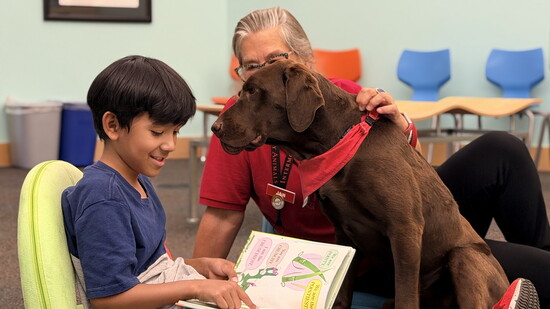
Inside a neighborhood library, an unlikely reading partner is helping children discover the joy of books.
Sitting cross-legged with a story open in their lap, a child hesitates over a difficult word, carefully sounding it out. They glance around the room, worried someone might laugh or correct them. Then they look down.
Curled quietly beside them is a furry therapy dog listening with patient eyes, a wagging tail, and absolutely no interest in judging pronunciation. The dog doesn’t notice the mistakes at all. Reassured, the child smiles, pets the dog, and continues reading.
Across Utah and around the world, moments like these are transforming young readers through the Reading Education Assistance Dogs® (R.E.A.D.®) program, created by Intermountain Therapy Animals (ITA) in Salt Lake City. Since its launch in 1999, the groundbreaking literacy program has paired more than 7,200 registered therapy animals and their volunteer handlers with children who need something many traditional classrooms cannot always provide: a judgment-free audience.
The concept is wonderfully simple.
Children read aloud to a certified therapy dog, and unlike a parent or a teacher might, the dog doesn’t interrupt. It doesn’t criticize. It doesn’t rush. Instead, the animal offers calm companionship while the handler quietly encourages the child through the reading experience.
For struggling readers of all ages, that emotional safety can be life changing and before long, hesitant readers begin turning pages with a little more confidence.
Research has shown that children who participate in R.E.A.D. programs often improve not only their reading skills, but also their motivation, confidence, communication, and overall attitude toward books. The therapy animals help replace reading anxiety with curiosity and even excitement to read to a dog.
Today, thousands of registered R.E.A.D. teams serve schools and libraries across the United States and 28 other countries. The program began in Utah where ITA pioneered the idea that a dog’s unconditional acceptance could unlock a child’s potential.
One ITA volunteer is Jan Abramson, whose therapy dog, Izzie, has become a familiar face and wagging tail to children who visit libraries across the Salt Lake valley.
“I first learned about Intermountain Therapy Animals and the impact of volunteer teams when I was at Guadalupe Center,” Abramson recalls. “Volunteering with ITA became an aspirational goal. Then the right dog showed up in my life.”
That dog is Izzie.
The pair officially became an ITA team in November 2022, and in just a few years have contributed more than 600 volunteer hours, serving as both a R.E.A.D. team and through Salt Lake City International Airport’s therapy animal program where they help calm weary travelers.
Those hours represent hundreds of individual stories—children finding confidence to tackle a new chapter, reluctant readers discovering a favorite book, nervous students smiling as they scratch a furry head between pages.
The science behind the program is compelling, but the magic often happens in moments too small to measure.
A child who barely whispered during the first session begins reading with expression by the fourth visit. A student who avoided books starts checking them out from the school library. A struggling reader realizes they are capable after all.
The reason is simple.
Dogs don’t care how quickly someone reads. They don’t notice missed punctuation. And they never roll their eyes at mispronounced words.
Instead, they provide exactly what educators have long recognized children need most: encouragement.
During reading sessions, handlers facilitate comprehension and vocabulary but rather than correcting every mistake, children become the storyteller as they read to their canine companion.
Researchers have documented improvements in children’s enthusiasm for reading, reading fluency, and confidence. Other studies have found that the presence of a friendly therapy dog can reduce stress during reading activities, making practice something children actually look forward to rather than avoid.
For volunteers like Abramson, however, success isn’t measured only by statistics. It’s measured by connection.
Throughout her career in higher education and nonprofit leadership, she built programs designed to help others succeed. Volunteering with Izzie became a natural extension of that work.
“I was fortunate to have a career that made significant impact on others, in the community, and advancing research and science,” she explains. “That impact aligns with my personal philosophy to pay it forward.”
Every time Izzie settles onto a library rug beside a young reader is another opportunity to positively change a child’s future.
Sometimes the child arrives nervous. Sometimes they’re convinced they hate reading.
By the end of the session, they're asking if Izzie will be back soon.
As parents search for ways to foster a lifelong love of reading in their children, programs like R.E.A.D. demonstrate that success can begin with a good book, a quiet room, and a therapy dog waiting patiently to hear the next sentence. Literacy can be achieved through encouragement, patience, and relationships with those who have four paws.
Because sometimes, the best teacher in the room never says a single word, and Izzie is always waiting to hear the next story.
To learn more about Intermountain Therapy Animals and the R.E.A.D. program, visit therapyanimals.org/read.
Reading Education Assistance Dogs® is a groundbreaking literacy program that allows children to read to a registered therapy animal.
As parents search for ways to foster a lifelong love of reading in their children, R.E.A.D. demonstrates that success can begin with a good book, a quiet room, and a therapy dog.