“There is nothing which has yet been contrived by man, by which so much happiness is produced as by a good tavern or inn.”
Dr. Samuel Johnson offered that verdict in 1776, as recorded by his biographer James Boswell. Johnson was praising the tavern, but his instinct reaches straight into the modern pub: give people a warm welcome, something good in the glass and permission to linger, and happiness has a fighting chance.
Where Everybody Knows the Sign
The word “pub” is short for “public house,” and the name is literal. In medieval Britain, an alehouse was often an ordinary home where the householder sold a fresh batch of ale. A pole, stake or leafy bush outside let the village know that the door was open. Taverns generally specialized in wine, while inns offered food, lodging and stables for travelers. The alehouse belonged most naturally to the neighbors.
By 1393, English ale sellers were required to display a sign so official ale tasters could find them. The penalty had admirable medieval clarity: fail to hang out a sign and “he shall forfeit his ale.” At a time when many customers could not read, a painted crown, white hart or lion worked better than lettering. Those pictures became names, and the great tradition of colorful pub signs was born.
The nineteenth-century gin palace gave the public house much of its familiar sparkle. Gaslight, mirrors, polished brass, etched glass and elaborate counters brightened the dark industrial cities. Beer engines allowed ale to be drawn from casks in the cellar. The pub had learned to dress for company, but its real attraction remained the company itself.
The Neighborhood Living Room
Sociologist Ray Oldenburg eventually gave this old idea a label: the “third place.” Home is first, work is second, and the third place is where people gather without an invitation or an agenda. The British pub had been doing the job for centuries.
A good pub is a neighborhood living room with better opening hours. It is the stop after work, the Sunday meal, the place to watch a match, hear a song or discover that the quiet fellow at the next table knows an alarming amount about Tudor monarchs. Formal titles soften. Generations mix. Conversation is allowed to wander.
Even its definition protects informality. The Campaign for Real Ale says a pub should be open to the public, sell draught beer or cider without requiring a meal, include at least one indoor area not arranged for dining, and allow drinks to be bought at the bar. In other words, eating may be welcome, but arriving for a drink and human company must remain a reason to enter.
The most cherished pub is “the local,” a noun that says everything. It is close enough to visit casually and familiar enough that the staff know your face, your order or at least which table you prefer. Becoming a regular is not a membership one buys. It is a relationship built one visit at a time.
Sterling Ridge Gets “Its Local”
Fittingly, The Blue Lion sits on McBeth Way in The Woodlands’ village of Sterling Ridge, an address that sounds as though it was chosen after someone had already settled on the Scottish theme. The Blue Lion calls itself a “Brunchery & Pub,” a playful title for a place where Scottish heritage meets Texas spirit from breakfast through late evening.
The menu travels comfortably. Morning can mean a traditional English breakfast, a Florentine omelette, Belgian waffles or the simple satisfaction of eggs and toast. Later come the Blue Lion cheeseburger, chicken pesto pasta and braised short-rib risotto, joined by draft beers, wine and cocktails. It is pub food in the broadest and best sense: something for the table, whether the table arrived at 8 a.m. or 8 p.m. Yes, even fish and chips is a staple on the menu!
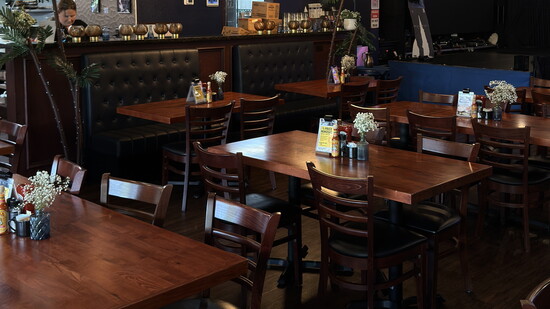
When the McBeth Way location celebrates its second anniversary in January, it will do so as an established neighborhood favorite. Several members of our own staff already count it among theirs. The room can at times be cozy without being hushed, lively without requiring a special occasion and welcoming enough for families, friends or a solo guest claiming a barstool.
Then there is the weekly rhythm, the secret by which a pub becomes part of people’s calendars. Tuesday brings the traditional pub quiz, given a local wink as “Trevia” with host Trevor Mock. The family-friendly competition begins at 7 p.m., complete with cash prizes and the timeless pleasure of discovering which friend has been hiding a storehouse of useless knowledge.
Live music is not an occasional add-on here. Wednesday features a house band and open-mic jam session. Friday and Saturday bring live bands with no cover charge. Sunday begins with acoustic brunch and closes with Jazz in the Woods. Thursday karaoke adds one more opportunity to become locally famous, for better or otherwise.
How to Pub
The rules are easy. First, go even when nothing monumental is happening; ordinary evenings are the point. If ordering at the bar, respect the invisible queue and know what you want when your turn arrives. In a group, taking turns buying rounds is traditional, although volunteering everyone for doubles is not.
Join the quiz without consulting your phone. Give the musicians your attention, applause and a tip. Talk to the staff, leave room for the regular beside you and remember that good pub conversation includes listening. Most importantly, return. One visit makes you a customer. Repetition is what turns a public house into your local.
Johnson called a good tavern a producer of happiness. At The Blue Lion, the machinery is easy to see: a familiar greeting, plates arriving, a song beginning, a quiz team arguing cheerfully over one impossible answer. The drink may bring someone through the door, but the neighborhood is what brings them back again.
The most cherished pub is “the local,” a noun that says everything.