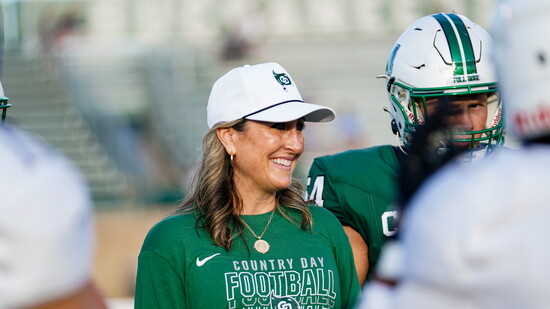
Dr. Tara Christie Kinsey became Head of School at Charlotte Country Day School in 2025 after serving as Head of The Hewitt School in New York City and as an associate dean at her alma mater, Princeton University. She earned her Ph.D. in English from Emory University and met her husband, Matt, while they were student-athletes at Princeton. The couple has two teenage children.
A nationally recognized thought leader in education, Dr. Kinsey is part of a network of researchers, authors and school leaders shaping the national conversation about youth development, achievement and well-being, including Jennifer Wallace, author of Never Enough. Her work addresses how schools can pursue academic excellence while also helping young people build lives of purpose, character and service.
That vision led her to Country Day, where she found a mission aligned with her belief that educational excellence carries a responsibility to serve others. In her first year, she has advanced a bold new plan based on four pillars—Lifelong Community, Educational Excellence, Responsibility to Serve, and Healthy Striving—positioning the school at the forefront of a national conversation about how to prepare students for lives of meaning and impact.
Before her career in educational leadership, Kinsey was a four-time All-Ivy League softball selection at Princeton and batted .402 one season to lead her team to the NCAA Division I Women's College World Series.
In a conversation with Queen City Lifestyle editor Carroll Walton, Dr. Kinsey discusses the forces shaping education today, the challenges facing young people and families, and the vision guiding her leadership at Country Day.
Q. First of all, which is hardest: hitting .402 in softball, leading a school of nearly 1,800 students, or being a parent?
A. Without hesitation, I would say being a parent. If it doesn’t feel hard, you’re probably not doing it right. As parents, we are wired to protect our children, but sometimes the most loving choice is to step back and let them work through difficulty. Trusting that struggle builds strength is one of the hardest parts of parenting.
Q. Why Country Day?
A. Our family had planned to wait until our daughter graduated before making another move. Then Country Day came along. It offered a rare opportunity to lead an outstanding school whose aspirations extend beyond its campus. I was inspired by a board that envisioned a school that is both academically excellent and a force for good in Charlotte. That belief— that schools have a responsibility to educate, inspire, and strengthen students and communities—is at the heart of my work. When schools define success by a college list alone, they lose sight of their deeper mission and settle for the short game.
Q. What’s the long game?
A. The true measure of a school is not where students are admitted but who they become. At Country Day, we have the opportunity to pair academic excellence with character development—challenging students, supporting their growth and cultivating a responsibility to others. The goal is not just high achievement, but using talents to serve something larger. That’s the holy grail of education.
Q. Jennifer Wallace wrote about this in Never Enough and your epiphany at Princeton. What happened?
A. Too many young people believe their worth is defined by the next achievement. As an associate dean, I saw rising anxiety and pressure, with students feeling that nothing was ever enough. I reached a crossroads: remain a safety net or work to address the problem at its source. I chose the latter.
Q. That’s making changes at the secondary level?
A. Actually, it begins even before high school. Independent schools have the freedom to create environments where high expectations coexist with well-being. Excellence and well-being reinforce one another. Students need challenges, but also sleep, relationships, time outdoors and opportunities to contribute beyond themselves. The best schools cultivate both achievement and purpose, helping young people see not only that they are valued but that they add value to the world.
Q. What is one way you did that at Hewitt?
A. We replaced AP courses with an Extended Inquiry Program, where students pursued faculty-mentored research on real-world issues and presented their work publicly. Students stood out for their curiosity and depth of inquiry, and their college outcomes improved for the right reasons.
Q. You’ve said Country Day’s emphasis on service excited you. How will you expand on that?
A. For one, we have a transformational opportunity in a 330-acre farm in Weddington, gifted by Smoky and Margaret Gragg Bissell. It already supplies fresh food to our dining halls. Our greater goal is external—partnering with local schools and communities facing food insecurity to expand access and build reciprocal relationships rooted in shared learning and service.
Q. What are some of the biggest challenges in education today?
A. We are facing a national challenge in recruiting and retaining educators. The demands are high, and compensation has not kept pace. As an industry, we have underinvested in professional growth. Teachers deserve the same coaching and development as leaders in other fields. Building that culture is a priority in our bold and visionary plan.
Q. What is your take on smartphones in schools?
A. Screen time competes with human connection. That is one of the reasons why we are phone-free indoors during the school day. The result has been more conversation, play, and connection—habits that colleges and employers consistently value.
Q. How is AI changing education, and how should schools respond?
A. AI presents a choice: fear or intention. We are choosing intention, building a framework for responsible use. Students need to learn how, when and why to use AI—and when human judgment matters most. AI cannot replace curiosity, empathy or character. Our responsibility is to graduate skilled students, thoughtful users of these tools, not passive consumers.
Q. In an age of screens and AI, what human skills matter most?
A. Listening deeply, sitting with uncertainty, collaborating across differences and asking better questions. I would add empathy and productive struggle. Curiosity must be practiced. Ethical judgment comes from lived experience and relationships—none of which can be automated.
Q. What suggestions would you give parents to help children strive healthily?
A. Two things: keep phones out of bedrooms and protect sleep. Sleep is foundational to well-being.
Q. You recommended Country Day parents read Never Enough. Are there other books you’d recommend as well?
A. The Emotional Lives of Teenagers, 10 to 25, The Art of Gathering, and The Art of Community.
Q. Are you seeing the change you’d hoped for when you left Princeton?
A. Yes—education is the most fundamentally optimistic profession. Our mission at Country Day captures it well: to develop the potential of each student through intellectual curiosity, principled character, ethical leadership and a responsibility to serve. Of course, there are hard days as in any field, but I am continually moved by the way I have been welcomed here, the dedication of our faculty and staff, and students who bring this work to life every day. I feel a deep sense of meaning and purpose in this role.