Griffin Pinkow loved playing sports as a kid. And that affection never waned even as he began to progressively lose his sight. Diagnosed with Retinitis Pigmentosa, a degenerative retinal disease that slowly takes your vision from peripheral to complete vision loss, he thought he'd never play baseball again. The path to that diagnosis wasn't an easy one and it wasn't just about not playing baseball.
"Around high school, I had started to lose more vision and it got really bad," says Pinkow. "Teachers didn’t want to support me so my grades weren’t that great because I had stopped caring about school."
Pinkow's family eventually returned to their East Coast roots to be around the support of other family members and seek out different options for Griffin's loss of vision. For Pinkow, that's when everything changed. "I actually had a guidance counselor who said, 'You have all the tools, you just need additional help and support,' he says. "I was more open in talking to my parents about my visual impairment, I was open to getting more adaptive equipment. My grades went back up to As & Bs and I was still really active and into sports even though I was losing my vision. I played three sports my junior and senior years of high school - football, wrestling and track and field."
Pinkow always wanted to be an athlete and it was a friend who introduced him to guided running. "I had a friend who asked if I wanted to run a marathon," he says. "It was the first experience where I learned I could still be an athlete just in a different capacity. And senior year of college, I trained and ran the New York City marathon. I got hooked. Then I did Philly, Boston and Chicago."
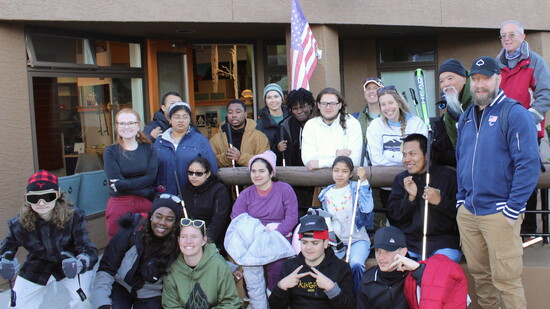
In 2017, after graduation, Pinkow started The Foreseeable Future Foundation, whose mission is to help the visually impaired and blind community live more fulfilling lives through sports and recreation. "Sports can be someone’s medicine," Pinkow says. "It’s realizing that sense of community. You get all the pieces of the emotional and physical experience through doing something, learning how to navigate it, gaining your independence, and understanding you can excel at it."
As part of its advocacy, the Foundation’s educational awareness events bring the sighted community together with the visually impaired community through an activity, such as “Dining in the Dark,” so that the sighted community can have a deeper understanding of those who are living with a visual impairment or blindness. The foundation's advocacy curriculum is one they want to continue to grow.
"We’ve created tip sheets, manuals, mock interviews, and webinars on how we can show young individuals to advocate for themselves around sports and recreation," Pinkow says. "We also talk about how a family member or support person can be an advocate, too. I'd love to eventually offer new programs around leadership as well."
The Forseeable Future Foundation also offers camps, clubs and clinics all over the country. The ranch program is a big one. "We give them weekends of fly fishing, horseback riding, roping, leather making, archery, rafting, etc., so they get those incredible experiences," says Pinkow. "And they're in an environment with their peers - other kids just like them - that they can talk to about similar things they may have gone through. And we're teaching life skills like how to get from one place to another."
Pinkow talks about kids like Henry when he talks about the good the foundation is doing. Pinkow helped him compete in a duathalon and at the end of the whole experience, Henry said to Pinkow that he, too, wanted to start a non-profit to help kids like him. Another young man Pinkow speaks of is one who conquered his fear of heights by climbing a rock wall. "These are moments I can talk to you about all day," he says.
But Pinkow feels there's still a lot of work that has to be done. "70% of the visually impaired community is unemployed," he says. "Employment is still a struggle for this community. How can we help them find the resources and support to do day-to-day things?"
The foundation partners locally with Southall Farm. "We have a new curriculum with the beekeepers there," says Pinkow."These kids don't realize they could potentially do these things as a career."
One easy way for people to get involved with the foundation is to share its existence. "A simple thing is sharing the mission and work," says Pinkow. "Make people aware. That’s how anything starts really - with education and awareness."
Of course, donations are paramount to continuing its good work. "Obviously, funding helps us to continue to help more people."
As far as goals for the future of the organization, Pinkow says, "I'd love to get it to a point where instead of a small organization doing a lot, it's a medium-sized organisation and instead of helping thousands of people through our initiatives and programs, we are helping millions." ForseeableFuture.org