In 2008, on his 50th birthday, architect Todd Hanson slipped and fell, an unusual incident for the elite distance runner and fitness enthusiast. Little did he know at the time that the mishap was a dark harbinger of things to come. The fall was the onset of increasing muscle weakness that a doctor would diagnose as Primary Lateral Sclerosis, a rare degenerative neuromuscular disease that is a variant of ALS.
Within four years, Hanson required the use of a wheelchair, a devastating blow for the former runner. But physical activity was not the only element of his life that the disease sabotaged. The busy architect had always found time to explore the coffee shops, restaurants, and charming shops in downtown Portsmouth. Now, the many steps, recessed doorways, and crowded layouts loomed as insurmountable obstacles. “Navigating these familiar places became daunting and overwhelming,” he says. “Honestly, I was afraid to go out.”
But the same inner toughness that made Hanson a fiercely competitive runner quickly quashed thoughts of giving up. He decided to use his affliction to make life easier for other individuals with disabilities. “I realized I had an obligation to share my experiences and insights,” he says. This altruistic attitude would later give rise to Access Navigators, a nonprofit that helps people with disabilities find access-friendly businesses in Portsmouth, the Seacoast area, and beyond.
Ironically, before becoming a wheelchair user, Hanson, a principal emeritus of JSA Design, spent most of his architectural career designing spaces for people with physical and emotional challenges. He tirelessly sought a deeper understanding of those he was designing for. But it was only after experiencing a disability himself that he found true empathy.
In 2016, Hanson teamed up with JSA Design’s director of business development, Anne Weidman, and CIO William “Tuck” Tucker, to form Access Portsmouth, which evolved into Access Navigators. In just three months, the determined triumvirate created a website listing accessible restaurants and attractions, focusing on entry, restrooms, interior layout, and parking. The team visited local businesses to determine how accessible the premises were. According to Hanson, Portsmouth’s old buildings, while beautiful, contain countless obstacles and challenges for individuals with disabilities.
Some restaurants believe they are accessible because their restrooms are. But the hallways leading to them may be filled with furniture, blocking a wheelchair’s ability to pass. As Hanson learned through personal experience, a seemingly benign object can present a serious problem. A visit to an art museum turned into a nightmare when he became trapped in a restroom because a small, decorative table blocked the pull clearance he needed to open the door.
The good news for businesses is that most fixes are small and inexpensive. “We would never go into a business with a pricey fix,” Weidman says. “It’s often something free or a simple furniture rearrangement that can fix the minor glitch.”
Initially, the young nonprofit assumed that its database of accessible restaurants and attractions would appeal to disability organizations. Instead, the tourism industry discovered the website through the Chamber of Commerce and embraced it. “That,” says Weidman, “is what first made us see accessibility as an economic driver.”
For businesses like restaurants, investing in accessibility lands them a hefty return. When Hanson meets friends for dinner, he chooses a restaurant that is accessible. And that party of ten or fifteen will rack up a big tab—an economic driver indeed.
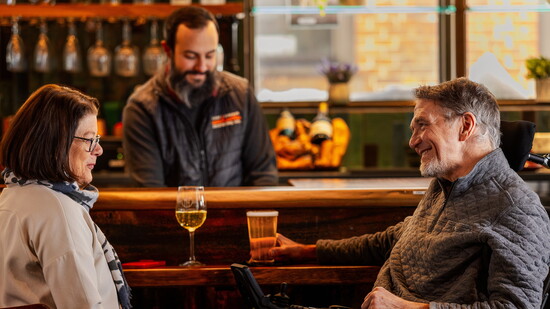
Buckley’s Market & Cafe is a prime example, boasting an open layout and an accessible bar counter set low enough for wheelchair users to enjoy a reachable drink. Hanson himself was part of the architectural team that designed the building.
The snazzy Jimmy’s Jazz & Blues Club welcomes people of all abilities. Co-owner Michael Labrie says, “It’s our mission to bring arts and culture to the community, including those in wheelchairs.” When the club first opened in 2021, wheelchair users could only enter through the back door. But subsequent renovations made the sidewalk flush with the club’s grand entrance, allowing for wheelchair entry. And that front door experience is something not to be missed, with a doorman in a top hat and tails as an elegant prelude to the show.
Access Navigators’ mission includes helping the City of Portsmouth invest in accessibility, making it a true “City of the Open Door,” its century-old tagline. Upgrades to parking, sidewalks, and parks have opened the gates wide to residents and visitors of all abilities.
The most celebrated upgrades have been to outdoor dining, an experience that grew out of necessity during the pandemic and evolved into a popular trend—one that brought frustration to wheelchair users, who struggled with uneven pavements and jersey barriers. Now, these patrons can easily access outdoor dining.
Special events have become more hospitable to disabled spectators. Increasing the accessible parking spaces at Prescott Park was a game-changer for Roger Goun, a lifelong wheelchair user. No longer must he and his wife lug their picnic dinner a good distance to an event and back to the car. “It seems like a small thing,” Goun says, “but small improvements make a big difference in the lives of people with disabilities.”
Access Navigators promotes Universal Design, focused on meeting the needs of everyone, regardless of ability. The new South Mill Pond Playground is a shining example. The colorful playground doesn’t scream, “accessible”—it is just a lovely playground with easy-to-use equipment for children with disabilities.
Like the playground, handicapped ramps don’t need to be ugly. The beautiful, curved ramp leading from Hanover Garage to the walkway near the Gaslight’s patio calls out to pedestrians and wheelchair users alike to walk—or roll—on it. According to Weidman, the ramp’s visual appeal “changes the whole perception of it.”
Todd Hanson is just one of the 26% of us living with a disability. As the global population ages, the number of people with disabilities rises along with it. Hanson says, “I am living proof that disabilities can affect anyone.”
"... it was only after experiencing a disability himself that he found true empathy."
"Access Navigators’ mission includes helping the City of Portsmouth invest in accessibility, making it a true 'City of the Open Door,' its century-old tagline."