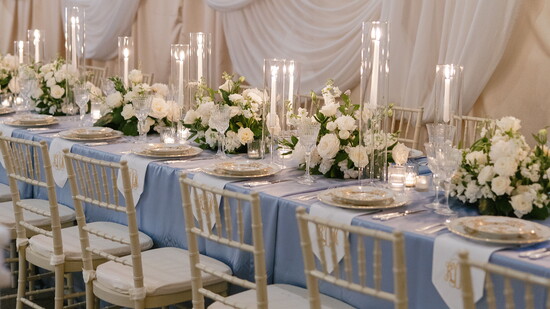
Washington weddings are a fascinating study in tradition and evolution.
Even when couples call Washington home, many of their guests do not. Ours is a uniquely transient city shaped by people who have moved here from across the country and around the world. Weddings here often become a blending of regions, family traditions, cultural backgrounds, expectations around formality, and at times, strong political views, too.
Add in out-of-town guests, dietary preferences, and protocol questions, and Washington weddings can present considerations that feel both uniquely modern and distinctly local.
While I’ve taught etiquette seminars at the White House, the U.S. Congress, and offices along K Street, one topic comes up over and over again: weddings.
What is changing? What remains timeless? And what can Washington couples teach us about modern hospitality?
To find out, I spoke with Liz Wayland, Creative Director at DC Rental, and Sarah Lusk, Account Executive with Design Cuisine, sister organizations whose work spans everything from intimate entertaining at home to celebrations for thousands, with DC Rental shaping design elements like furnishings and tablescapes and Design Cuisine leading catering and hospitality; and Devin Murphy, Head Chef and Co-Founder of Murphy Hospitality, whose boutique events often emphasize thoughtful hospitality and deeply personal food experiences.
Personalization Is Replacing Formula
One of the clearest shifts happening across Washington weddings right now is a move away from celebrations that feel formulaic and toward celebrations that feel unmistakably personal.
At DC Rental, Wayland sees couples increasingly gravitating toward weddings that reflect who they are rather than recreating something they have seen online or elsewhere.
“One of the biggest wedding design trends is creating celebrations that feel deeply personal and intentionally curated to reflect the couple’s personality, style, and story,” says Wayland.
Wayland says couples increasingly want spaces that feel layered and welcoming rather than formal simply for formality’s sake.
Custom lighting, collected décor pieces, mixed china patterns, and lounge furniture that encourages guests to gather and connect are replacing environments that feel detached or overly prescribed.
“Sometimes what may initially feel like an eclectic mix of patterns, colors, textures, china, and glassware can ultimately come together beautifully when thoughtfully layered,” says Wayland.
That same instinct toward storytelling increasingly shapes wedding menus.
“Couples seem to be prioritizing food memories over strict formality, which is a refreshing and fun change of pace,” says Murphy.
Increasingly, menus themselves become part of the story.
“Instead of classic wedding food, couples now frequently pick foods based on their relationship history (‘we ate this on our first date!’) or upbringing (‘this was something I ate all the time as a kid’),” says Murphy.
Lusk sees similar priorities emerging through food and hospitality.
“One of the most common things we hear from clients is that they want to create an elevated dining experience that feels both exciting and approachable,” says Lusk.
“Many couples are gravitating toward menus that balance familiar, comforting flavors with a few more unexpected or boundary-pushing culinary elements… incorporating meaningful nods to their families, cultural backgrounds, and relationship story through the menu,” says Lusk.
Good etiquette has always made room for thoughtful personalization. The best weddings invite guests into a couple’s story rather than making them feel as though they are standing outside of it.
Luxury Looks Different Than It Used To
Luxury has not disappeared from Washington weddings, but it has evolved.
Today, luxury looks less like extravagance and more like intentionality.
Wayland sees couples prioritizing experiences that create connection rather than grandeur for grandeur’s sake.
“Couples are prioritizing meaningful moments and creating celebrations that allow them to truly spend quality time with their closest friends and family,” says Wayland.
“Rather than focusing solely on grandeur, today’s luxury weddings emphasize thoughtful details, exceptional hospitality, elevated design, and experiences that feel deeply personal and memorable.”
Custom linens designed specifically for an event, layered tablescapes, thoughtfully arranged gathering spaces, and wedding weekends structured to encourage meaningful time together increasingly shape what luxury looks like now.
We’re also seeing hospitality extend beyond décor.
“The goal is to ensure that guests feel comfortable and cared for while still being treated to a dining experience that feels memorable, refined, and uniquely reflective of the couple,” says Lusk.
Hospitality increasingly extends to food choices as well.
“I think we’re long past the days of ‘check chicken or beef on your RSVP card,’” says Murphy.
“There’s a huge emphasis on providing vegetarian, gluten-free, and vegetable-forward options, and ensuring that every guest is able to eat and enjoy.”
And communication is key.
“With so many RSVPs going digital, it’s easier than ever to ask guests to indicate any food allergies or sensitivities.”
Lusk says thoughtful planning increasingly means anticipating needs before guests ever have to ask.
“Our team takes allergies very seriously,” says Lusk.
“Our couples collect that information from guests and pass that information along to us so that we can ensure that each guest has a meal that is appropriate for them.”
Another shift wedding professionals are watching closely: beverage service.
“As alcohol consumption continues to plummet among young people, more wedding parties are embracing mocktails and non-alcoholic options,” says Murphy.
Thoughtful hospitality increasingly means making sure everyone feels included.
Some Washington Wedding Traditions Endure
For all that is changing, some Washington wedding dynamics remain remarkably consistent.
Washington may be one of the few places where conversations at cocktail hour move seamlessly from travel recommendations to public policy. In a city shaped by government, law, advocacy, nonprofits, media, and business leadership, weddings often bring together guests with deeply held beliefs, varied professional backgrounds, and perspectives shaped by experiences from across the country and around the world.
Contrary to popular belief, etiquette does not require avoiding every potentially sensitive topic. It does, however, ask something increasingly valuable: curiosity without combativeness. Reading the room. Recognizing that a wedding celebration is not the place to win an argument. It is a place to strengthen relationships.
Washington also presents etiquette questions that feel uniquely local.
Does your former member of Congress friend still get introduced as “The Honorable”?
In formal written correspondence, generally yes. Former members of Congress, governors, judges, ambassadors, and cabinet officials often retain honorific conventions even after leaving office.
Socially, however, warmth matters too. Good etiquette balances appropriate formality with helping guests feel comfortable.
The city itself also increasingly finds its way into celebrations.
“DC weddings love to acknowledge their DC-ness,” says Murphy.
That may appear through regional ingredients, references to local history, or thoughtful details that reflect the city couples now call home. Murphy, for example, is particularly excited about incorporating pawpaw, a Mid-Atlantic fruit often compared to banana and mango, into seasonal menus.
Perhaps that balance between tradition and evolution is exactly what makes Washington weddings so interesting.
Washington values history.
It also embraces reinvention.
In a city shaped by movement, ambition, service, and constant change, celebrations continue to evolve while remaining rooted in something timeless: bringing people together thoughtfully, generously, and well.
Wedding trends will continue to change, but hospitality never goes out of style.
Alison M. Cheperdak, J.D., is a bestselling author, internationally certified etiquette coach, and the founder of Elevate Etiquette. She is the author of Was It Something I Said? Everyday Etiquette to Avoid Awkward Moments in Relationships, Work, and Life (HarperCollins, 2026).
Instead of classic wedding food, couples now frequently pick foods based on their relationship history (‘we ate this on our first date!’) or upbringing (‘this was something I ate all the time as a kid’)