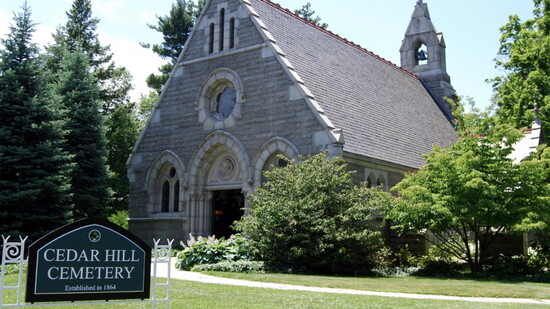
The winding roads and towering trees of Cedar Hill Cemetery feel less like a traditional burial ground and more like an open-air museum woven into the landscape of Hartford and West Hartford history. Established in 1864 during the Victorian-era “rural cemetery” movement, Cedar Hill was designed to be both a place of remembrance and a peaceful public retreat — a landscaped sanctuary where art, nature and history meet.
Spread across 270 acres along Fairfield Avenue, the cemetery was designed by noted landscape architect Jacob Weidenmann, who also helped shape Hartford’s Bushnell Park. Rather than the rigid rows common in older church graveyards, Cedar Hill embraced rolling terrain, ponds, woodlands and curving drives intended to encourage quiet reflection. The result remains one of New England’s most striking historic cemeteries and one of Hartford’s enduring cultural landmarks.
More than 35,000 people are buried there, including industrialists, politicians, artists, military heroes and cultural icons whose stories trace the rise of Connecticut itself.
Among the cemetery’s most visited graves is that of actress Katharine Hepburn, the four-time Academy Award winner whose family roots in Hartford ran deep. Nearby rests firearms inventor Samuel Colt, whose Colt Manufacturing Company helped make Hartford an industrial powerhouse in the 19th century. Financial titan J. P. Morgan and members of the influential Morgan family are also buried there, as are poet Wallace Stevens, anesthesia pioneer Horace Wells and educator Thomas Hopkins Gallaudet, founder of what became the American School for the Deaf in West Hartford.
The cemetery also reflects Hartford’s political and civic legacy. Connecticut governors, Civil War figures and business leaders lie beneath elaborate monuments and mausoleums crafted by prominent architects and sculptors of the era. Some memorials are works of art in themselves, including towering obelisks, Tiffany stained-glass windows and the striking Morgan monument of red granite.
Yet Cedar Hill has evolved into far more than a historic cemetery.
In recent decades, the accompanying Cedar Hill Cemetery Foundation has transformed the grounds into one of Greater Hartford’s most active centers for public history programming. Founded in 1999, the nonprofit organization works to preserve the cemetery’s historic art, architecture and natural resources while offering a robust calendar of educational events that draw visitors from across the region.
From May through October, the cemetery hosts guided walking tours, history talks, bird walks, tree tours, photography programs and themed events exploring everything from Hartford’s Gilded Age to Victorian mourning traditions. Visitors can attend programs focused on cemetery symbolism, famous residents, historic landscape design and even the wildlife that inhabits the grounds.
The programming has helped redefine how many residents think about cemeteries. Rather than places visited only in grief, Cedar Hill has become a living community resource where local history feels tangible and immediate. Families stroll the roads photographing monuments. History enthusiasts attend twilight tours. Birders gather at dawn to observe migratory species among the cemetery’s ponds and mature trees.
That blend of remembrance and community has earned Cedar Hill growing recognition as both a historic treasure and an urban oasis. Even online, visitors frequently describe the cemetery as one of Connecticut’s most beautiful and atmospheric places, praising its architecture, serenity and remarkable concentration of state history.
There is something quietly moving about Cedar Hill’s endurance. Hartford has changed dramatically since the cemetery opened shortly after the Civil War, yet the grounds continue to connect generations through stories carved in stone. A walk there can feel like stepping through chapters of Connecticut history — from industry and politics to literature, theater and social reform — all beneath the shade of century-old trees.
For many visitors, that is Cedar Hill Cemetery’s real power: not simply preserving the past, but keeping it vividly present.
Among the cemetery’s most visited graves is that of actress Katharine Hepburn, the four-time Academy Award winner whose family roots in Hartford ran deep. Nearby rests firearms inventor Samuel Colt, whose Colt Manufacturing Company helped make Hartford an industrial powerhouse in the 19th century.