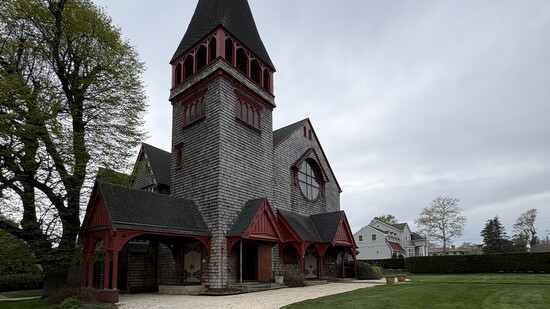
To explore a place is to look beyond what is immediately visible—to uncover the stories, contradictions and quiet details that shape its identity. Along the coastline of Long Branch sits Elberon Memorial Church, a historic sanctuary that offers exactly that: an invitation to step into a living narrative that spans centuries.
At first glance, the structure feels timeless. Its woodwork, stained glass and intricate architecture evoke a sense of permanence. But a closer look reveals something deeper. Every element carries a story, some carefully documented, others passed down through generations of parishioners and caretakers.
Built in 1886, the church began as a seasonal sanctuary for wealthy families escaping the heat of New York City. At a time when railroads transformed coastal travel, Long Branch became a summer destination for high society. “The church was really built for the summer residents who came down from New York during the Gilded Age,” explains Sharon Lees, President of the Board of Trustees at Elberon Memorial Church. “Long Branch was considered one of the premier seaside destinations at the time.”
Today, rhythm still shapes its operation. Services continue during the summer months, honoring tradition while responding to the realities of maintaining a historic space. Inside, many original features remain remarkably intact, including the church’s celebrated Hilborne L. Roosevelt organ, a rare instrument that has filled the sanctuary with music for generations.
“The Roosevelt organ is one of the treasures of the church,” Lees says. “People come not only for services, but also to hear the music and experience the acoustics inside the sanctuary.”
The stained-glass windows offer another layer of history. Commissioned by prominent families of the era, they reflect devotion and craftsmanship. Catherine Taylor, wife of financier Moses Taylor, commissioned the Nativity window, while additional windows were commissioned by members of the Taylor family as memorial tributes.
“The windows are extraordinary pieces of art,” Lees explains. “Some of the glass formulas, especially the deep blues, can’t even be recreated today.”
Other details throughout the church carry stories of preservation and adaptation. According to church historians, several of the chandeliers are believed to have originated from a New York bank, adding another layer of history to the already richly detailed space.
But to fully explore this space is also to confront its more complicated history. The wealth that funded many Gilded Age institutions was often rooted in industries shaped by exploitation and inequality. Those realities remain part of the historical context surrounding places like Elberon Memorial Church. The building is more than architecture; it is history.
Still, beauty remains central to the experience. Visitors are drawn not only to the craftsmanship, but to the atmosphere itself—the quiet stillness, the filtered light and the sense of reflection the church inspires. Despite its age, the church continues to host weddings, musical performances and seasonal services, bringing contemporary life into a space shaped by the past.
They come for history, spirituality, music or art. But many leave with something harder to define: perspective.
Begin exploration at elberonmemorialchurch.com.
Editor's Note: Sharon Lees, who generously shared her knowledge of Elberon Memorial Church for this article, died after the story was written. We are grateful for her contributions and the care she brought to preserving the church’s history.