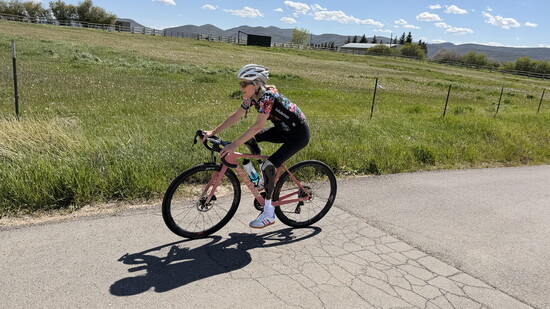
It was the night before Heather Van Boerum's husband’s birthday celebration. He had one request: that Heather join him skiing. It would be Heather’s first time attempting the sport since her accident.
"I started getting this nervous stomach . . . I was worried about disappointing him and others around me . . . having to say, ‘I can't do it.’"
The next morning, Heather pushed the feeling aside and made her way to the top of the mountain with the help of the National Ability Center (NAC), a Park City-based nonprofit that endeavors to bring outdoor recreation to people with disabilities.
"I got up and realized, I'm going to go down the hill no matter what. So whether I ski, or whether I sit-ski, or whether someone pushes me, I'm going to do this today, and it’s going to be as beautiful as it would be no matter how I do it."
It only takes five minutes around Heather to note the positive lens through which she views the world. Though she remarks on how her accident has made her a better person, it’s hard to imagine a time when she wasn’t utterly remarkable. After all, hardship has a way of underscoring what already exists in us.
In December 2021, Heather was involved in a devastating accident that resulted in the loss of both of her legs.
Her husband Don, a trauma surgeon, arrived just seconds after she had been loaded into the ambulance and jumped in, helping facilitate her immediate care and recovery, followed by ongoing rehabilitation.
"If someone had told me, ‘Next year, you're going to lose your legs and have to live the rest of your life like this,’ I would have said, 'I can't imagine coming back from something like that.' And now I'm like, ‘What's next?’"
A long-time resident on the east bench, Heather’s connections to the community are vast and diverse. She volunteers at the local food pantry and the teen homeless center, supports mental health endeavors for the Huntsman Mental Health Institute, and works with the Stop the Bleed organization. And the list, she’ll tell you, is always growing.
Heather and her family have also made advocacy around safety and accessibility a priority.
Heather was part of an initiative to acquire funding for tourniquets in schools, devices used to stop profound blood loss. She is also currently involved in “So Everybody Can Move,” an initiative focused on helping fund mobility devices for those in need.
"Knowledge is the main thing, honestly. I live right next to Cottonwood Elementary and I drive past that school and I think, ‘I'm so glad I have the knowledge that I could stop my car and I could help.’"
On a smaller scale, every room she enters—every conversation—is subject to Heather’s overwhelming warmth. She notices the lovely little details in things and people that others glance over, like the dainty glass jars in the coffee shop window where we held our interview. She remembers the names of people she’s briefly encountered. A woman she met at Sonic and a homeless man on Fort Union are among those she considers close friends.
"If you're going down the Narrows and you don't look up, you miss the whole hike, and that's like life,” she says. “I’ve learned the difference between living a life where you don't connect that way and a life where you do. It's 100% different."
The loss of her legs has only seemed to sharpen her zest for adventure. These days, you can find Heather cycling, skiing, running, hiking, and climbing. The outdoors, in particular, have become a type of medicine that deepens her sense of human connection and spirituality.
Last summer, Heather had a surgery that required months of rehabilitation. Three months went by without leaving her home, and despite her careful planning of activities to pass the time, the days began to grow long.
“Don said, ‘I'm going to take you for a drive up the canyon.’ And all of a sudden it was like, ‘Oh, I just have to be out. And I'm fine.’ And my healing process just ramped up.
“And so that's something to think about. When we find ourselves, for whatever reason, cut off from the world a little bit, we need to find a way to get back and get out and be in it.”
Heather and her family have always been avid hikers, even planning vacations that revolved around day-long excursions in the mountains; however, Heather’s prosthetics have made the activity somewhat tricky.
“But I think that's another thing . . . you can make anything happen, you know? We just have to dig deep inside and find that strength—through spirituality, through our physical strength, and our mental strength too."
Ask Heather if she has bad days and she'll correct you. She doesn't have bad days. She has “moments.”
Not long after her accident, she spent time in a clinic around an “old cowboy” named Tony who shared advice on getting through the tough stuff.
“[Tony] said to me, ‘You are gonna have to let yourself sit in the bad times and sit in the pain. And then I want you to kick yourself in the butt and get going.’”
Heather’s outlook, while forward-moving, doesn’t suggest that strength lies in solitude. Leaning on one another is vital to our own stories, and to others’.
"If you feel like you need help, get help. There's no shame. The stronger person is the one who seeks help. It's the weaker person who won't allow themselves,” she says.
For Heather, the work of healing and the work of noticing beauty have always been the same. Open yourself up—to help, to a stranger, to a new experience—and the world starts to look different.
“I remember the first time I rode bikes with my sisters up the mountain after the accident. And I'm like, ‘Oh my gosh, those flowers are so beautiful.’
“And my sister said, ‘Heather, that's what our neighbors call weeds.’
“I'm like, ‘They're so pretty.’ She's like, ‘Okay.’
“But you're finding the beauty.”