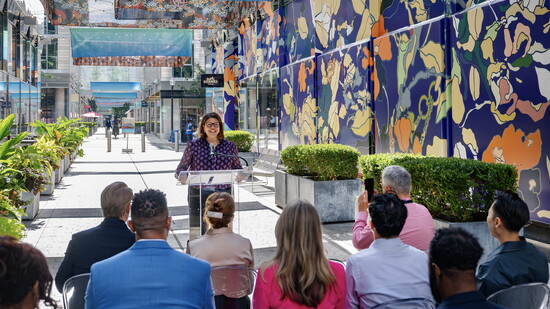
When visitors step into Palmer Alley at CityCenterDC, they're likely to notice the color first.
Suspended overhead, 17 larger-than-life living rooms stretch across the pedestrian corridor, each layered with bold textiles, architectural forms, and cultural references that invite a second look. Together, they make up Urban Living Rooms, the immersive public art installation by Vietnamese American artist and architectural designer Tung Nguyen.
But Nguyen hopes visitors leave with more than photographs.
"I wanted to create a place where people could recognize pieces of themselves," he said. "American culture is not one single story to be told."
Selected from more than 100 submissions in CityCenterDC's national 250 Years of American Style competition, Nguyen's proposal reimagines one of the home's most familiar spaces as a reflection of the country's shared identity. The nationwide call invited artists to interpret 250 years of American style through public art, with proposals evaluated by a distinguished jury that included Pulitzer Prize-winning journalist Robin Givhan; Jeffrey Wilkins, vice president of visual merchandising for the Americas at Gucci; and Melissa Chiu, museum director, curator and author.
Rather than defining American style through fashion, architecture or historical milestones alone, Nguyen turned to the living room—a place where families gather, traditions are passed down and personalities quietly reveal themselves.
"The living room exists at the threshold between private and public life," Nguyen said. "It's where we gather, host and tell stories about who we are."
The idea didn't begin with sketches. It began with conversations.
As Nguyen developed the concept, he asked friends, family members and colleagues a simple question: What does American style mean to you? Their answers were remarkably different, yet they all pointed toward the same conclusion—that the country's identity is shaped not by a single narrative, but by countless individual experiences.
That perspective mirrors Nguyen's own journey.
Born in Vietnam, Nguyen moved to Houston in 2011 to study architecture before earning his master's degree at Columbia University. Today, in addition to leading his interdisciplinary practice, Studio Tung, he teaches architecture at Rice University, where he continues exploring the intersection of design, public art and community.
His understanding of culture has been shaped as much by travel as education.
"Traveling is not just experiencing a place, but experiencing what the people do—what shapes the city," Nguyen said. "The stories of a place are best told by the people who live there."
Those stories are woven throughout Urban Living Rooms, which unfolds chronologically across three chapters—Foundations: Nation Building, Modernity: Cultural Transformation and Remix: Community & Contemporary Identity. Rather than illustrating history literally, Nguyen layers recognizable references into each suspended room, encouraging visitors to make their own connections.
One installation pairs imagery inspired by Levi's rise during the California Gold Rush, while another celebrates the Jazz Age through vibrant patterns and saxophone motifs—a tribute to music's ability to unite people across cultures. The symbolism isn't meant to be exhaustive or definitive.
"There are so many more stories that could be told," Nguyen said. "I wanted the work to remain open enough that every visitor could interpret it differently."
That spirit of accessibility also reflects a broader shift in how people experience art.
For Timothy Lowery, managing director of retail and mixed-use at Hines, public spaces like CityCenterDC have become cultural gathering places as much as shopping destinations.
"CityCenterDC was envisioned as more than a collection of shops and restaurants—it was designed to be a place where people come together. Public art is an important part of that vision because it creates opportunities for visitors to experience the neighborhood in new ways while making art accessible outside the walls of a museum,” said Lowery. “Whether it's Urban Living Rooms, Wild Race Against Time, or our ongoing cultural programming throughout the year, these experiences help create a stronger sense of place and give people another reason to visit downtown. We're proud to continue investing in initiatives that strengthen CityCenterDC's role as a community gathering place and contribute to the vibrancy of Washington."
It's a philosophy evident throughout CityCenterDC, which has become known for large-scale installations ranging from Wild Race Against Time by internationally acclaimed artists Gillie and Marc to Nguyen's immersive exploration of American identity.
For Nguyen, bringing art beyond the walls of museums was always part of the vision.
Not everyone visits a gallery. But nearly everyone walks through a city, meets a friend for lunch or stumbles across something unexpected on the way home.
When visitors leave Palmer Alley, they'll likely remember the color. Nguyen hopes they'll also remember the stories—both the ones woven into the installation and the ones they bring with them. Because in the end, Urban Living Rooms isn't asking viewers to agree on what American culture looks like. It's inviting them to see themselves within it.
IF YOU GO
Urban Living Rooms
Where: Palmer Alley at CityCenterDC, between 9th and 11th streets NW, Washington, D.C.
When: On view through November 2026
Admission: Free
More information: CityCenterDC.com