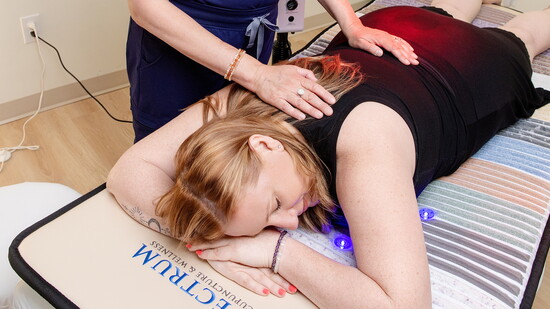
“I hear the same thing over and over,” says Dr. Devorah Walder. “Women tell me, ‘I don’t feel like myself anymore.’ They’re sleeping poorly, struggling to focus, feeling anxious or emotionally overwhelmed — and they often don’t realize that these symptoms can all be connected.”
They're also often silently dealing with something else no one warned them about: sexual health concerns, urinary urgency, recurrent UTIs, a pelvic floor that suddenly feels weaker, tighter, or simply different. Walder, founder of Spectrum Acupuncture in Bethesda, sees it every day - the hot flashes get talked about, but what's happening underneath them rarely does.
That last part — the one nobody wants to bring up — is where Walder does some of her most important work.
The symptoms no one names out loud
That cluster of symptoms has an actual clinical name — Genitourinary Syndrome of Menopause, or GSM — and as estrogen declines, it’s remarkably common.
“GSM is real, it’s common, and it’s treatable — but most women have never heard the term,” Walder says. “They think what they’re feeling is just something to live with, or they’re too embarrassed to bring it up with their doctor. By the time they get to me, they’ve often been quietly struggling for years.”
It’s a silence Walder is determined to break. In her Bethesda practice, pelvic floor health isn’t an afterthought tucked into a general wellness conversation — it’s often the center of it.
When the body sends signals that seem unconnected
Walder’s approach treats the midlife transition as one interconnected system rather than a list of isolated complaints. A patient who came to her exhausted from months of insomnia was also living with chronic shoulder pain she assumed was unrelated. As her sleep improved through treatment, the shoulder pain began to resolve too.
“That’s often how the body works,” Walder says. “Sleep disruption worsens anxiety. Hormonal shifts fuel brain fog. Pelvic floor tension can be tied to stress the same way a clenched jaw is. Systems that seem unrelated are actually talking to each other constantly — my job is to listen to the whole conversation, not just the loudest symptom.”
A practitioner who has been on the other side of the table
Walder’s commitment to this work is personal. In her twenties, a repetitive strain injury left her unable to perform basic daily tasks. Acupuncture was the treatment that finally gave her relief, after nothing else had.
“It completely changed my understanding of what the body is capable of,” she says. “That experience is why I do this work — I know what it feels like to be dismissed, and I know what it feels like to finally be heard.”
Today, Walder combines decades of clinical experience with a deeply personal approach to patient care. Rather than focusing on isolated symptoms, she works to understand the broader picture of a woman’s health, lifestyle, stress levels, and hormonal changes.
A space built for the conversations women put off
At Spectrum, appointments begin with an in-depth conversation — the kind many women say they’ve never had before. Patients describe the space as calm and unhurried, a deliberate contrast to the rush of daily life and the rushed feeling of most medical visits.
“I want women to feel heard the moment they walk in,” Walder says. “So many have been carrying this alone, wondering if what they’re feeling is normal, too embarrassed to ask. Sometimes the most powerful part of treatment is simply someone saying: this is real, and we can do something about it.”
That combination of clinical expertise and genuine listening has built Spectrum’s reputation in two ways: the old-fashioned way, with patients referring their sisters, daughters, and closest friends — and through Walder’s growing collaborative relationships with local OB-GYNs, primary care physicians, and pelvic floor specialists, who refer their own patients to Spectrum when they need an integrative approach alongside conventional care.
You don’t have to just push through it.
Perimenopause and menopause are not conditions to endure quietly for a decade. Vasomotor symptoms, pelvic floor dysfunction, and GSM are common — but common doesn’t mean you have to just live with it.
“My goal is for women to feel empowered, informed, and comfortable in their bodies again,” Walder says. “That starts with one conversation.”
Spectrum Acupuncture & Wellness is located at 4833 Rugby Ave, Suite 200, Bethesda, MD, serving women throughout Bethesda, Chevy Chase, and greater Montgomery County. To schedule a consultation, visit spectrumacuwell.com or call 301-565-2700.