Food is essential to daily life, but sometimes unexpected challenges can make it hard to keep enough on the table.
After years working with people in crisis, Kristen Cox, founder and executive director of Long Beach Community Table, set out to ensure food was one less thing they would have to worry about.
“This is why I work 80, 90 hours a week, because what would happen to Long Beach if 5,000 or 6,000 people a week weren’t being fed,” Kristen said. “It would be mayhem.”
Long Beach Community Table, or LBCT, is a 501(c)(3) nonprofit cooperative focused on supporting residents experiencing food and housing insecurity with dignity and compassion.
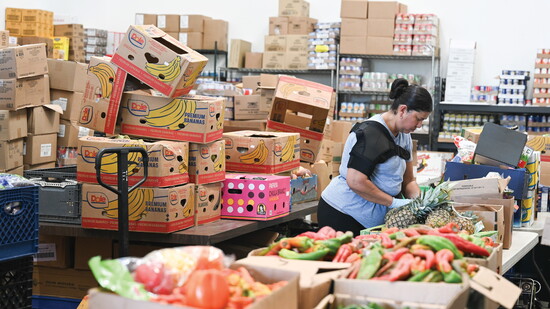
Each week, LBCT distributes more than 40,000 pounds of groceries and fresh produce, along with basic hygiene products and clothing, to more than 6,000 people across the greater Long Beach area, including homeless individuals, low-income families, students, seniors, veterans and homebound residents with disabilities or medical conditions.
With groceries covered, families can use that money to pay bills and other expenses.
“We like to say food is freedom,” she said. “By alleviating the food problem, we lower stress, which lowers domestic violence and child abuse or neglect and raises academic scores. It has so many positive impacts because food and water are the things you have to have.”
LBCT follows a weekly routine across the city, one Kristen has kept up for years. They visit the same eight Long Beach parks — Grace, DeForest, Drake, Martin Luther King Jr., Silverado, Orizaba, MacArthur and Bixby — at the same time each week.
Volunteers also bring food and supplies to six unhoused encampments. On weekends, the program adds homebound deliveries for older adults and people with disabilities or medical conditions who cannot easily leave their homes.
The warehouse, located at 151 W. Victoria St., runs four weekly pantry openings on Tuesday and Wednesday evenings, Friday and Saturday.
Visitors check in at the lobby, answer a few basic demographic questions with no ID required and then mark down the items they need from whiteboards listing the inventory. Volunteers put together the orders, tailoring them to the number of people in each household, and bring them up front once ready.
“In the meantime, there’s pleasant conversation going on in here,” she said. “People will sometimes talk about recipes. We’re trying to teach them how to cook whatever food we give them in a nutritious way.”
The goal is to make the experience feel as far from a one-way handout as possible. Kristen points out that many of the people who help unload trucks or pack boxes often go home with groceries from the same pantry and, in turn, come back to volunteer again.
“Once you’ve been a recipient, you know what it feels like to get a box somebody didn’t put a lot of effort into,” she said. “They generally tend to put more effort into it if they’re also a recipient.”
Before starting LBCT, Kristen earned a master’s degree in psychology and spent years working with people who were struggling, including foster youth and low-income families. She later moved into politics for a short time, but eventually decided she could do more by helping people directly.
The organization relies on grants and individual donations, but Kristen has seen both sources of funding tighten. As a result, a truck sat broken for weeks because there was not enough money to repair it.
“Grants have gotten significantly harder to get, and government grants are almost impossible,” she said. “We’re serving more people, but the money coming in has gone down.”
Even with those challenges, the work on the ground continues. The nonprofit not only distributes food but also teaches people how to grow and prepare their own. It has built and maintained urban vegetable gardens in Long Beach and now leans on container and vertical gardening as more residents live in apartments or have limited outdoor space.
“We’re teaching them how to grow out there and how to do it to get the greatest volume of food out of it,” she said.
Looking ahead, Kristen hopes to expand that educational side even more, offering more classes on sustainability and self-sufficiency.
“Everything from financial literacy to parenting classes would be great,” she said. “But right now my big focus is on sustainability and teaching people how to survive what’s coming.”
LBCT also relies on partners across the region, including food banks, food recovery programs, farmers markets and other organizations that donate or redirect surplus food. These partnerships move large amounts of produce, groceries and basic supplies into the community each week instead of letting them go to waste.
“Nobody really deserves to be treated like they’re not a human being,” she said. “Sometimes people get in better situations than others, but we’re all just people.”
To learn more about LBCT’s work or get involved, visit longbeachcommunitytable.com.
“What would happen to Long Beach if 5,000 or 6,000 people a week weren’t being fed?”
“Nobody really deserves to be treated like they’re not a human being. Sometimes people get in better situations than others, but we’re all just people.”