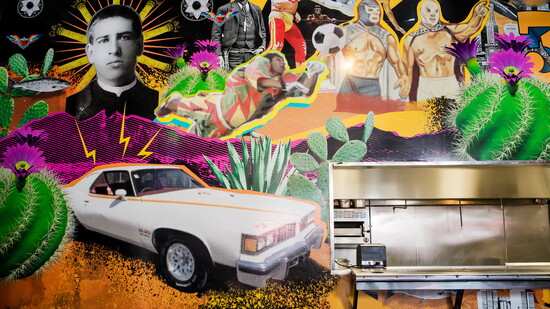
The creation of Antiguo Lobo came forth in bursts of creativity. Jesús Orñate's tribute wall, dedicated to his father and namesake, Jesus Onate Aguirre, is no exception. “I had no idea what it was going to look like,” Jesus shared. “I was just forming it as I was going - with memories.” From growing up in his father’s restaurants to honing his love of cooking in Mexico, this space seeks to honor both past and present.
During the restaurant’s construction, Jesus saw the large blank wall go up and suddenly knew a mural would be perfect. “The restaurant was always going to be in honor of my father,” Jesus says. “From day one, that was what I always wanted to do.” Set in the heart of Chamblee, this location was the only option, as it’s the city where Jesus’ father opened his first restaurant in the 1970s. “I wanted to do a full circle…go to where he started,” Jesus shared. Pablo, a friend from Mexico for almost a decade, came on as his muralist and collaborator. Throughout the design process, Jesus sent ideas as they came to him, and in the end, only very minor adjustments were needed to reach its final iteration.
The mural exudes an energetic power that's felt even without a cognitive understanding of every detail of its design. Shocks of sparkling orange juxtapose black cityscapes, laying the groundwork for the multicolored images to shine forth. The top left features Santo Toribio, a saint who is said to protect immigrants. Jesus’ father carried and kept his image everywhere: in his wallet, on his shelves, and across walls. Just below Santo Toribio is a neon purple rendering of El Cerro de la Silla, a mountain range representing Monterrey, Mexico. His father’s Monterrey restaurant chain is one of his greatest legacies to the Atlanta food scene.
Seemingly driving out from the center of the mountain range is a bright white 1977 Pontiac Can-Am. This depicts his father’s first brand-new car purchase, a symbol of the success he built from the ground up; the family still owns the vehicle to this day. Floating upwards out of the mountain range is Jorge Campos, the all-famous Mexican goalkeeper, whom Jesus, his father, and brother saw play live at the 1994 World Cup. His custom-made uniform, drenched in the colors of the Mexican flag, shines brightly against the backdrop. Directly above Campos stands Emiliano Zapata, a Mexican Revolutionary of mythical proportions, honored in the name of the restaurant that kick-started his father’s culinary journey: “Sapata.”
Toward the top center are two pairs of “Luchadores,” Mexican wrestlers, bringing dual meanings to the mural. Firstly, they harken to one of his father’s restaurants in Gwinnett, “Agave Canina”, where he commissioned a muralist to paint luchadores all over the interior walls, as a way to stand out from typical Mexican restaurant decor. Secondly, Jesus wanted them included because “luchador” also translates to “fighter,” and symbolizes his father’s true fighting spirit; he migrated to the U.S. with nothing to his name and built a successful life through pure grit and talent.
The number three stands in prominence to represent his father’s lucky soccer number. The numeral is so significant, so deeply reminiscent of his father, that Jesus has it tattooed on his arm. Sprouting from the top of the number is an agave plant. They’re placed in numerous spots across the mural, in reference to Los Altos de Jalisco, their native land, known distinctly for its tequila production.
At the top right is a donkey, mid-bray, as a tribute to his father’s Carrollton restaurant, “The Lazy Donkey.” This particular project struck a chord with Jesus, as a massive undertaking his father chose to enter in his twilight years. It wasn’t out of necessity, thus demonstrating his capacity for sacrifice, perseverance, and unending ambition. Jesus witnessed the toll it took on his father and learned from its resounding impact, while still being in awe of the beautiful product created.
Two city skylines round out the mural: Chicago, where his father first immigrated and learned all about the food industry, and Atlanta, where he settled and made his everlasting mark. Two fish float in the lower center, referencing his father’s love of fishing at his pond in Newnan. Jesus feels the game of fishing, waiting for just the right moment to earn your prize, reflects his father’s life of auspicious patience. The bottom right features an aerial view of a sombrero, nodding to the family’s heritage in Jalisco and their cultural connection to mariachi music.
Significantly, a partial wolf face looks out at the top right, representing the mural’s home restaurant, “Antiguo Lobo,” which translates to “Old Wolf.” The old wolf symbolizes a person whose great knowledge is hard-won, not gained from formal education, but through the trials and tribulations of a life well-lived. In that sense, Antiguo Lobo’s name and mural provide a daily source of inspiration. “You can’t quit, you can’t stop,” Jesus intones. “And even when things get difficult, I have a different kind of motivation.”
I was just forming it as I was going - with memories.
The old wolf symbolizes a person whose great knowledge is hard-won, not gained from formal education, but through the trials and tribulations of a life well-lived.