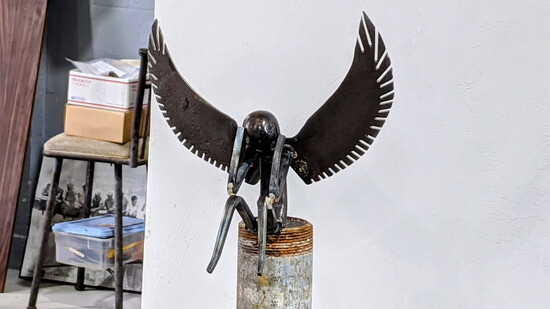
In Goodland, where weathered wood, working boats, and old Florida character still hold their ground, artist Marziano Gizzi, who goes by "Gizzi", has built a life, and an art practice, defined by instinct, grit, and imagination. His sculptures are not born from trend forecasts or tidy commissions. They begin with what he sees, what a piece of metal suggests, and what movement or memory asks to become.
“I don’t do that,” Gizzi says of custom requests that try to prescribe the outcome. “I just wait and work with what I see around me.”
That philosophy is everywhere in his work. Gizzi transforms discarded iron, steel, tools, springs, propellers, and other found materials into soulful, often whimsical forms: turtles, dreamcatchers, hearts, dragons, and abstract pieces that seem to carry motion even while standing still. A blade becomes part of a story. A spring becomes a circle. A pile of salvaged scrap becomes something startlingly alive.
Before art, Gizzi spent decades as an ironworker and builder, a career shaped by discipline, danger, and precision. “There were rules,” he says. “Now I have no boundaries, no rules with this, so it’s so much more enjoyable.” That freedom has become the heartbeat of his second act.
His Goodland studio reflects the same spirit. Tucked beside the historic home he famously saved and moved, the space is equal parts workshop, gallery, and gathering place. Doors open, breeze moving through, sculptures tucked into corners, metal waiting for its next incarnation—it feels less like a formal studio and more like an extension of Gizzi himself. Visitors often arrive at his home workshop and studio already feeling like they know him after discovering him through Organically Twisted, a healthy restaurant known for vegan, vegetarian and gluten free options on Livingston Road in Naples, where many of his pieces are on display; or, via word of mouth around Goodland, Marco, Isle of Capri, South and East Naples, and beyond.
That easy familiarity makes sense. Gizzi is candid, funny, sentimental, and completely uninterested in art-world posturing. He will tell you plainly that not everything is for sale, that he does not need to sell, and that if someone loves a piece, he may simply decide to make them another. “The longer it takes, the better,” he says. “Because it changes as it evolves.”
Evolution has defined his life as much as his work. Health challenges pushed him toward a cleaner lifestyle. The loss of friends and family deepened his sense of purpose. Caring for his mother, preserving a historic home, and building a studio that now shares space with wellness and movement all seem connected by one idea: make something meaningful, then keep going.
In Gizzi’s world, art is not separate from living. It is welding, gardening, healing, remembering, rebuilding, and noticing the shape hidden inside raw material. In Goodland, he is doing exactly that—one honest, unexpected piece at a time.
There is generosity in the way he works. A repaired mailbox tail, a stand made for a treasured plate, a sculpture gifted to the person—Gizzi treats making as both craft and conversation. He speaks often about movement, brotherhood, history, and preserving the soul of Goodland as change arrives around it. His story is a reminder that artistry does not have to be polished to be profound; sometimes it is forged, weathered, and beautifully human.
Gizzi's outlook is perhaps best captured in one of his more memorable philosophies: “Life’s a big hero sandwich… and every day you take a bite or two out of it, but you wrap the sandwich up, and you put it away so you can take another bite tomorrow.”