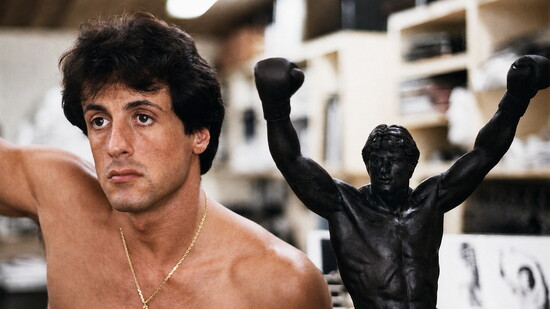
As Rocky approaches its fiftieth anniversary, millions of people around the world still travel to the Philadelphia Museum of Art to stand beside the bronze statue of Rocky Balboa. They raise their fists, recreate the famous pose, and celebrate one of the most enduring symbols of the underdog spirit in film history.
What many people don’t realize is that the statue’s story begins far from Philadelphia or Hollywood. The iconic sculpture was created in Colorado by artist A. Thomas Schomberg, and for years one of its castings remained connected to a studio in Littleton.
Schomberg began his career in the mid-1970s, creating bronze sculptures that explored themes of sport, struggle, and perseverance. Boxing in particular fascinated him. In 1980, tragedy struck the U.S. Olympic amateur boxing community when members of the U.S. Olympic boxing team were lost in a plane crash near Warsaw. The loss deeply affected Schomberg, who lived near Colorado Springs, where many of the athletes trained. Determined to honor their memory, he created a powerful sculpture titled Down But Not Out… Lost But Not Forgotten.
At the time, one of Schomberg’s collectors was actor Sylvester Stallone, who had purchased a boxing sculpture during an exhibition in Las Vegas. When Stallone began planning Rocky III, he contacted the Colorado sculptor with a new idea, a statue of Rocky Balboa himself. Schomberg traveled to California to meet Stallone and begin capturing the character’s likeness. Using plaster bandages, he created a life mask of the actor’s face and photographed him striking variations of the now-famous victory pose.
But Schomberg was not interested in simply sculpting Stallone’s portrait. “I was trying to create Rocky Balboa, not just Sylvester Stallone,” Schomberg later explained. “I wanted a figure representing many people.” Back in his studio, Schomberg began sculpting the first model. The initial maquette, a twenty-eight-inch wax sculpture built on a wire armature, captured Rocky’s triumphant stance, arms raised and chest open in victory.
Turning that small model into a monumental sculpture, however, would prove to be an enormous challenge. Traditionally, sculptors use a mechanical pointing machine to transfer measurements from a small model to a larger form. At the scale required for Rocky, the device proved ineffective. Instead, Schomberg relied on hand calculations and sculptural instinct, enlarging the figure proportionally and building the full form in clay at Art Castings of Colorado.
Working alongside several assisting sculptors, he gradually shaped the massive surfaces by hand. As the sculpture increased in size, the complexity multiplied. Details that appeared subtle on the model became enormous on the full-scale figure, requiring each muscle, fold of clothing, and facial expression to be carefully reinterpreted across the larger form.
The finished clay sculpture stood larger than life inside Schomberg’s Colorado studio. The bronze casting took place at Art Castings Foundry, using the centuries-old lost-wax method. Large molds were made from the clay sculpture, wax versions were produced, and molten bronze was poured into ceramic shells to create the final form. The statue was assembled from roughly twenty sections welded over a steel armature.
During the final stages of production, one of the foundry owners welded a small bronze heart inside the sculpture. Rocky, quite literally, has a heart of bronze.
Once completed, the statue returned to Schomberg’s Colorado studio for final patina finishing before being shipped to Philadelphia. It debuted alongside the release of Rocky III in 1982 at the top of the famous museum steps.
The art world initially rejected the statue, dismissing it as a movie prop rather than a serious sculpture. The public, however, embraced it immediately.
Visitors from around the world lined up to take photos beside Rocky’s raised fists. After filming ended, the statue was moved to the Spectrum sports complex in South Philadelphia, home to the city’s major teams. Yet fans continued seeking it out, recreating the famous pose and running up the museum steps just as Rocky did in the film.
Over time, the sculpture became something larger than the debate surrounding it. It represented resilience, determination, and the belief that anyone could overcome the odds.
In 2006, after years of public popularity, the Rocky statue returned to the grounds of the Philadelphia Museum of Art. While it was not placed back at the top of the steps, it found a permanent home nearby at the base of the staircase, where it remains today as one of the most photographed public sculptures in the United States.
Few people realize the Rocky statue is not a single sculpture. Schomberg created three monumental castings, all produced from the same molds at Art Castings Foundry in Loveland.
The best-known statue stands beside the Philadelphia Museum of Art steps. A second casting was installed at the San Diego Hall of Champions before being purchased at auction by Sylvester Stallone for his personal collection. The third remained in Colorado for nearly two decades, displayed at Schomberg Studios in Littleton until 2025, when it was acquired by the City of Philadelphia and installed at Philadelphia International Airport.
Today, the Rocky statue stands not only as a tribute to a fictional boxer but as a universal symbol of perseverance. And its roots trace directly back to Colorado.
For decades, Schomberg’s work and archives remained tied to the region, with sculptures and studio history connected to the Littleton area until as recently as 2025. That makes the Rocky statue not only a piece of movie history, but also a surprising part of Colorado’s artistic legacy.
So the next time someone raises their fists beside Rocky Balboa, they may think of Philadelphia, Hollywood, or the famous run up the museum steps. But the statue that represents one of cinema’s greatest underdog stories was first shaped in Colorado, in a sculptor’s studio where clay, bronze, and perseverance were forged into a legend.
“What most people don’t
realize is that one of
the most recognizable
symbols in movie history
was created right here
in Colorado.”
A. THOMAS SCHOMBERG
Creator of the world-famous Rocky statue
For more than five decades, sculptor A. Thomas Schomberg has built an international reputation for powerful figurative work that captures the intensity of the human experience. Raised in Iowa in the late 1940s and 1950s, Schomberg pursued formal training in the arts, earning both MA and MFA degrees and continuing his studies in Europe before beginning a teaching career.
In 1975, he relocated to Colorado and established Schomberg Studios with his wife, Cynthia, who serves as his agent. The move would shape the next chapter of his career and ultimately lead to one of the most recognizable sculptures in the world.
Schomberg’s work explores themes of perseverance, sport, and human emotion. His sculptures appear in major museums, memorials, and public spaces around the globe, including the Philadelphia Museum of Art, the Butler Institute of American Art, and the United States Olympic Training Center.
Among his many works, the Rocky statue remains one of the most celebrated pieces of public art
ever created.
Explore A. Thomas Schomberg’s work at SchombergStudios.com and order The Making of the ROCKY STATUE at RockyStatue.com.