In what is now New Lenox, two fur traders Aaron Friend and Joseph Brown established an outpost along Hickory Creek in 1829 near present-day Gouger Road. They called their clearing "Hickory Creek Settlement", one of the earliest settlements in Will County. The growing town was later known as "Van Horne’s Point" before being renamed New Lenox by township supervisor J. Van Dusen, who honored his hometown of Lenox, New York. For a brief moment, the village was renamed "Tracy" after a railroad superintendent, but the man himself asked that the honor be withdrawn.
Early settlers came mostly from Massachusetts, New York, New Jersey, and Pennsylvania. They endured the winter of 1830 and 1831, remembered as the winter of the Deep Snow. A killing frost came in September, and severe cold and heavy snow lasted for months. Many families were unprepared and livestock was lost. Yet they stayed.
The first post office in Will County stood at Gouger Crossing and was known as the "Young Hickory Post Office." The Great Sauk Trail, one of the earliest transportation routes in the region, ran through the area and is reflected today in Haven Avenue. A school was first taught in around 1832. By 1899, New Lenox was home to the first rural telephone station in the United States. Electricity followed between 1900 and 1910. When Lincoln Highway was built in 1920, it signaled that this small settlement was becoming firmly connected to a wider world.
Around the same time New Lenox was taking shape, Mokena was rising just to the north. Incorporated on June 16, 1880, Mokena’s story is marked by both courage and community. Several homes served as stations on the Underground Railroad. When the Civil War began, thirty four of Mokena’s men joined the 100th Regiment of Illinois.
Faith and education were early investments. In 1855, the first school, a small frame building, was erected for $1,000. German immigrants founded St. John’s United Church of Christ in 1862. South of town on Wolf Road, St. Johns Cemetery began in 1863 for church members and later opened to the public. Pioneer Cemetery at Denny Avenue and Wolf Road dates back to 1839, when Revolutionary War veteran Charles Denny was buried there.
Mokena invested in safety and infrastructure as it grew. Kerosene street lamps were installed in 1885, replaced by gasoline lamps in 1898, and electricity arrived in 1913. Gas service followed in 1927. The volunteer fire department organized in 1917 with an old hose cart and purchased its first truck engine in 1933. The State Bank, established in 1909 with a capital stock of $25,000, survived four robberies, including a successful theft of $4,000 in 1924.
In Frankfort, settlers from New England arrived along the Great Sauk Trail. During the Black Hawk War in 1832, residents fled to safety in Lafayette, Indiana. Families such as the Owens, Carpenters, Dotys, Bowens, Latts, Rices, Stephens, and Clayes returned and rebuilt. The railroad arrived in 1855, and most steam engines stopped in Frankfort to take on water, placing the village firmly on the map.
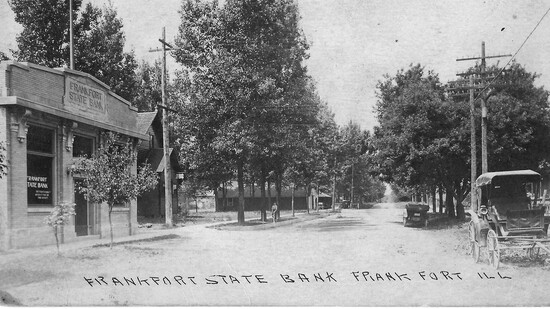
Frankfort organized its first bank in 1880 and continued expanding its financial institutions into the early twentieth century. Its first school was a one room log cabin taught by Lizzie Kent, replaced in 1870 by a two story building with three classrooms and an enrollment of 150 students. These were not small commitments. They were declarations of permanence.
Further south, Manhattan began as "Five-Mile Grove". Orin Stevens filed the first land claim around 1833 and operated a tavern for passing travelers. Farmers, stock growers, and dairymen shaped the township. A log cabin school was erected in 1852. The village itself did not formally exist until the Wabash Railroad passed through in 1880, the same year Manhattan was incorporated. Its first post office operated above a blacksmith shop, and its first general store served a community built on agriculture and ambition.
Each of these towns began with simple structures, dirt roads, and uncertain winters. They invested in rail lines, schools, banks, churches, telephones, and street lights long before growth was guaranteed. What we see today in New Lenox, Mokena, Frankfort, and Manhattan is not accidental. It is the result of generations who believed their small settlements were worth building, protecting, and connecting.
The open land is gone, replaced by neighborhoods and thriving downtowns. Yet the original investment remains. It lives in the roads we travel, the schools our children attend, and the communities we are proud to call home.
Before the subdivisions, before the stoplights, before the morning rush down Route 30, there was open land and a decision to invest.
Communities don’t grow by accident, there was a vision for the future. One that we now get to live happily and successfully in. The first investors in our towns weren’t corporations; they were families, farmers, and risk-takers.