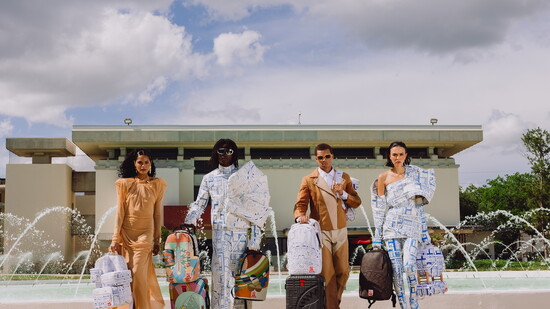
Beyoncé, Rihanna, Bruno Mars, Kevin Durant, Snoop Dogg, 50 Cent, Chris Brown, Kendall Jenner and Paris Hilton have all carried it.
And we're not talking about a Birkin. Rather, a backpack.
In 2010, Bronx-born artist David BenDavid looked at one of fashion’s most functional accessories and saw something different: a blank canvas.
His first Sprayground design, the instantly sold-out “Hello My Name Is” backpack, traded safe and sensible for bold and expressive. Then came the now-iconic Shark Mouth motif, limited-edition drops and a cult following spanning more than 90 countries.
Collaborations with the NBA, Porsche, Star Wars, Spike Lee and Shaquille O’Neal followed. So did the runways of New York and London Fashion Week. Somewhere along the way, BenDavid did more than build a global brand. He made backpacks cool.
Now, he has found a creative icon famous enough to rival Sprayground’s celebrity roster: Frank Lloyd Wright.
For Sally Russell, Director of Licensing for the Frank Lloyd Wright Foundation, Sprayground’s unexpected interpretation is precisely what makes the collaboration work.
“They’ve taken Wright’s architectural language, the geometry, the structure, the bold sense of form, and turned it into something you can carry. It’s playful, a little unexpected and a great way to introduce Wright’s ideas to a new generation that might discover Organic Architecture through fashion first,” she says.
The limited-edition Sprayground x Frank Lloyd Wright collection transforms Wright’s blueprints, furniture, stained glass, interiors and architectural forms into sculptural backpacks and statement luggage.
For our Style Issue, we scored an exclusive 1:1 with BenDavid about celebrity influence, creative instinct and what happens when one disruptor enters the world of another.
So tell us... how did David BenDavid become David BenDavid?
I’ve always believed creativity is a gift meant to be shared. As a kid, I was constantly getting in trouble for doodling instead of paying attention in class, but those sketches became the foundation of my future. After studying at the School of Visual Arts in New York, I realized backpacks were an untapped canvas for self-expression.
You launched Sprayground when backpacks were largely viewed as functional. What did you see that the rest of the industry didn’t?
Bags were viewed as purely functional, not as fashion. That’s when the light bulb went off. I realized they could become a canvas for my art.
It was a simple idea that challenged an entire category. Backpacks were no longer merely something to carry; they became wearable art, collector pieces and a visible declaration of individuality.
Why do you think your stuff resonates with artists, athletes and entertainers?
I think people are naturally drawn to things that feel genuine. We never created products for celebrities. We created them for anyone who appreciates bold creativity. It just so happened that many celebrities connected with that same spirit.
That spirit has always centered on refusing to blend in, which makes Frank Lloyd Wright an unexpectedly perfect creative counterpart.
What made Frank Lloyd Wright feel like the right partnership?
Frank Lloyd Wright did not simply design buildings. He challenged how people lived inside them, designing architecture, furniture, interiors and landscapes as one complete experience. At Taliesin West in Scottsdale, the desert was not treated as scenery. It became part of the architecture itself.
I’ve always admired creators who aren’t afraid to dream differently, so collaborating with his legacy felt less like a partnership and more like a creative conversation across generations.
What did it mean to earn the Frank Lloyd Wright Foundation’s trust?
It meant a great deal because trust like that has to be earned. We understood we weren’t just designing a collection. We were helping carry forward the legacy of one of history’s greatest creative minds. That responsibility inspired every decision we made.”
We worked closely with the Foundation, studying the intention behind Wright’s lines, materials, patterns and structures.
What was your vision from day one?
My vision was to honor Frank Lloyd Wright’s legacy by translating his way of thinking into something people could live with, travel with and experience every day. I wanted each piece to feel like functional art.
How did you translate his work into wearable pieces?
We focused on his geometry, patterns, materials and belief that design should exist in harmony with its surroundings rather than simply recreating buildings.
Blueprint blues, midcentury terracottas and geometric motifs appear throughout the collection. Wright’s floor plans become fashion canvases. Architectural layers create multidimensional forms. One backpack draws inspiration from the spiraling structure of the Guggenheim Museum, while others reinterpret Wright’s stained glass, murals and graphic language through Sprayground’s unmistakably bold lens.
But the collection’s most conversation-starting piece may be the Chair Backpack, a sculptural design framed by one of Wright’s most enduring philosophies.
What inspired the Chair Backpack?
What fascinated me most was that Frank Lloyd Wright didn’t stop at designing the building. He designed the entire experience, from the architecture to the furniture and interiors. That chair represented his philosophy of total design. Reimagining it as a backpack felt like honoring the idea that great design shouldn’t live in one place. It should move with people.
We reimagined Frank Lloyd Wright’s architectural blueprints as patterns, transformed his iconic furniture into sculptural backpacks and created modular, three-dimensional pieces inspired by his home and buildings.
With luggage, the goal was to make travelers feel like they were carrying a piece of architecture through the airport; impossible to overlook.
Which piece do you think would make Frank Lloyd Wright smile?
The Chair Backpack. Not because we recreated his work, but because we dared to reinterpret it. Frank Lloyd Wright believed great design should continue evolving, and I’d like to think he’d appreciate seeing one of his ideas inspire something entirely new.
If you could ask Frank Lloyd Wright one question, what would it be?
When you looked at an empty space, what did you see that everyone else missed?
Personally, I think that’s where true creativity begins.
franklloydwright.org