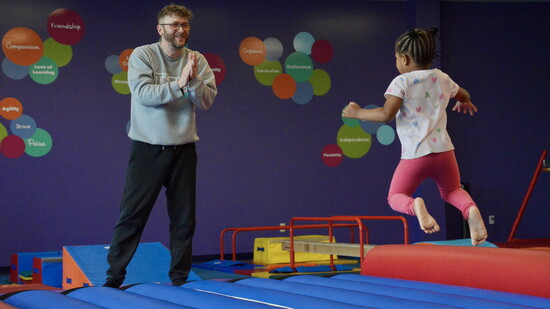
Children constantly test the invisible boundary of their bodies. Space is not merely occupied; they collide with it, test limits, and seek out new ways to bounce, tip, balance, spin, and fly. In response, parents quickly develop superhuman reactions, existing in a state of perpetual readiness to catch their tumbling toddlers.
While cultivating their independence is essential, handing your child over, with the hope that they will be genuinely seen, protected, and encouraged, can feel daunting. This hesitation is natural, yet early immersion in structured play eases those protective instincts while initiating healthy growth. Movement is the first language children speak, and the way they learn to navigate physical challenges directly shapes how they approach the rest of the world.
Jackie Dorris intuitively knew she wanted to build a career around supporting family health. During her time in Chicago, she owned a prenatal and postnatal fitness business focused on maternal wellness as the baseline for healthy families. Upon returning to the Madison area, she continued to advocate for family wellness at Harbor Athletic Club, where she launched another FIT4MOM franchise and expanded her personal fitness influence.
When the opportunity arose to acquire The Little Gym in Middleton, it felt like a natural transition to combine her expertise in childhood development with her personal training background. Now, with five years in the books and a year into opening a Sun Prairie location, Jackie ensures the environment matches her original vision: "Anytime you’re here, it is warm, sunny, and happy."
(p.2)
Every week, the entire layout of the gym transforms to follow an expert-developed curriculum based on the American Academy of Pediatrics milestones. This intentional variability keeps young minds curious while targeting specific developmental skills.
Parent-child classes begin with infants as young as four months old, providing space for caregivers to guide their first sensory and balance play. This early exposure not only eases the expected anxiety of new parents but also helps hesitant children transition smoothly into independent classes.
(p.3)
Instead of pushing kids toward competition too early, the noncompetitive setting allows the focus to remain on body mechanics and cognitive development. Classes become a space for self-discovery and spatial awareness, as interactive play naturally builds social adaptability. The goal of the age-specific curriculum is to create a groundwork of confidence as they target physical milestones. Younger classes emphasize social life skills, learning the framework for how to share and cooperate, wait patiently, and follow multistep instructions. As students advance, the focus transitions to skill progression, where they introduce concepts such as fast and slow power mechanics and teach kids to overcome self-doubt through positive self-talk.
Progression happens faster than expected when you expose children to structured movement. For instance, during a parent-child session, instructors guide young children through a somersault form. Within just a few attempts, the children somehow begin to understand the physics of the movement and tuck their heads independently. Despite their age, innate instincts kick in and validate the statement Jackie frequently hears, “I wish I had started sooner.”
These physical breakthroughs represent only one facet of the gym experience, as instructors are equally focused on a child’s emotional comfort levels. Until they are ready to partake on their own account, instructors take a patient, hands-off approach, ensuring they feel welcome and wanted. Recognizing their developmental readiness allows a child to feel in control. Gradually, the shy, hesitant toddlers who cling to their parents allow their curiosity to take over.
This steady growth is due to a three-dimensional learning approach that balances Get Moving, Brain Boost, and Citizen Kid components. The physical aspect focuses on coordination and teaching bodies how to fall and move safely. Simultaneously, the educational elements sharpen spatial awareness and executive function through rhythmic games and counting exercises. Finally, the social pillar facilitates peer interaction and emotional regulation. This approach ensures classes function as a beneficial routine. When it comes down to it, kids will always seek out play, and providing a space designed to absorb that collision of energy makes all the difference.
Birthday Celebrations
Date Night Drop-Offs
Indoor Themed Camps
Parent & Child Classes
Caregivers share the mat, guiding infants and toddlers through early sensory play, coordination milestones, and balance challenges to cultivate foundational development skills. (4 Months - 3 Years)
Levels: Bugs, Birds, Beasts, Super Beasts.
Pre-K Gymnastics Classes
Independent, imagination-fueled structured classes designed to channel boundless energy into physical strength, socialization skills, and the ability to follow multistep instructions. (3 - 6 Years)
Levels: Funny Bugs, Giggle Worms, Good Friends.
Grade School Gymnastics Classes
A non-competitive environment focusing on progressive skill development, personal goals, positive self-talk, and teamwork. (6 - 12 Years)
Levels: Beginner, Intermediate, Advanced.