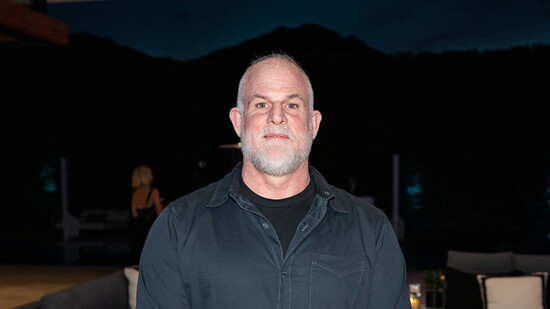
At a Paradise Valley private residence, Auragens welcomed patients for a private appreciation evening, and PVCL was granted exclusive media access.
The room was filled with many individuals who had traveled to Auragens in Panama seeking advanced regenerative medicine not currently available in the United States.
For Dr. Dan Briggs, CEO of Auragens, the night was not about spectacle. It was about validation.
“This is our chance to say thank you to the patients who entrusted us with their health,” Dr. Briggs shares. “Most of the people here have traveled with us. Tonight we get to see the long term benefits.”
Auragens operates in Panama by design. Dr. Briggs explains that regulatory frameworks there allow access to expanded biologics and advanced mesenchymal stem cell applications cultivated over an extended period, a distinction he believes separates serious regenerative science from domestic alternatives.
“Not all stem cells are the same. There’s a major difference between minimally processed material and biologics developed over 15 months for true anti-inflammatory and regenerative potential.”
For many in attendance, including notable public figures, privacy came first. Results came second. Advocacy came last.
“We never ask anyone to speak publicly. When they choose to share their story, it’s because they’ve experienced meaningful change.”
The broader conversation, however, was less about celebrity and more about capital.
As longevity becomes a global industry, high performers are viewing health not as maintenance, but as infrastructure, something to build, protect, and optimize.
“Your quality of life has to match your lifespan. That’s what we’re trying to support.”
And that message resonated.
Because for those who understand investment, the most valuable portfolio may not be financial at all.
Enter John McPhee, a retired U.S. Army Special Operations Sergeant Major. A Green Beret. A career Ranger. A sniper whose work required precision most people cannot conceptualize. For more than two decades, his world was angles, distance, discipline, and consequence.
He’s also dubbed The Sheriff of Baghdad.
In person, he’s quick. Funny. Direct.
“What brings you here tonight?” we ask.
“Stem cells.”
He smiles, but there’s no performance in it.
When he traveled last year, he says he wasn’t chasing hype.
“I was trying to figure out how I feel now,” he shares. “So I have something to compare it to. Where am I at?”
That question becomes the pulse of the conversation.
After twenty years in the Army, pain had become background noise.
“I got knee pain. Shoulder pain. Broke my back before. It’s just pain every day. Not excruciating. Just there.”
He says something that stops us.
“You don’t really stop and ask how you feel. You just keep going.”
So we pivot asking what makes someone excel as a sniper.
“Math. No one wants to admit it. It’s trigonometry.”
Wind. Angles. Distance. Timing. Variables stacking on variables.
So we ask if he’s good at math.
“No,” he says, grinning. “I just know how it’s going to work. Once I figure out how it works, I know how it works.”
When we ask what kind of personality survives elite military life, he shrugs.
“I’m not a shrink. I’m just a regular guy.”
Then:
“I think guys like me are bored underachievers. We don’t do well in school until you give us something we want to do.”
He calls himself a “C” student. Says people joke that he breaks everything he touches.
“I’ve been adulting since I was a kid,” he says. “I hate that.”
He laughs.
After retirement, structure disappeared. The mission changed. He doesn’t sugarcoat that chapter.
“The VA gave me a bunch of pills. I laid on the couch. Watched TV. Got fat. Years went by.”
He doesn’t blame anyone.
“I realized that wasn’t the way to live.”
Positivity, he says, is not personality.
“It’s a choice.”
He remembers waking up one morning thinking, I’m just going to try to have fun today.
“I used to be fun. I had to figure out how to get that back.”
When we ask what he hopes people take from him now, he keeps it simple.
“It’s about honesty. Owning your stuff. There’s no magic to it.”
If John carries the stillness of a sniper, Erika Jayne carries a spotlight.
Before the confessionals, she was a performer. A dancer. A singer with nine #1 hits on the Billboard Dance Club chart. A woman who understands choreography, stamina, and the cost of high heels better than most.
Erika Jayne is a Bravo favorite and one of the defining forces of The Real Housewives of Beverly Hills, now ten years into one of the most dissected runs in reality television.
When we ask what brings her to Paradise Valley that night, she answers easily.
“I’m here to celebrate Auragens. I’m a patient. I’ve had incredible results.”
But the more interesting part of the conversation isn’t about treatment. It’s about wear and tear.
“I’ve had three knee surgeries,” Erika says. “I’m a professional dancer and singer. That kind of wear and tear on the joints is something you really can’t treat. It’s not just the absence of pain. It’s the absence of swelling.”
When we ask if she feels cured, she corrects me immediately.
“Cured is a strong word. But when I say I’m 90% better? That’s insane.”
Ten years on The Real Housewives of Beverly Hills means public evolution. Public friendships. Public fractures.
“I think what people gloss over is how deep these friendship ties really are,” she says. “When you fall out with somebody, it hurts. We’re all human. We’re showing our lives. Not necessarily the best parts.”
We ask what viewers don’t see.
“Every day of my life,” she says when we bring up being edited or misunderstood.
How do you survive that?
“You don’t. You compartmentalize. You can’t fall in love with the good things said about you or the bad things said about you. You need to remain neutral. Yes, the show is edited. Yes, there are story arcs. And no, you may not look your best. But that’s part of the game.”
Then she smiles.
“Life goes on. Life goes on. Life goes on. You have to decide what kind of life you want to live.”
And right now?
“A really good one. I feel good.”
If John carries precision and Erika carries spotlight, Mark Kerr carries survival.
Former UFC heavyweight champion. PRIDE icon. The Smashing Machine. A man whose career was built on impact.
When we ask about the necklace resting against his chest, his entire posture shifts.
“It’s a Rudis,” Mark says. “When you’re a Roman gladiator and you earn your freedom, you’re given a wooden sword. It means you don’t have to fight anymore.”
“It’s my reminder.”
For decades, fighting was literal. Night after night.
“Where I sustained most of my injuries was my right side. Hip. Shoulder. Just bone on bone.”
Some days, he says, were unbearable.
“Give yourself a toothache and see how happy you are. When you’re dealing with that level of pain every day, you’re not your best self. I just dealt with it. It made me cranky all the time. My mental health was suffering because of my physical pain.”
Five years ago, he hit a point of desperation. Surgeons offered more operations.
However, he turned to Auragens.
And today, he mountain bikes sixty to seventy miles a week.
“If I go out for ten miles, I don’t feel like I got enough in. I didn’t realize how much I missed working out. It does something for me that nothing else does.”
When Mark and his wife Francie graced our PVCL February cover, it marked more than a milestone. It marked a legacy. The Smashing Machine, a major motion picture based on his life and starring Dwayne “The Rock” Johnson, brings one of the most complex careers in combat sports to the big screen.
From their home in Scottsdale, the moment carries weight beyond Hollywood.
“This is my community,” Mark says. “These are my people.”
And while some legacies are built in arenas under bright lights, others unfold differently.
Ali Landry does not enter a room loudly.
Former Miss USA. The original Doritos Girl. Actress. Producer. Founder. A woman whose career spans Super Bowl commercials and independent film.
When we ask what brought her to Paradise Valley that night, she smiles.
“I’m really excited. A friend of ours told me about Auragens. We travel all over the world together, and he knows the issues I deal with… especially with my shoulder and neck. We’re always asking ourselves, are we actually going to get a good night’s sleep tonight, or are we going to be up because of the pain?”
Ali recently wrapped her first experience in Panama.
“If I can get out of pain, that’s a win.”
From the outside, she looks timeless. She laughs when she remembers the night her iconic Doritos commercial first aired during the Super Bowl, watching it live at a bar in Arizona.
“I remember hearing the music,” she says. “And then I saw myself on that huge screen and thought, oh my gosh.”
Today, the conversation turns to aging. Brain fog. Hormonal shifts.
“Age is not on our side. I’ve noticed forgetfulness. There are some things going on that I really need to look into. I did a treatment at Auragens that’s really for neurological issues. Hoping to get some results there.”
Then she smiles.
“And of course, while I’m there, I enjoyed some injections in the face.”
Because Auragens does it all.
After years of nonstop work, Ali made a decision.
“I heard someone say she didn’t want someone else raising her kids. And I realized I needed to be there. I made a choice to step back. That is my focus right now.”
Looking back on her career, one project still stands apart.
Bella, the award winning independent film directed by her husband, Mexican filmmaker Alejandro Gómez Monteverde. Ali has been married to Alejandro since 2006, and the film remains deeply personal to them both.
“To be part of something that had meaning, that gave people hope, that made them think, it made me ask, what do I want to put out into the world?”
When asked the key to a long marriage, she answers quickly.
“Patience.”
Then she adds,
“Personal growth. As you change individually, you change as a couple. You have to grow together.”
auragens.com