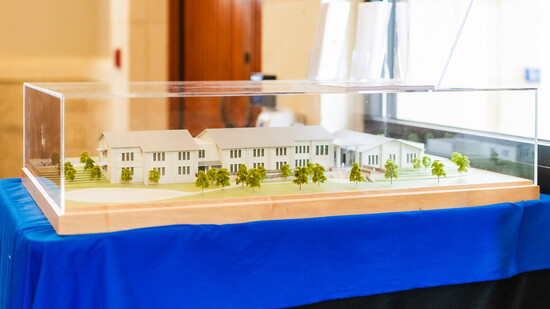
Long before the buildings were designed or the funds were raised, the foundation had already been laid by a community that believed students deserved more than a standard education. That foundation is now coming to life at St. Peter the Apostle Catholic School, where a new campus reflects both a shared vision and the commitment behind it. Walking the grounds offers a clear view of how the project came together: the influence of philanthropist Clarence Kahlig, the leadership of Father Norman “Norm” Ermis, and a community that responded with wholehearted support.
Beyond the limestone walls and carefully planned spaces, the school seeks to distinguish itself with a high level of student engagement, personalized instruction, and learning shaped by discipline, rigorous academics, and a foundation of faith. This approach is already on display in temporary classrooms serving kindergarten through seventh grade, before the full campus opens in August with the space to grow to 550 students.
Clarence Kahlig, the founder and president of Kahlig Auto Group, is known for his philanthropic work that extends well beyond a single project. Though he speaks about his role at St. Peter’s with little emphasis on himself, it is foundational. He first approached Ermis with a direct question: “I asked him, ‘If I gave you five million dollars, would you build a school?’” Then, a process of prayer, consultation with the archbishop, and a formal feasibility study in 2022 confirmed strong backing from both parishioners and neighbors alike. As Kahlig recalls, “Community support for the school was unmatched and has been there since the beginning.”
The campus of St. Peter the Apostle has been built in layers. At the front of the property sits the original chapel. Behind it stands the larger sanctuary, opened in the late 1990s, with a layout that departs from tradition. Pews face inward, creating an open space, framed by limestone walls that feel like the Hill Country brought indoors. As the campus expanded with the addition of the Cana Ballroom and other structures, this same material was used to create a sense of continuity throughout.
The school grounds fit the space as well. The land, acquired from the Benedictine Sisters, sits just beyond the main campus, connected by both proximity and design. Walking from the church to the school, the transition feels seamless. Retaining walls and graded elevations guide the descent, shaping the landscape as it opens up. At the entrance, textured limestone stretches across two primary buildings, punctuated by polished limestone pillars that give structure and rhythm to the facade. To the right, the academic wing rises with 43,000 square feet of learning space, anchoring the campus with a presence that is both substantial and cohesive with everything that came before it.
Inside the academic wing, Kahlig pointed out details that might otherwise be overlooked, each one tied to how students will learn and move through the day. Classrooms are sizable but intended for smaller groups—no more than 20 to 30 students per class. “Young people are being formed with a base and foundation of Christianity and values,” Kahlig says of the current students. “They are academically strong, and it is just amazing to see how they are progressing in their analytical thinking.”
Built for direct instruction and individual attention, each classroom features a simple whiteboard, a contrast to other approaches that rely heavily on computers and online learning. Technology is used selectively: security systems are top-of-the-line and comprehensive, while instruction relies on teacher-led learning, favoring whiteboards over screens. The youngest grades have bathrooms inside the room, a feature that keeps students present and minimizes disruption. As Kahlig moved through the space, it became clear that these choices were intentional and central to the school’s priorities. In the chapel, eight stained-glass windows add a sense of meaning, with panels carefully selected, customized, and designed just for the space. The composition helps create a setting in which focus is expected, and students are shaped through consistency, structure, and direct engagement.
Hearing Kahlig’s vision for students' academic and spiritual potential echoes the legacy of Sam Champion, the namesake of the city’s second public high school. He was known for taking his time to speak directly to students, remembering their goals, and following up with a handwritten letter of encouragement, all small gestures that reinforced a larger belief in their potential. Kahlig’s work and the vision of St. Peter’s operate on different scales but share a similar throughline: a commitment to creating an environment in which students are expected to grow, engage, and take their education seriously. It is a continuation of a legacy the community has long valued, now taking shape in a new setting. “Seeing the community improve makes it all worthwhile.”
stpetersboerneschool.org | 830-816-5670 | 202 W. Kronkosky St.
kahligauto.com
PULL QUOTE 1 (15):
“Community support for the school was unmatched and has been there since the beginning.”
“Community support for the school was unmatched and has been there since the beginning.”