Jonathan Mustich spends much of his time thinking about what happens after we're finished with something.
Mustich is the founder of TerraLoam, a sustainability company that transforms products into nutrient-rich compost to reduce waste and improve soil health. His latest innovation, the BioDigester, can convert up to 220 pounds of compostable personal protective equipment worn by medical workers, as well as food waste, into soil.
"It's like a fancy garbage can,” he says. "It takes food scraps and other organic material and turns it into soil in 24 hours. We're proving that compost doesn't have to be dirty, smelly or gross."
Mustich developed his fascination with composting like many people did, during the pandemic. He found comfort during lockdown cooking and gardening and began composting in his backyard.
"Then I realized I was only putting my trash out once a month,” he says. “So much of what we throw away is food scraps."
FROM SUITS TO SOIL
In 2020, the native New Yorker was in his 12th year as founder of his own fashion company, Evolution of Style, which specialized in custom suits. He spent a decade in Los Angeles, tailoring custom suits for celebrities and professional athletes, before moving to Charlotte in 2018 to expand his business. Things were going well. Then the pandemic hit.
"No one was wearing suits," he says with a laugh.
So he adapted. He converted his factory to manufacture medical gowns as hospitals faced critical shortages. As demand grew, he couldn't ignore another problem hiding in plain sight.
"The medical industry generates an incredible amount of plastic waste," he says.
It inspired Musitch and his business partner to develop the world's first compostable isolation gown, the extra layer of protection medical workers wear over their scrubs. The work earned them the 2024 Innovative Tech Award. Since then, TerraLoam has diverted more than 40 tons of plastic waste, transforming it into compost for community gardens in Charlotte and Hickory.
FROM GOWNS TO GARDENS
Now TerraLoam is working with hospitals to transform their food scraps into compost, then use that compost to build gardens on hospital campuses.
"We're taking food scraps and turning them into soil that grows more food in the same communities,” Mustich says. “That's where the opportunity lies."
TerraLoam is partnering with restaurants, hospitals and universities to rethink how to handle the mountains of waste they generate. It’s all part of connecting his passions for better food, better health and a greener planet.
A TASTE FOR REAL FOOD
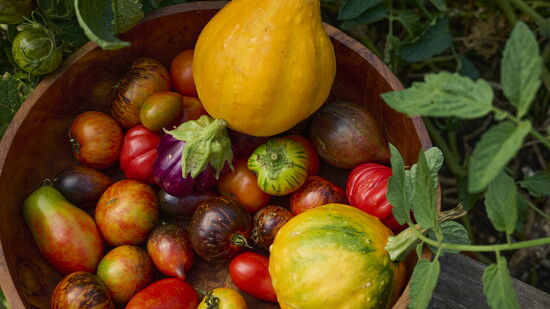
Depending on the day, Mustich might be found growing heirloom vegetables for one of Charlotte's top chefs or hosting a sushi dinner with produce from his own backyard.
Mustich first connected with Chef Sam Diminich during the pandemic when he grew a particularly successful crop of artichokes. Today, he supplies the chef with specialty produce.
"I can't grow enough," he says. "It's been wild to see how much he can use every week."
Mustich has traveled extensively throughout the world, which has only deepened his appreciation for fresh, nutrient-dense food.
"I've been fortunate to eat all over the world," he says. "It made me realize how bland our food system is here in the U.S. When friends come over and taste my produce, they're kind of blown away, like they're remembering what real food tastes like."
For Mustich, introducing people to unfamiliar ingredients is as rewarding as inventing new composting technology.
"Everyone wants convenience all the time," he says. "I get it. Sometimes I want to order a pizza, too. But it's really not that hard to roast some vegetables and make a great meal."
Now, he’s bringing those two passions together with a simple idea: waste less, grow more, eat better.