As Earth Day approaches, many Rochesterians will head outside—to a favorite trail, nature preserve, or farm stand. What they may not realize is that a local nonprofit has been working for decades to ensure those landscapes remain protected for generations.
Founded in 1989, the Genesee Valley Land Trust is dedicated to protecting land and water for wildlife, farmland, and families across the region. Its service area includes Monroe and Wayne counties and parts of Cayuga, Ontario, Livingston, Genesee, and Orleans counties—boundaries defined by the Lake Ontario watershed rather than municipal lines.
“We also work to connect people to nature,” says Executive Director Lorna Wright. Over the past 35-plus years, the land trust has protected thousands of acres through land ownership, partnerships, and conservation easements. It now owns 19 permanently protected nature preserves across the region.
Corbett’s Glen Nature Park on Penfield Road, a beloved hiking destination, was co-created and is co-managed by the land trust. “We ensure that it’s there forever,” Wright says. Another well-known project is Gosnell Big Woods Preserve, maintained in partnership with the town of Webster as a nature park.
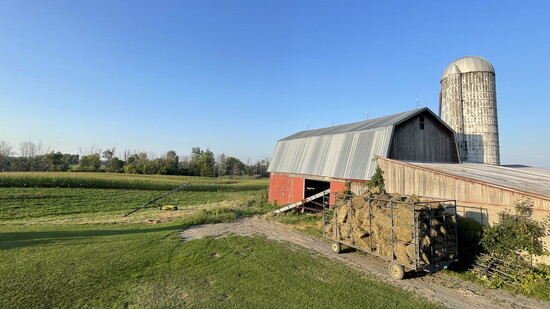
Beyond public preserves, the organization works closely with private landowners, especially farmers, to protect working landscapes. Wright estimates the trust has helped 45 local family farms ensure their land remains dedicated to agriculture.
Farmers often learn about the land trust through neighbors. “They are interested in ensuring that their farm can always stay a farm,” Wright says. Some worry about development pressure; others want their farming legacy to continue after they’re gone.
A key tool is the conservation easement, a legal agreement that permanently restricts development while allowing families to continue farming. Filed with the county, it functions like a deed that keeps land available for agriculture. “We don’t tell them what to do,” Wright says. “But they can’t turn it into a housing development or the next Amazon warehouse. It always has to be able to be used for agriculture.”
Land conservation has taken on added urgency with climate change. Forests and farmland help absorb carbon, protect water quality, and buffer communities from extreme weather. “The need to balance clean energy and affordable housing with clean water, clean air, and wildlife habitat is challenging and requires nuance,” Wright says. “Conservation is a long-term thing.”
Farmers are key partners. “Farmers are as much a part of the solution to combat climate change as everyday people are. The farmers we work with care greatly about this Earth. It supports their livelihood.” Supporting local agriculture can also help. “Buying and eating locally, and thanking your farmer, can go a long way toward improving the environment,” she says.
There are signs that long-term conservation is paying off. When Wright first joined the organization, the Rochester embayment was designated an environmental “area of concern” by the Environmental Protection Agency. In the past two years, that designation has been lifted. “It doesn’t mean it’s perfectly healthy,” she explains, “but it’s so much better than it was. It’s satisfying to see the payoff of decades of hard work.”
Wildlife is also returning, with recent sightings of fishers—elusive mammals once nearly extinct in the area. As forests recover and ecosystems improve, their reappearance signals healthier habitats.
For those looking to explore new natural spaces this Earth month, Wright recommends the Irene Gossin Nature Preserve. “It’s bite-sized and right in the village of Penfield,” she says. “You can walk around and get fresh air without the kids having to go too far.”
Cornwall Preserve along Lake Ontario offers sweeping views, wetlands, meadows, and old-growth woods. Visitors can look for frogs, skip stones, or watch butterflies. Wright believes the region’s access to nature is sometimes overlooked. “People do take for granted how much access we have,” she says. “But since COVID, many have come to appreciate it more.”
Like many nonprofits, the land trust relies on grants and donations. “We have donors who give $10 a year, or kids who give a dollar,” Wright says. “Every amount matters.” Volunteer opportunities include a monthly Trailkeepers program that maintains preserves and builds small infrastructure. The organization also hosts at least one free public walk each month, often focused on birding, geology, or seasonal changes.
Community advocacy can also spark conservation. Corbett’s Glen, Wright notes, came under protection after residents spoke up when the land faced potential sale. “People said, ‘That piece of land is really important,’” she recalls. “Bringing those things to our attention and helping advocate is always a help.”
This Earth Day, Wright hopes residents will explore the region’s natural spaces—and remember the work required to protect them.
To learn more, volunteer, or donate, visit geneseelandtrust.org.