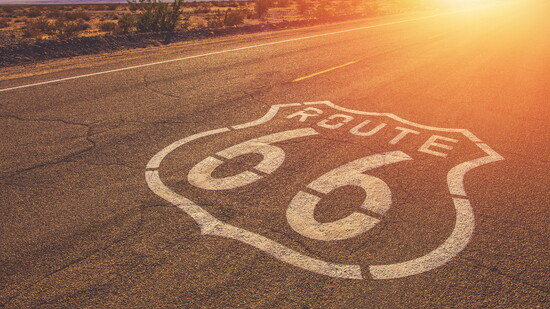
For our Explore Issue, we’re taking a road trip down memory lane.
This year, Route 66 officially turns 100 years old, fitting as America simultaneously celebrates its 250th anniversary.
While the road itself stretches from Chicago to Santa Monica, some of its most iconic and emotionally resonant miles live right here in Arizona.
The Mother Road winds through old mining towns, weathered trading posts, quirky diners, mountain passes, neon-lit downtowns, ghost towns, roadside motels, and sweeping desert landscapes that feel untouched by time.
And according to Route 66 historian and author Jim Hinckley, that sense of nostalgia, Americana, freedom, and emotional connection has always been at the heart of the highway’s enduring magic.
“Route 66 was the road of dreams,” Hinckley says. “And today it is viewed as the quintessential American road trip.”
For Arizona travel writer and author Roger Naylor, the road’s continued relevance feels especially meaningful in today’s fast-paced world.
“In a world of social media and AI, we crave authentic experiences,” Naylor says. “We want to hold on to something that feels real.”
Long before Route 66 became immortalized in movies, songs, and pop culture, it emerged from America’s growing fascination with exploration, mobility, and the open road.
Hinckley explains that the roots of Route 66 actually trace back to the 1800s, when political leaders began envisioning a connected America built through transportation systems linking communities together.
By the early 20th century, automobiles transformed travel forever. Families began venturing farther from home, roadside businesses exploded, and a national highway system became essential.
Then came 1926 when Route 66 was officially established.
What followed cemented Route 66 as one of the most iconic roads in American culture.
The highway carried Dust Bowl migrants west during the Great Depression. It connected military bases and training camps during World War II. It became the backdrop for postwar family vacations, cross-country adventures, and stories of reinvention.
On I Love Lucy, Route 66 represented opportunity.
In Easy Rider, rebellion.
For travelers around the world, it became symbolic of freedom itself.
One memory still stands out vividly for Hinckley.
While speaking at the European Route 66 Festival in Zlin, Czechia, a man approached him and explained that while growing up behind the Iron Curtain, he secretly listened to the song about “getting your kicks on Route 66” through Radio Free America and watched bootleg copies of Easy Rider.
“Then he told me that for his generation Route 66 came to symbolize freedom as the Statue of Liberty had for a previous generation,” Hinckley says.
That symbolism remains deeply woven into Arizona’s stretch of the Mother Road today.
Every state along Route 66 tells a slightly different story.
According to Hinckley, Illinois offers farming towns tied to Abraham Lincoln, while Missouri delivers quaint Ozark communities dating back to the Civil War alongside former mining boom towns that help give the highway what he describes as the feeling of “America’s longest small town.”
That sense of authenticity continues westward toward California, but Hinckley believes Arizona’s stretch of Route 66 stands apart.
“What makes Arizona unique is the combination of devastating scenery, wide-open spaces, and a sense of the Wild West that no other state can match,” Naylor says.
He describes Route 66 as the “main artery” of Arizona itself.
And nowhere is that more evident than the legendary drive through Sitgreaves Pass.
Hinckley says the pre-1952 alignment west of Kingman through Sitgreaves Pass and down into the Colorado River Valley is often considered the most scenic stretch of the entire highway. Built in 1921 to replace the dangerous 26% grades of the old National Old Trails Road, the route features dramatic curves, steep grades, and breathtaking overlooks unlike anywhere else along the Mother Road.
“Driving this road is almost like time travel,” Hinckley says.
Along the way, Arizona delivers a collection of unforgettable roadside moments.
There’s the Wigwam Motel in Holbrook.
The neon glow of Williams after dark.
The famous Standin’ on the Corner landmark in Winslow.
The quirky charm of Seligman.
The Route 66 Drive Thru Shield in Kingman.
The burros wandering through Oatman.
And then there are diners, cafés, pie counters, and roadside restaurants that somehow taste even better after hours on the open road.
“You’ll never forget grabbing a burger at Miz Zip’s in Flagstaff or a huge piece of carrot cake at Westside Lilo’s Café," says Naylor.
According to Naylor, Route 66 nearly disappeared altogether in 1985 when the highway was officially decertified, signs were removed, maps changed, and America’s most famous road quietly faded from the federal highway system. But Arizona refused to let it die.
Naylor attributes much of the preservation movement to Seligman barber Angel Delgadillo, who helped lead the effort to revive and preserve the Mother Road after its decertification.
“Angel spearheaded the movement to resurrect the Mother Road after it had been decertified in 1985,” Naylor says.
Delgadillo and the Historic Route 66 Association of Arizona successfully convinced the Arizona Department of Transportation to designate portions of the highway as Historic Route 66, creating the blueprint other states would eventually follow.
“It wasn’t saved by the government or billionaires or huge corporations,” Naylor says. “It was saved by individuals.”
Route 66 Favorites
Seligman
Roadkill Café and Westside Lilo’s Café sit across from each other and deliver the classic Route 66 experience with comfort food, quirky charm, and authentic roadside nostalgia.
Sitgreaves Pass & Oatman
The winding drive from Kingman through Sitgreaves Pass to Oatman offers dramatic desert views, sharp curves, roaming burros, and one of Arizona’s most unforgettable stretches of Route 66.
Pine Country Restaurant, Williams
A longtime Route 66 staple known for its legendary pies, classic Americana atmosphere, and front-row seat along the Mother Road.
Tin Can Alley on 66, Kingman
This retro-inspired lodging concept blends vintage Route 66 nostalgia with modern comfort in Kingman’s historic district near shops, breweries, museums, and Beale Street Theater.
Earl’s Route 66 Motor Court
More time capsule than motel, this nostalgic roadside stay captures the spirit of classic American road trips and old-school Route 66 culture.
Jack Rabbit Trading Post
Dating back to the 1940s, this iconic family-owned roadside stop remains one of Arizona’s most authentic slices of Route 66 nostalgia filled with vintage charm, souvenirs, and photo ops.
Ash Fork Route 66 Historic Museum
This understated museum offers small-town charm and quirky exhibits highlighting Arizona’s Route 66 history, roadside culture, and vintage Americana.
The iconic Hotel Beale
Originally purchased by Thomas Devine, father of actor Andy Devine, the historic hotel hosted guests including Amelia Earhart, Charles Lindbergh, and Buster Keaton. Earlier this year, the landmark sign was relit for the first time in more than 70 years.
jimhinckleysamerica.com
rogernaylor.com