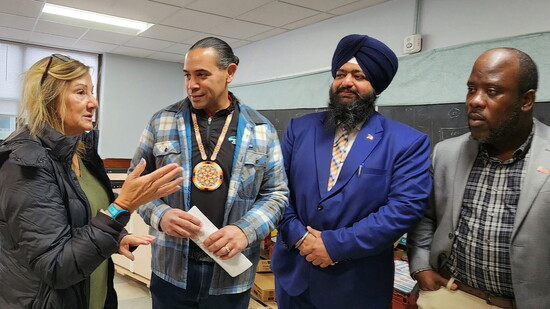
For the Mashantucket Pequot Tribal Nation, giving back has long been part of its commitment to its members and the surrounding communities. Since Foxwoods Resort Casino opened in 1992, the Tribe has supported local organizations, charitable causes, municipalities and programs that help families throughout the region and beyond.
The Tribe has contributed more than $100 million in donations and sponsorships to local charities and social service organizations. Revenue from Foxwoods also funds tribal programs that include education, youth services, childcare, social services, health care, public safety and the Mashantucket Pequot Museum & Research Center.
“Giving back to our community is an important part of who we are as the Mashantucket Pequot Tribal Nation,” said Rodney Butler, Chairman of the Mashantucket Pequot Tribal Nation. “We are proud to support organizations, programs and initiatives that strengthen the communities around us. Whether through philanthropy, education, health care or cultural outreach, our goal is to make a meaningful difference and build strong, lasting relationships with our neighbors.”
Annual giving is an important part of the Tribe’s giving back philosophy. Through its partnership with United Way of Southeastern Connecticut, the Tribe supports programs that help families in need throughout the region. For example, Foxwoods Resort Casino collects approximately 15,000 new children's toys, blankets, winter coats and other essentials in partnership with United Way's Tommy Toy Fund.
The Tribe’s support of its neighbors includes direct investment in the surrounding community. For more than 30 years, the Mashantucket Pequot Tribal Nation has provided nearly $89 million in local road improvements. The Tribe’s neighboring town of Ledyard receives approximately $1 million annually from the Pequot Fund, while the Tribe also provides road maintenance, snow removal and landscaping for local and state roads surrounding Foxwoods.
Through its Employee Emergency Assistance Fund, the Tribe helps Foxwoods team members dealing with unexpected financial hardships, including family emergencies, acute illness, natural disasters or fires. Employees and others contribute to the fund, which provides assistance when it is needed most.
Healthcare is also a focus of the Tribe's charitable work. Since 2006, the annual Driving Out Diabetes golf event has raised more than $2.4 million. The event promotes healthier lifestyles and raises money for programs addressing diabetes in surrounding communities and throughout Indian Country.
The Mashantucket Pequot Museum & Research Center also plays an essential role in the Tribe’s overall philanthropic efforts. The more than 300,000-square-foot museum was created to help bring to life the Tribe’s story and history and has become a major resource on the history and culture of not only the Mashantucket Pequot Tribe, but of all Native American Tribes in the Northeast.
It consists of permanent exhibits, a gallery of temporary exhibits, classrooms, a 320-seat auditorium, a restaurant and a museum shop. It houses collections, archives, and archaeology and conservation laboratories where ongoing work continues on the study of Native cultures in the region.
There are multi-sensory dioramas and exhibits throughout the museum, along with videos, interactive programs, archival materials, ethnographic and archaeological collections, commissioned art and traditional crafts by Native artisans.
Former President Bill Clinton had this to say about the Pequot Museum on its opening day in 1998: “As a research and educational hub, this Museum will help ensure that Native American culture remains a living, thriving part of America’s future. The museum is a vital sign of both the richness of your past and the great promise of your future.”
At the center of the Museum's fundraising efforts is Meesumôk Neetôp, an initiative whose name reflects the concept of giving and community-building. The program raises funds to sustain and expand the Museum's educational and public programs and to support outreach. Contributions can help fund school-group visits, exhibitions, public programs and hands-on activities. Meesumôk Neetôp fosters interdependence by bringing communities together to help and learn from one another.
The museum also advances its educational and cultural outreach through Reading Across Turtle Island, an initiative that promotes literacy and awareness of Indigenous culture and authors through traditional and modern forms of storytelling and sharing.
The initiative encourages Indigenous and non-Indigenous communities to support and create awareness of the rich cultures of tribal communities across Turtle Island. Programs include Wetu Book Club Jr. and Art of Storytelling. A Turtle Island Fund supports the initiative and its efforts to promote literacy, cultural awareness and the sharing of Indigenous voices and stories.
“Since we opened, our museum has hosted well over three million visitors, including upwards of 800,000 school children and their teachers who have taken advantage of our special educational programs and tours,” said Maurice Jackson, Director of Sales and Museum Services. “We are eternally grateful for our museum members and sponsors, as well as numerous grants that have helped us develop and introduce educational programs, historic preservation efforts, and the promotion of Indigenous arts and culture.”