In the heart of Portsmouth’s bustling downtown stands one of the city’s first grand homes, the John Paul Jones House, an 18th century gem named for the celebrated Revolutionary War hero known as the Father of the American Navy. Built in 1758, the stately, white-trimmed butter-yellow Georgian mansion is not only an exquisite example of fine architecture, but also a treasure trove of Portsmouth’s storied history through the centuries.
The impressive house was built for Sarah Purcell and her husband, Gregory, a Portsmouth merchant and sea captain. When Gregory died in 1776, his widow began taking in boarders to help support her many children. According to local tradition, John Paul Jones rented rooms from Sarah in 1777 and 1781 while visiting Portsmouth, giving rise to the home’s noteworthy moniker.
Jones’ bountiful legacy includes his well-known, audacious quote, “I have not yet begun to fight.” While his bravery in battle is renowned, he also left his mark as a ruthless raider and harsh commander. Regardless of his multifaceted reputation, his famous name may be the reason the house is still standing.
In the late 1910s, the Georgian mansion and its rich history were almost lost when demolition threatened the structure. Thankfully, concerned citizens came to the rescue, establishing the Portsmouth Historical Society in 1917 and acquiring the house—its connection to the colorful seafaring swashbuckler likely spurred their motivation. A museum since 1920, the house was declared a National Historic Landmark in 1972.
Stepping through the front door summons a palpable sense of those who walked here long ago—elegantly dressed ladies with rustling petticoats, dapper gentlemen in waistcoats and breeches, and the rakish Captain Jones himself. Historical Society Curator Gerry Ward understands this powerful aura of the past. “We can picture these people sitting in the very chairs here,” he says.
The central hallway is akin to a gallery, displaying six portraits of the Badger family, prominent 19th century Portsmouth residents. The father, Samuel, was a master shipbuilder on Badger’s Island. The wide hallway is a classic feature of Georgian houses, and much of its original woodwork and moldings remain intact. The stairway with its sweeping, curved banister boasts intricately carved spindles. Ward explains that the banister is in the typical Portsmouth tri-art design, the spindles displaying three distinct patterns—a design unique to Portsmouth.
Like the banister, nearly everything in this carefully curated home was made in Portsmouth or claims a history of local ownership. In the parlor, a small, oval table is one of the few remaining pieces of the home’s original owners. But the parlor’s most striking piece is the fancy pinkish-orange sofa, reupholstered in the style—and unusual color—of the times. With its multiple pillows and round bolsters arranged in the period fashion, it is easy to imagine a couple of cultured ladies perched on the brightly hued sofa, sipping tea from delicate china cups.
In a corner, an exquisite 1820s square Babcock piano makes a bold artistic statement. Genteel young ladies of the time would have sat at its keyboard, displaying their musicianship—with perfect straight-back posture, of course. Even now, dulcet tones of Mozart and Beethoven seem to linger in the air.
Across the hall in the dining room, lovely blue-on-white ceramic tiles frame the fireplace. Crafted in Holland in the mid-18th century, the tiles are considered original to the house. Each tile depicts an Old or New Testament biblical scene with chapter and verse numbers, a common practice in English and Dutch tiling.
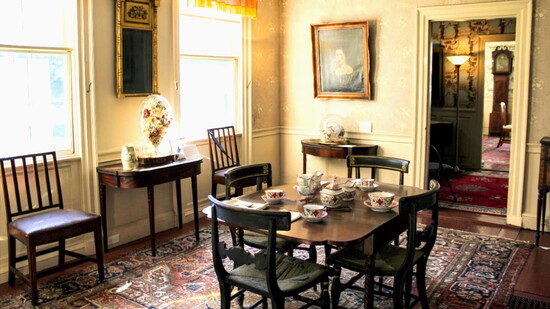
The dining room and adjacent pantry beautifully showcase the Historical Society’s extensive collection of ceramics and fine china. These pieces, along with the home’s furniture and other memorabilia, weave a vibrant tapestry of Portsmouth’s history. Since 1920, local families have donated their treasured heirlooms, spawning a collection that has grown to more than 3,000 objects.
Ward stresses the importance of preserving these historical objects. “They don’t lie, like documents often do,” he says. “These items illustrate the popular culture and craft industries of the time; as valuable as written documents—and much more interesting.”
Ascending the stairs reveals another enchanting piano in the upstairs hallway, once thought to be the oldest piano in America—an idea that gained it much attention when the house first opened to the public. It is indeed old, crafted in London in the 1770s. Esteemed ancestors of Portsmouth’s Pike, Burrier, and Tarlton families keep watch over the antique instrument from their portraits on the walls.
In a second-floor bedroom, the Barnes Bed claims fame as the bed Lafayette reputedly slept in. Surrounding the bed, 18th century furnishings offer a glimpse into the private details of daily life, including a large, wooden bathtub hewn out of a solid mahogany log. A bedside chair discreetly conceals a chamber pot—a convenient alternative to a midnight outhouse excursion.
The bedroom John Paul Jones presumably rented is a veritable mini museum, dedicated entirely to the house’s namesake. Paintings of Jones hang from the sea-blue walls, letters and documents reside in glass cases, and a dignified plaster bust of the war hero surveys his domain.
A maritime gallery occupies another bedroom, chronicling the maritime trade that was crucial to the economic life of New Hampshire’s only seaport.
This stunning historic home is a testament to the efforts of the Portsmouth Historical Society, whose members maintain the home, curate and display its furnishings, and present various exhibits. The Society conducts tours of the house from Memorial Day weekend through the end of October. The property’s lush gardens are a popular draw when in full bloom.
While John Paul Jones no longer walks among us, his essence lives on in the grand house that bears his name. Beyond the home’s connection to Jones, its greatest charm lies in the centuries of Portsmouth life that reverberate within its walls. Ward states proudly, “This is the only museum in town that collects the history of Portsmouth from Native American times to—literally—today.”
"...his famous name may be the reason the house is still standing."
"Stepping through the front door summons a palpable sense of those who walked here long ago—elegantly dressed ladies with rustling petticoats, dapper gentlemen in waistcoats and breeches, and the rakish Captain Jones himself."