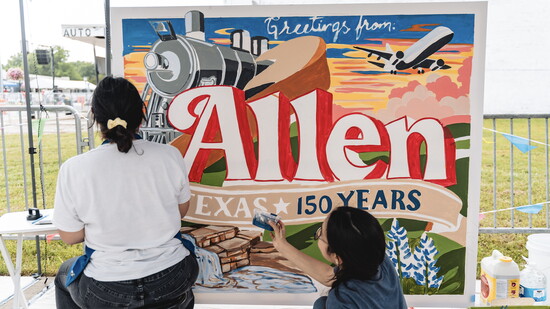
There is something about this time of year that invites us to look around, take stock of what matters, and reflect on the places we call home and the people who make them special.
For Allen residents, 2026 marked the city’s 150th anniversary, celebrating “Allen Through the Eras” and showcasing the people and history that transformed a small railroad stop into the community more than 113,000 people now call home.
“I think the first impact of the Allen 150 Fest celebration was one of community pride,” says Chelsey Aprill, director of the Allen Public and Media Relations Office. “People were excited to see Allen celebrated in this way and have this special occasion to celebrate our history and where this community is going together.”
That sense of gratitude was especially fitting for a celebration that depended so heavily on the community itself.
More than 80 local businesses, nonprofits, schools, and civic groups helped bring Allen 150 Fest to life, joining hundreds of volunteers and city employees to create a celebration that drew more than 10,000 people downtown.
For Aprill, seeing everyone together became one of the most memorable parts of the celebration.
“I turned around at one point and looked down Main Street and saw all the people gathered of all different backgrounds and ages,” Aprill says. “There is a lot of pride about Allen’s character, and that results in a community that comes together for moments like this.”
Held April 25, Allen 150 Fest commemorated the city’s sesquicentennial, marking 150 years since Allen first appeared on a county plat in 1876. But city leaders envisioned the milestone as more than an anniversary celebration. They wanted an event that could honor Allen’s heritage while bringing together the people, businesses, and organizations that make up the city today.
“Our residents and business owners are big fans of Allen,” she says. “They want to volunteer and contribute to help make this community a successful one.”
History was woven throughout the festival through an “Allen Through the Eras” concept, which allowed organizers to celebrate different chapters of the community rather than focus solely on its railroad beginnings.
Eventgoers could also enjoy a variety of musical genres and dance performances. The entertainment lineup included bluegrass/country music, Texas folk and polka, a mariachi ensemble, rock, and house, disco, and techno before the event’s grand finale firework and drone show.
Visitors arriving near the Allen Heritage Center encountered demonstrations showing what life might have looked like around the time the city was founded. The Allen Heritage Guild shared historic displays, while a kitchen garden and quilting demonstration helped bring the past to life. Elsewhere, families found vintage-inspired carnival activities, bounce houses, a car show, art, dancing, a sports zone, local vendors, and photo opportunities. Attendees cooled off by touring one of the oldest buildings in Allen, now turned into an event venue downtown.
For Aprill, working with the Allen Heritage Guild before the festival offered a new appreciation for the people who have preserved those stories.
“It was enlightening to hear their experiences of growing up in Allen and curating all of these displays that tell a story of its history,” she says. “This group has been stewarding all of these stories so well throughout Allen’s history.”
According to the Allen Heritage Guild, the city of Allen was named for Ebenezer Allen, former attorney general of Texas and a promoter of the railroad. So, it only made sense for the locomotive downtown to be one of the main historical attractions, providing a family photo opportunity and connecting younger generations to the community that existed long before the Allen they know today.
“Incorporating the locomotive and Allen Train Depot allowed people to step back in history themselves,” Aprill says. “It was important for us to showcase this historic location that many people in Allen haven’t experienced before.”
Yet perhaps the most fitting tribute to Allen’s history was how many people helped tell it.
“A true community event involves a lot of different perspectives and personalities and ideas,” Aprill says, “and it can create something really unique.”
A citizen steering committee helped guide the event and ensure programming represented different ages, backgrounds, and interests. Local organizations took ownership of individual pieces, including the Allen Arts Alliance, which hosted a mural competition. Businesses and individuals also contributed financially, generating more than $135,000 in cash and in-kind support (nearly three times the original private sponsorship goal).
Aprill says organizers intentionally made sponsorship opportunities accessible so smaller businesses could participate too.
“We saw so much support from the ‘mom-and-pop’ businesses that maybe couldn’t afford to advertise on a larger scale, but still wanted to contribute,” she says, noting that several individuals and families also supported the event financially.
“It was a really fun group project that brought together both city employees and our community,” Aprill adds. “Adding more people can make any project more complex. But inviting different talents and skillsets also leads to unexpected and beautiful outcomes.”
For Aprill, that community ownership made the celebration particularly meaningful.
“As you’re walking around, you’re seeing your neighbors, and you’re seeing your kid’s kindergarten teacher and friends that you haven’t maybe run into for a couple of years,” she says. “Everybody’s there to celebrate the place they live, and that pulls everyone together.”
Allen has changed considerably since its days as a railroad stop, and it will continue changing. The festival itself offered a glimpse of what a revitalized downtown could become. Seeing streets packed with residents gave city staff and community members an opportunity to imagine the historic district as an increasingly vibrant gathering place.
Aprill describes it as a “sort of suspended reality” which allowed citizens to think about what Allen could look like in the future.
The answer will unfold over years. But in a season when gratitude often takes center stage, Allen’s milestone offers another reason to appreciate the people behind the place. Allen 150 Fest offered a reminder that a city’s story isn’t simply measured in buildings, population, or anniversaries. It is carried by the people who remember its history, those raising families there today, and those willing to invest their time and talents in what comes next.
“This event serves as proof that community relationships are so precious,” Aprill says. “When we are able to do things together that leverage the expertise of our arts community and our business community and our local historians, it creates something so much more magical than what the city government could have done alone.”
This event serves as proof that community relationships are so precious.