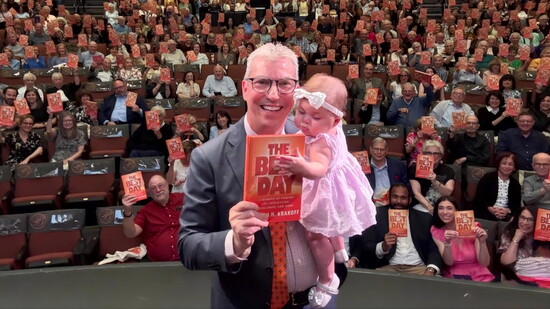
Rabbi Joseph Krakoff has spent much of his life sitting beside people on some of their worst days.
As CEO of the West Bloomfield-based Jewish Hospice and Chaplaincy Network (JHCN), “Rabbi Joey” and his team care for people from the time of a terminal diagnosis, providing spiritual care, social work, care navigation and life-enrichment services through the end of life, followed by bereavement support for those left behind.
It might seem an unlikely place to learn about joy. Rabbi Joey would tell you otherwise.
Years ago, he visited a man in the hospital on a cold December day. The man had received a terminal diagnosis and believed he had perhaps 48 hours to live.
“If you can just get me home to die, I would be so grateful,” he told Rabbi Joey.
He did go home. But instead of living two more days, he lived another 13 months.
“He said those 13 months were among the best of his life,” the Rabbi remembers. “He felt the love of friends and community who helped him understand the power of his legacy.”
A worst day had somehow opened the door to some of his best.
That idea sits at the heart of Rabbi Joey’s new book, The Best Day: A Memoir of Finding Joy, Inspiration, Resilience, and Hope. Through personal stories, including his parents’ divorce and even surviving a 21-story elevator fall when he was younger, he examines how difficult experiences can change us without having to define us.
“We all have challenging struggles,” he says. “Not everything can be made into a good experience. But if we reflect on the lessons we learn and how we can evolve because of them, a lot can change.”
The book is deliberately not written only for a Jewish audience. Biblical teachings appear throughout, but Rabbi Joey describes it as a “human book,” one meant to speak to experiences that cross faiths and backgrounds.
So what has a rabbi who regularly encounters grief, illness and loss learned about finding joy?
Turn outward.
“When we stay inside ourselves, we can get very lost and feel very alone,” he says. “When we let other people in and do nice things for others, we realize the world is a lot bigger and we’re in this together.”
And then there is gratitude.
“I think the people who are the most grateful are, by extension, the happiest people in the world,” he says. “Gratitude is humbling. Gratitude is centering.”
Gratitude isn’t simply recognizing that something good has happened, he adds. It means expressing appreciation for the people and moments that matter, particularly when life is difficult.
That lesson has been reinforced by the thousands of people his organization serves. Based in West Bloomfield, JHCN provides its services without charge, relying on community support rather than insurance reimbursement.
Last year alone, the organization recorded more than 32,800 interactions through spiritual care, social work, life enrichment, care navigation, bereavement services and volunteer support.
For Rabbi Joey, it all comes back to a question at the beginning of his book: Are you happy?
His answer is yes, not because difficult things haven’t happened, but because they have helped him understand what deserves his gratitude.
“The people who are the most grateful find joy, find inspiration, realize resilience and also hope,” he says. “All of those come out of a feeling of gratitude at their core.”
Perhaps the best day, then, isn’t necessarily the day when everything goes right.
Sometimes it’s the day we recognize what remains good, let someone else in, offer something of ourselves and decide to take one meaningful step forward.
You can find the book on Amazon.com, BarnesandNoble.com and Walmart.com. To make a donation to JHCN, visit jhcn.org/donate. For more about Rabbi Krakoff, visit josephkrakoff.com.