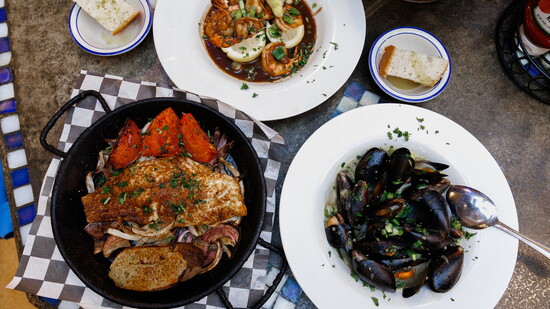
Tonight, there’s a high school graduation dinner for 40 on the patio at Fish Market. Last weekend, there was a wedding for 500 at Saint Mark the Evangelist. Regulars drift toward their usual tables and order the same thing they’ve been eating for years: Athenian shrimp, gumbo, Greek snapper.
In the middle of it all is Dorothy Sarris — answering phones, filling in when someone calls out sick, greeting blue-blood Birminghamians and construction workers with the same easy smile. She moves through the dining room with the calm authority of someone who has been doing this since elementary school, because she has.
Fish Market feels like a return to an older Birmingham in the best possible way: bigger portions, hushpuppies without apology, and dinner plans not dictated by Instagram. Dorothy’s stepmother, Rose, calls it “Greek Cracker Barrel” — an unpretentious place to gather.
Her father, George Sarris, opened the restaurant in 1983, a year before Dorothy was born. He had come over from Greece with nothing and washed dishes at Niki's West until he had enough money to buy a deli. He sold the deli and then bought the place that would become a Birmingham institution. Dorothy was peeling shrimp at Fish Market before she was in middle school, and was proficient at the cash register by fifth grade.
"Fish Market is Birmingham to me,” she says. "Birmingham is Fish Market. It's home."
She left anyway. In 2018, newly minted with Greek dual citizenship, she flew to Athens and stayed for nearly eight years — nannying and teaching English for a Greek family, living in different corners of the city, and immersing herself in a different version of the Greek life her father had given up to build hers in Birmingham. She came back last May.
Now, she runs the import side of the business: hand-painted ceramics, silk scarves, handmade jewelry, and pashminas sourced from workshops in Izmir, Turkey, alongside large-scale urns from Greece, all sold from a small boutique tucked in the back of Fish Market. Above the display hangs a banner reading “Sarris and Sons” — despite the fact that, these days, it is George Sarris’s daughter running the operation. Dorothy laughs that traditional Greek culture tends to favor the sons anyway, whether or not they’re the ones actually doing the work.
Tell us about growing up at Fish Market.
"I could make change and help customers completely unassisted. Around fourth or fifth grade, I started working one day a week. That carried through middle school, and in high school I was here a couple of days a week, right after school until closing."
Did you always know this is where you'd end up?
"In the back of my mind, yeah. I always thought, if I'm in Birmingham, I'm going to be at Fish Market. When we're really busy on a Friday or Saturday night, I get a high from it. It's an adrenaline rush. When I'm not here, I miss it."
What's the biggest trait you inherited from your father?
"Stubbornness. It doesn't always serve me well, but it is what it is. I think it's a Greek thing. All Greek people are stubborn. But I don't give up very easily, so in many ways, that stubbornness does help. And I really do like people. He loves to talk to customers, and I have that same knack."
Tell us about your first experiences of Greece.
"I spent most of my summers in Greece. The summer before first grade was the first time I went. My grandparents would go from May to September, and Dino, my younger brother, and I would go for four to six weeks. My dad came with us for the first time when I was seven — that was the first real vacation he'd taken since coming to America. It was a huge deal."
What made you finally go and stay?
"I had a really bad day at work — I was managing the business office at our catering company — and I called my dad and said, 'How hard do you think it is for me to get dual citizenship?' He said, 'I think you can do it.' And I said, 'I think I want to go for six months or a year.' He said, 'Yeah, you should.' Zero pushback. I was shocked. The next day, I was on the phone with the Greek embassy in Tampa. That was October 2017. I moved in July 2018."
What brought you back?
"Family. My brother’s family is growing. My parents are aging. And the cost of living in Greece has risen enormously, but salaries haven't kept pace. It didn't make sense to live there while I still needed to work and earn money. Would I retire there? One thousand percent. But to work and make real money, I needed to come back to reality in America."
You came back to run the import side of the family business. Tell me about that.
"Dino had been doing it himself for the last couple of years, but wanted to focus more on the food import company, Kalimera. They said, ‘You can help with the boutique, bring in goods from Turkey and Greece.’ I was very interested. I placed one order without having gone to Turkey, and then for my second big order, they said, ‘You need to go. Boots on the ground.’ So this past February, I went to Izmir on a buying trip."
What came back with you?
"I focused on hand-painted ceramics — coffee cups, little ring dishes, jewelry. Pashminas at a price point I don't think you can find anywhere else in Birmingham. Some silk scarves. The bags always go fast — every time I bring them in, they're gone within the first couple of weeks. I never buy enough."
How is Greek food in Greece different from what you grew up eating here?
"We are very Americanized. A Greek salad has no lettuce. It's tomatoes, onion, a couple of olives, green pepper, a lot of cucumber, oregano, a big hunk of feta, olive oil drizzled on top. That's it. No romaine, no iceberg, no dressing. I love our Greek salad here, but it is not a Greek salad."
What's your favorite thing to eat in Greece?
"Anything with eggplant. The area where our family is from — Leonidion, in the Arcadia region — is famous for its eggplant. They have an eggplant festival every year. Stews, jellies, all kinds of preparations. It's extraordinary."
What do you miss most about living in Greece?
"The simplicity. In Greece, you can sit at a café and have one cup of coffee, and it lasts four or five hours. No one's in a rush. Here, I can't tell you the last time I went to a coffee shop and just talked to someone. It doesn't happen — I'm in a work meeting, or I'm working. In Greece, your dinner lasts three or four hours, and you're there until two in the morning. That does not exist in Alabama."
What has coming home looked like for you personally?
"I recently purchased a home for the first time. I was moving around for so long, and I was unsure about buying in Greece. It feels good to know — okay, I'm going to be here for a while. It feels good to be putting down roots."
Dorothy's Greece
Eight years of living as a local. Here's what she'd tell a first-timer.
Start your morning right.
Skip the hotel breakfast. Find a local bakery and order a pie — spanakopita, chicken pie, or wild greens. Then get a Freddo cappuccino or Freddo espresso. "The best coffee was invented in Greece," Dorothy says without hesitation. "It blows the Italians out of the water." Beach hack: first coffee of the day, Freddo espresso, no sugar, add Baileys. "It sets your day up for success."
Morning: Monastiraki
The flea market neighborhood has its own metro stop and is pedestrian-only. Skip the tourist shops and go deeper. "If you want cool art, vintage, old stuff — it's amazing. I found a needlepoint from 1910 of Athena riding a horse." Dorothy recommends Yannis Michalopoulos in Plaka for rugs, art, and textiles.
Lunch: Exarcheia
Athens's counter-culture, graffiti-covered neighborhood is worth half a day. "Some of the best food in Athens - I love Avli Gefsipoleion. There are lots of really great art galleries, too."
Dinner: CTC
Eleven courses, and the menu changes constantly. Book ahead and budget at least three hours. "It's a culinary experience you won’t forget.”
Neighborhoods worth knowing
Kolonaki is where moneyed Athenians live. Great cafes, pretty streets, and a Saturday farmers' market. Amaya Jewels is worth a stop. Psiri is the more bohemian option with great restaurants and bars.
Museums
"I hope everyone goes to the Acropolis Museum. The Greeks put a lot of time, effort, and money into that museum, and it's really incredible." The Cycladic Museum and the Benaki Museum are worth adding if you have the time.
Beyond Athens: Dorothy's top three places in Greece
ARCADIA (Leonidion and Poulithra) — "By far my favorite place in Greece." The small beach village of Poulithra anchors the market town of Leonidion (population ~5,000), which has quietly become a world destination for rock climbers. "The people are so happy you're there. They're not jaded like on some of the islands. And they have some of the best food in Greece."
METEORA — Monasteries rising from rock spires, roughly two hours from Athens. "It's kind of life-changing."
SIFNOS — A Cycladic island known for its food and pottery workshops. "It'll be like Milos in a couple of years. The beaches are great, the food is great. It's quiet and beautiful and small." Dorothy spent her first visit on a boat and has returned every summer since.
"Fish Market is Birmingham to me,” she says. "Birmingham is Fish Market. It's home."
When we're really busy on a Friday or Saturday night, I get a high from it. It's an adrenaline rush. When I'm not here, I miss it."