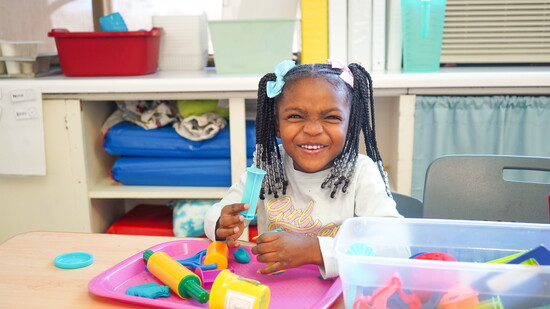
On the Growing Futures Early Education webpage, it says, "Kids get one childhood. Let's make it count." For the past 60 years, they've accomplished this goal by supporting families and children during the early years of development. The kids get a strong start in life, and their parents don't have to go it alone.
The center, located in the heart of Johnson County, serves children from six weeks to five years old as they transition into the school system. They also have a home-visiting program, where they go directly to families and support them prenatally for a healthy birth, followed by providing the little ones with a full educational experience. All total, they help educate about 225 children.
This was one of the first Head Start programs, developed by the Johnson administration in 1965 as part of the War on Poverty. The idea was that the best way to combat poverty was to give children an early start on their education. So, pre-K children ages three to five receive a high-quality early education to prepare them to enter the school system. Years later, in 1996, when studies showed that aspects of brain development begin at birth, Early Head Start was created for children ages zero to three.
Executive Director Larry Lewis explains, "Our goal in all spaces is to educate, empower, and make sure that parents can do for themselves. It's not our place to do it for them. We're just part of their journey, and we're going to make sure that they feel fully equipped to do everything they can to support their family."
All of Growing Futures' programs follow a curriculum-based approach. The Early Head Start and Head Start educators in the classrooms have skills ranging from early childhood accreditation to master’s degrees. All the classes follow a well-developed lesson plan while also considering the needs of each individual child. And those plans are fine-tuned throughout the year to keep those children moving forward.
The home-based Early Head Start program follows the respected Parent as Teacher curriculum, which is available to all families in Johnson County, regardless of income. This method brings a family educator to the home where they work one-on-one with parents and caregivers. These educators offer guidance on supporting early learning for infants and toddlers through activities tailored to each child.
"Our family educator looks at everyday items in the home and uses them to move the child forward in their development," says Lewis, who was once an in-home educator. "A great example is taking cereal and putting some next to a bowl. Then the parent picks one up and puts it in the bowl, and then the child picks one up and puts it in the bowl. Now you're working on fine motor skills. You're also counting. All these beautiful things are happening in this space of development right there in that moment. Plus, there's a bond happening between that parent and child."
Every Growing Futures family has a caseworker to advocate for their needs. With families in poverty, it isn't uncommon for a crisis to exist, and their caseworker will help them learn to address the problem so they can deal with it should it arise again. Wraparound services are also provided for the families and children. Twice a year, every child gets vision and hearing screenings. They also provide dental support, as well as speech, play, and occupational therapy.
Growing Futures is a 501 (c) (3) nonprofit organization. Funding for their programs comes through the federal government, but that amount hasn't increased in more than 40 years. So, to fill the gap, they rely on grants and fundraising. Harvesting Hope, a beautiful outdoor autumn gala, is their primary fundraiser. This year's event takes place on October 1st.
For more details about Growing Futures' programs and Harvesting Hope event, visit growingfutures.org.