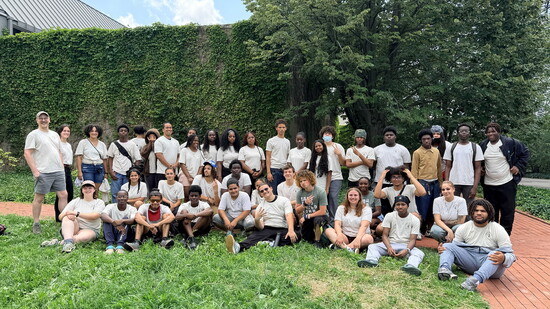
Of the 44 teenagers who spent this summer working in gardens connected to Taproot Collective, maybe one will grow up to be a farmer. But that’s fine with Nathaniel Mich, the organization’s executive director. The goal has never been to inspire more farmers, but to give local youth the opportunity to build skills, understand their stake in the community, and grow in them the confidence to lead.
“What we have found is the exposure to community engagement, principles for organizing, and food justice and social justice is how these kids are talking about their career choices,” Mich says. “We hear from our youth that the community engagement element is becoming more and more important to them, regardless of their specific career path after us.”
While working with youth is significant in the work Taproot is doing, the nonprofit was originally founded in 2017 as an all-volunteer organization. By 2022, the organization began transitioning to being a staff-run model and has grown to include five year-round staff members, with 40-45 youth interns.
The Taproot Collective got its start when a group of community garden managers and advocates observed that a lot of people wanted to start community gardens to feed, beautify, and support the health of their neighborhoods. But the logistics to get going were complex, from navigating land access and land resource policies to finding volunteers and funding.
Almost a decade later, Taproot Collective has grown into the primary support system for community gardens across the Rochester area. The organization doesn’t run gardens itself; that responsibility stays with the neighbors and volunteers who start them. Instead, gardens come to Taproot, through a suite of services the organization calls The Collective, for whatever help they need: materials, infrastructure design and installation, workshops and training, or a staff-led volunteer day to paint a rainwater barrel or tackle a bigger project. Twice a year in the spring and fall, gardens can register for $200 worth of supplies to start or close out the season. This past spring alone, 103 gardens took part.
No other organization in Rochester is open to working with every community garden in the area, regardless of who owns the land or what the garden is for, whether it’s for a school, church, library, or rec center. This year, Taproot expects to reach somewhere between 100–110 gardens total, with a longer-term goal of reaching all community gardens in Rochester, roughly 120–130 a year, including gardens in surrounding suburbs and rural communities. The organization is also expanding into community orchards for people who want to plant or already own fruit trees, while also building out support for more home gardens, with many already attending their workshops.
Taproot also handles the less visible work of keeping a community garden running, like acting as a fiduciary partner for grants, helping gardens secure liability coverage, and navigating the bureaucracy of finding land or getting permits.
Since the organization’s founding, youth employment has been integral to the work. In 2023, the organization began scaling up and standardizing the youth employment program, which provides long-term supportive employment relationships with low-income Monroe County teens, starting at age 14. Some youth are invited to take part in the school year employment program, which is more intensive and longer-term training. Through the work they do, they build technical, carpentry, leadership, and facilitation skills, Mich explains. “So they can move into a peer role model role the following summer.”
Some of the youth this summer have been with Taproot for four years. Over the next year, the organization plans to add more certifications and programs to the school year program and build more relationships with local employers. “We want to set them up for success for whatever their next step is,” he says. This past summer, they had 44 interns, ages 14-22, and for the school year they expect 15-20 youth leaders.
This year, they reached 100 interns. As of mid-summer, those interns had collectively earned $300,000 in wages and performed 19,000 hours of service in their communities. “That right there has a tremendous impact,” Mich says.
This past summer, youth were working on projects in 12 gardens. Mich explains that the projects they choose for their youth have to have some technical skill involved, so there’s building and basic carpentry, art, and placemaking. In the past, youth have even installed paved pathways and patio seating areas, honing in on landscaping skills as well.
Taproot’s own farm, First Market Farm near the Public Market, is used as a teaching and training garden, so youth do some work there over the summer as well. During the school year, youth play a bigger role at the garden site, with the organization transitioning the space into a youth-led growing space.
For many of the youth, it’s their first job ever—and the goal is to support youth in a lifetime of career exploration, Mich explains. “I think a lot more of them will become engaged community leaders with a deeper understanding of their role as engaged and active participants, not only in our food systems but our civic systems.”
"We hear from our youth that the community engagement element is becoming more and more important to them..."