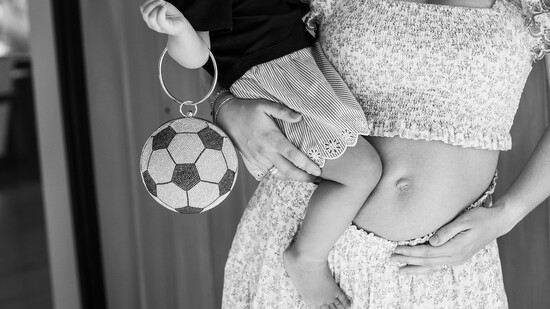
Before she was the wife of Phoenix Suns standout Grayson Allen, before she became a mom, and before the Valley started to feel like home, Morgan Reid Allen was already living the kind of life little girls dream about when they lace up cleats for the first time. She grew up in a house full of athletes, committed to Duke by her sophomore year of high school, competed at the highest levels of youth soccer, represented the United States at the U-17 Women’s World Cup in Azerbaijan, and went on to play professionally in the NWSL.
Sports taught her how to compete, how to recover, how to lead, and how to keep going when plans change. They also gave her perspective. The kind that comes from being drafted by your hometown team, winning a championship as a rookie, getting traded, hustling through the realities of women’s professional sports, and then facing a career-ending hip injury that forced a different future than the one you once imagined.
Today, Morgan’s life looks different, but her competitive fire, self-awareness, and gratitude haven’t gone anywhere. She’s grounded, articulate, and deeply present in this chapter, one that includes a daughter, a baby boy on the way, and a husband whose NBA career keeps life moving at a familiar athlete’s pace.
For our May Women’s Issue, as we tune into the World Cup this summer, Morgan reflects on chasing that same stage herself, competing at the highest levels of the game, and what it looks like to still love it just as deeply... now, from a different season of life.
You grew up in a family where sports were everywhere.
I had a basketball in my hands before a soccer ball, which is ironic now. My mom was an All-American point guard at Ohio State and coached my basketball teams growing up, so I was in the gym as soon as I could walk. My dad, also an athlete at Ohio State in wrestling, coached my soccer teams. They actually met in the weight room; still one of my favorite stories.
I grew up with a dual love for sports. It was soccer and basketball. I played AAU basketball, high school basketball, travel, USA soccer… I tried to fit as many sports into my life as I possibly could.
I have a sister and three brothers, so our house was full, loud, and competitive in the best way.
When you were little, what did you dream of becoming?
I wanted to play soccer. I wanted to play for Team USA. I never really saw sports ending. It was in my blood. And it’s funny, because even though I’m not playing professionally now, I did kind of end up with sports still being part of my everyday life. I’m married to a professional athlete. We still make everything competitive.
What do you appreciate most about your parents, especially as a mother yourself?
My parents had five kids all playing competitive sports at the same time. We were almost never in the same state on a weekend, but they just made it happen. And that takes time, energy, money, planning, and sacrifice, but they never acted like it was a burden. That’s what I appreciate most. They were always happy for us, always there when we succeeded, and always there when we didn’t.
You committed to Duke early.
My club team was incredibly successful. We won three national championships, and that brought a lot of attention to our team. I committed to Duke by my sophomore year of high school. They offered me a full ride.
At one point, were you truly deciding between soccer and basketball?
Yes. I went to Duke recruit camp for basketball too, and part of that recruiting conversation was that they would try to make it work if I wanted to do both. But once I got there, it became very clear that the commitment level was too high. You couldn’t really be all in on both, and our soccer team was very good. We made it to the Final Four twice.
What kind of player were you?
I played anywhere on the back line, mostly left. A lot of it came down to one-on-one battles; I’m not going to let you beat me. That was my mentality. Especially in college, I played outside back, so there was a ton of ground to cover, a lot of people racing to the ball, a lot of physicality. That’s where I thrived. I was technically solid, but what made me a great player was grit. If it came down to who was going to hustle harder, compete harder, or outwork the other person, that was where I felt strongest.
You and Grayson (Allen) both went to Duke. Did sparks fly right away?
We were friends for a few years first. Duke is much smaller than people realize, and the athlete community is really close because you end up doing a lot together. We started dating senior year and have been together ever since.
Did you go to each other’s games?
Oh, yes. I went to a lot of his home games, and he would come watch me too, which definitely made me nervous. I was nervous before every game anyway, but knowing he was there added a little something. Once the whistle blew and I touched the ball, however, the nerves disappeared.
Did you always think you’d go pro?
Yes and no. I was pre-med at Duke, so I always had this second path in mind. But after our senior year, when we lost in PKs in the Final Four, I just didn’t feel done. It felt like an unfinished story. I wanted more.
What was it like getting drafted by your hometown team?
Very special. I was drafted by the North Carolina Courage, which was basically right by where I grew up.
And that team won it all your rookie year.
Huge. Not everyone gets drafted and then immediately lands on a team that wins the regular season shield and the championship. We won in Portland, and it was such a beautiful turnaround from the heartbreak of losing in the Final Four in PKs. So special.
At the same time, Grayson was heading into the NBA.
We understood what the other one was going through. My rookie year, I didn’t play a ton, which was new for me. I had started every game in college, so it was humbling. Then his rookie year, he didn’t play a ton either. He spent some time in the G League and played in about thirty games. He was fantastic and still didn’t get the minutes you’d think. So it was really helpful to have someone who could understand that emotional side of professional sports. The uncertainty, the frustration, the work behind the scenes.
That kind of athlete-to-athlete understanding feels rare in a relationship.
It is. There are things people don’t fully get unless they’ve lived it. Even now, basketball is a never-ending job. He can be “home,” but if it’s game day, he’s at the gym for hours, he needs his nap, he has his routine, he’s mentally preparing. I completely understand the sanctity of a game-day nap because I had my own game-day rituals. So I think being athletes helped us understand each other’s mindset and recovery and what it takes to show up.
You were eventually traded to Orlando.
It was my first real experience moving away from home. Orlando was a great opportunity because I got to play more. But it was also adult life in a new way. I wasn’t near my parents. Grayson had also been traded to Memphis, so we were both navigating new cities, new teams, new systems, new coaches.
You’ve been very honest about the economics of women’s professional soccer.
The minimum salary when I got drafted was $19,000 a year. You can’t live off that. So I was private training, working camps, doing social media marketing, doing athlete model shoots, hustling however I could. That’s what all of us were doing. You did it because you loved the game so much you were willing to sacrifice for it.
And yet, you still speak about that chapter with gratitude.
Because I would do it again. I got to compete at the highest level with the best players in the world. NWSL had the best of the best. Even if the money wasn’t there, the experience mattered.
You also represented the U.S. at the U-17 Women’s World Cup in Azerbaijan.
When I was younger. I got called up to the national team around 13, and then made the U-17 World Cup roster in high school. Azerbaijan wasn’t even a country that had been on my radar before that. Soccer gave me the chance to travel the world and see places I never would have seen otherwise. But what really stands out is that it was the first time women in Azerbaijan were allowed to attend sporting events. That made the experience feel bigger than soccer. It was a meaningful moment for women’s rights, for the game, for progress. Grateful I got to be part of that.
Your career ended because of injury.
It was really hard, but maybe not in the way people think. I had torn over 50% of my labrum off the bone, had bone growth on my hip socket, bone growth on my femur. They had to fully reshape the bone of my hip and reattach the labrum with anchors. It was a major surgery and a very long recovery. But by that point, I was so physically limited that I wasn’t even debating whether I should try to keep playing. I could barely lift my leg. I just wanted to live normally again. So in a strange way, I didn’t have the dramatic emotional conflict of “should I keep going?” because my body made it clear.
And you knew you wanted to be a mom one day...
The doctor basically told me that if I went back to play professionally, the odds of needing a total hip replacement in the next five years were very high. I knew I wanted kids. I knew I wanted to coach them, run around with them, live a full life physically. A fake hip by 28 didn’t sound like the future I wanted.
Did coaching help you heal?
Yes. When we lived in Milwaukee, I coached a high school team right after surgery. I was on crutches. I couldn’t physically show them much, but it was this beautiful reminder that even when my body was really limited, my brain and my experience still had so much value.
And now you have a daughter.
Just like my mom, I put a ball in her hands early.
I think because I’m the oldest of five, I’ve felt like a mom since I was young. I definitely want to be steady, loving, and present, but I also love that my daughter already has this little spark in her. That spunk. I want her to stand up for herself. I want to help shape that, not dim it. I think sports gave me so much confidence and resilience, and I hope I can pass that on.
You’ve also spoken beautifully about the growth of women’s soccer.
The league has grown exponentially in just five years. The minimum salary is no longer what it was. There are more teams. Stadiums are full. Attendance is incredible. The opportunities for girls now and twenty years from now are so much bigger than what I had.
What is it about the Valley that feels different for you and Grayson?
We’ve moved a lot, but when we got to Arizona, it felt different. Then we moved into our house two years ago and said, no matter what happens with basketball, we’re keeping this house. That was a huge feeling for us. We finally formed a home base. We love it here. We love the people.
Why was saying yes to this magazine cover important to you?
Because this place feels like home now. In the beginning, it was more transitional. I still had work in Milwaukee, I got pregnant, everything was moving quickly. But now we’re more grounded. We have rhythm. We have a support system. And once those pieces start fitting together, you’re able to be more present and involved and feel like you’re really part of a place. That matters to me.
What are you most grateful for in this season of life?
Our little family. I feel proud of Grayson. I feel grateful to be here. I feel grateful to be raising our kids in a place we love. And I feel grateful for where life has landed after all the twists and changes and hard moments. None of it looks exactly how I pictured it when I was younger, but I think that’s part of what makes it feel so special now.
IG @morgan_reid
Want to snag little Em’s style? Head to Garage Boutique & Concept Store in Old town. Styled in a blue Chloé dress, a studded soccer purse, and an adorable pink dress.
“If it came down to who would outwork the other person, that was where I felt strongest.”
“None of it looks exactly how I pictured it when I was younger, but that’s part of what makes it feel so special now.”