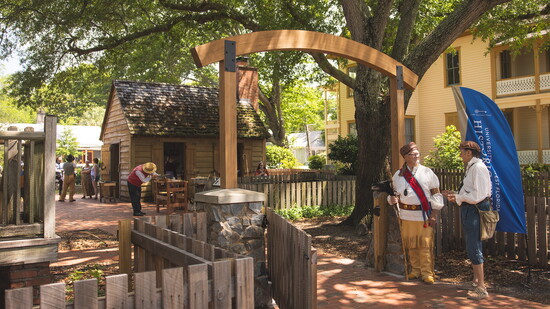
Tucked away in a beautifully shaded area within the heart of downtown Pensacola lies one of the area’s most fascinating hidden treasures: The Historic Pensacola Village, managed by University of West Florida’s Historic Trust. For visitors and locals alike, the village offers a remarkable walk through more than two centuries of Pensacola’s history, architecture, culture, and contributions to Northwest Florida’s people, industries, growth and history.
I recently met up with Education and Interpretations Supervisor, Phillip Mayhair, and Group and School Coordinator, Matt Santillo for a guided in-depth tour of the eight-acre village situated near Seville Square, in view of beautiful Pensacola Bay. The two well-versed historians shared some of the unique details of the village with remarkable knowledge of the buildings, period history and people that inhabited this intriguing Pensacola landmark.
The Historic Village features museums, preserved homes, a church, nostalgic cottages, a boarding house, and multiple interpretive exhibits that tell the story of one of America’s oldest settlements. The collection includes over 30 historic structures representing Colonial, Victorian, French Creole, and early Gulf Coast architecture, creating the feeling of stepping into another era entirely.
Among the village’s most fascinating landmarks is the historic Julee Cottage, a modest but incredibly important structure tied to Pensacola’s African American history. Built in the early 1800s, the cottage was once owned by Julee Panton, a free woman of color who became known locally for selling baked goods and candles. According to local history, she also helped purchase freedom for enslaved African Americans during that era. Today, the cottage stands as a tribute to resilience, entrepreneurship, and the often-overlooked stories that helped shape early Pensacola.
Another highlight is the beautifully restored Lavalle House, one of the oldest surviving homes in Pensacola and one of the few remaining examples of French Creole architecture in Florida. Originally built in 1805, the home reflects the city’s early Spanish and French influences and offers visitors a glimpse into life during Pensacola’s territorial period. Its raised design, broad porches, and historic furnishings make it one of the village’s architectural gems.
A short walk away stands Old Christ Church, widely regarded as the oldest standing church building in all of Florida. Constructed in 1832, the church remains one of Pensacola’s most iconic historic landmarks. Over the decades, it has survived wars, hurricanes, and changing governments while continuing to serve as both a spiritual and historical centerpiece of the city. During the Civil War, the church was even occupied by federal troops. Today, its soaring windows, historic cemetery, and quiet sanctuary transport visitors back to another century, while it also serves as one of the city’s most coveted wedding venues.
Perhaps the village’s most colorful story belongs to the Tivoli High House. Originally dating back to 1805 and reconstructed using archaeological and photographic evidence, the building once operated as a boarding house, tavern, gaming hall, and gathering place for Pensacola society. During Prohibition-era lore, the structure also gained a reputation for hidden speakeasy activity, adding another intriguing chapter to its already lively history.
The village also includes the fascinating Museum of Industry, where guests can learn how fishing, lumber, brickmaking, shipping, and rail transportation helped build early Pensacola into an important Gulf Coast port city. Historic artifacts, industrial equipment, and exhibits help showcase the industries that once fueled the local economy. You can even see a restored vintage locomotive that was used to carry brick and lumber across Northwest Florida and parts of Alabama.
Other attractions throughout the village include the Museum of Commerce, Pensacola Museum of History, Voices of Pensacola, the Children’s Museum, and several beautifully restored homes and cottages. Guided tours are offered by reservation, while self-guided exploration allows visitors to move at their own pace throughout the district.
Historic Pensacola Village is open Tuesday through Saturday from 10 a.m. to 4 p.m., with select Sunday hours for some museums. Tickets may be purchased at the Tivoli High House or online through the HistoricPensacola.org site.