Founded in 1942 and housed in a historic church on a quiet neighborhood street in Park Ridge, the Pascack Historical Society (PHS) museum serves as a portal through which visitors can transmit themselves through time to experience what life was like for those who chose to settle in the area that now comprises eight towns in the Pascack Valley region: Emerson, Hillsdale, Montvale, Park Ridge, River Vale, Westwood, Woodcliff Lake, and Washington Township.
This year, in preparation for the upcoming 250th anniversary in 2026 celebrating America’s turbulent journey to independence from Great Britain, the museum added an exhibit on the Revolutionary War in New Jersey. In addition, a series of events are planned, beginning with a lecture on March 22 about the Revolutionary War and the Pascack Valley by local historian Tim Adriance, a past president of the Bergen County Historical Society.
On April 26, PHS will present Benjamin Franklin impersonator Jack Sherry, a retired high school history teacher from Paramus, who is a devotee of Franklin’s and became involved in historical re-enacting in 1980. Another historical impersonator, Carol Simon Levin, will appear at PHS on June 14 when she portrays Abigail Adams. Called “the strongest voice in the American Revolution,” she was married to John Adams—America’s second President—and the nation’s first President’s wife to live in the White House.
Kristin Beuscher, a local historian who is also president of the society, organized the lecture series to focus exclusively on the Revolutionary War. “People love to see a re-enactor,” Beuscher says. “They’ll both come dressed in character and conduct the lecture speaking in the first person to tell their life story.”
After the July 4th holiday celebration, on July 12, PHS welcomes Joel Farkas, a volunteer docent and tour guide for the National Park Service at Washington's Headquarters in Morristown, New Jersey. Farkas will discuss the Declaration of Independence, one of the nation’s seminal founding documents.
“What we bring to people is the hyper-local focus and what was going on in the Pascack Valley during the Revolutionary War,” says Beuscher. “We saw our role as one giving information not just to people in general but bringing history home and getting kids excited about these events by letting them know that the Revolutionary War didn’t just take place in the big cities mentioned in their history books. These historical events happened here too, right in their own backyards.”
Ralph Donnell Jr., another PHS historian, and the society’s treasurer, is excited about the acclaimed recent broadcast of the PBS multi-part documentary series, The American Revolution, by Ken Burns, that focuses on New Jersey towns in the region that were central locations of the conflict.
The Baylor Massacre took place in River Vale and the Continental Army, under George Washington’s command, built encampments along Kinderkamack Road that stretched into Emerson and north to Soldier Hill Road in Oradell, Beuscher stresses.
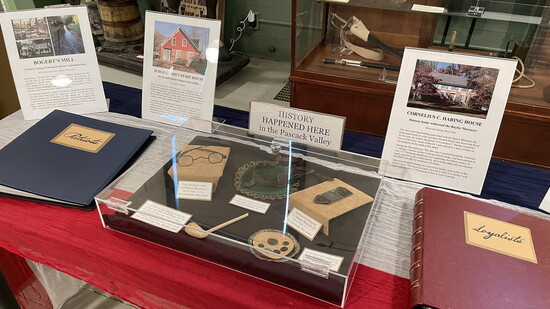
One of the Revolutionary War exhibits at PHS that she organized frames the struggle as a complex civil war sparked by simmering tensions between pro-British Loyalists and Patriots, Americans who rejected English rule and wanted to overturn the status quo.
“The vast majority of people here were Loyalists, and the reason they were Loyalists was because they were doing really well as farmers,” explains Beuscher. “They were the Jersey Dutch and they had carved out a life here in the middle of the wilderness; things were going well for them. They had food and what they needed, so at a time when life was so precarious, do you necessarily want to turn everything upside down for the sake of an idea that hasn’t really been tested and no one knows if it would be successful? The very real needs of survival would come first, so a lot of them remained Loyalists."
“Another element to the story is that the people who were here were Dutch by ancestry,” Beuscher continues. “They saw themselves as a separate culture. They spoke their own language and had their own traditions. For them, the revolution was more of a quarrel with the English and not really their fight.”
After conducting extensive research of materials in the PHS archives, Beuscher unearthed two lists she found in a 1960s issue of Relics, the organization’s newsletter that’s been continuously published since 1955. “One list named known Patriots and the other known Loyalists,” Beuscher says. “I thought that people should know this, so I decided to create two different books, one featuring Patriots, the other Loyalists.”
Through online sites for census records, ancestry.com and muster rolls from the Revolutionary War, Beuscher organized a biography for each person listed and placed the information in their respective book.
“I thought that would be so interesting, something that I hoped kids might come and look at,” Beuscher says. “I tried to track down an image to go along with each person—whether it was the house they lived in, their grave, or something else—in case the kids wanted to pick out a person and write more about them. That took a while, but I looked up every single person and tried to find every detail about them that I could.”
Beuscher’s diligent sleuthing revealed a lot more information about some people than others. “There’s a page about an entire Loyalist family who lived in Park Ridge and worked as spies during the Revolutionary War,” she shares. “There’s just so many interesting stories. I was hoping that schools might be interested and send kids here to do projects.”
Despite battling time constraints and other challenges, Beuscher and her team worked assiduously to include as many lectures about the Revolutionary War as possible into the museum’s lineup of events.
“My dream is that when people walk or drive down the street they’ll see that George Washington stood right there, or they’re able to picture the Continental Army up on Soldier Hill Road,” she says. “’I’m hoping it gives them a greater appreciation for their community and the history that happened here.”
Beuscher’s dream neatly dovetails with the stated mission of the museum: to preserve the past for the future. “When you know about historical events that happened in your community, you just look at it differently because it fills your heart with so much pride—at least it does for me,” she says. “I hope other people will feel that as well.”
For more information, visit the Pascack Historical Society at 19 Ridge Avenue, Park Ridge, NJ 07656. The museum is open on Sundays from 1pm to 4pm and Wednesdays between Memorial Day and Labor Day from 10am to 1pm. Admission is free and open to all.
Visit the website at pascackhistoricalsociety.org or call 201-573-0307. Follow Pascack Historical Society on Facebook at facebook.com/pascackhistoricalsociety or on Instagram @pascackhistoricalsociety.
“When you know about historical events that happened in your community, you just look at it differently because it fills your heart with so much pride." - Kristin Beuscher