If the walls of Glenview House could talk, they would need several voices. Since 1878, the landmark has served as a saloon, hotel, tavern, restaurant, dance hall, house of worship and civic gathering place. Glenview’s first village board met here in 1899, and local accounts suggest its charter may have been signed on the premises. Nearly 150 years later, the building speaks a lively new language: Mediterranean flavors, contemporary art, fresh seafood and the hum of a room people want to be in.
Foxtail at Glen View House opened Aug. 20 at 1843 Glenview Road after more than a year of renovation. The restaurant is the third Foxtail, joining locations in Des Plaines and Downers Grove. Yet this one feels inseparable from its address, a modern restaurant in conversation with the past.
Family ties run through the ownership group, which includes Michael Canning, Tim Canning, David Villegas, Anthony “Tony” Lupo and Elizabeth Lupo. The Lupos are related to the Cannings by marriage. Michael’s connection to the property predates Foxtail. He purchased and fully rehabilitated the building in 2010, then operated the former Glenview House tavern until it closed in 2023. Rather than walk away from the landmark, he remained an investor and partner as the group envisioned its next chapter.
The red-brick facade and front porch remain. Above, “Glen View House” stretches across the building in lettering recreated to resemble its 1890s appearance, when the village’s name was written as two words. Inside, nearly everything has changed.
The former layout divided the building into separate worlds. A dark, steep staircase greeted visitors, while the upstairs banquet room seemed detached from the bar below. Working with Chicago-based DXU Architects, the owners softened the staircase’s pitch and opened the ceiling above the bar, allowing energy to travel between floors.
“We want a Mediterranean vibe that’s light, bright and airy,” says Tim Canning, one of Foxtail’s principal partners. “Vibrant, colorful, playful and sexy. That’s the feeling we’re creating in the space.”
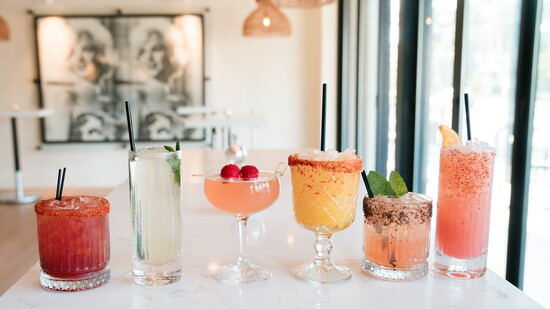
Mission accomplished. Foxtail trades nostalgia’s sepia tones for something sunnier. Creamy walls and pale wood floors catch the glow from globe pendants and enormous woven shades, which cast feathery shadows overhead. Deep green banquettes ground the dining room, while cane-backed chairs, patterned blue-and-white plates, illuminated arches and trailing greenery provide a coastal rhythm. At the long bar, chartreuse panels and niches glow against graphic black-and-white tile. Upstairs, a glass-edged opening now offers a view of the action below.
Then there is the art. Tim Canning has collected for roughly 14 years and owns an estimated 300 works, many held for future spaces. He chooses intuitively, looking for a piece that speaks to a building, a theme or the feeling of a room.
Foxtail’s collection rewards a closer look. A large portrait of a woman is assembled from hundreds of marble-like circles, each containing a miniature story and occasional wink, including SpongeBob SquarePants.
Elsewhere, glamorous faces emerge from graffiti-style compositions alive with pink, orange, turquoise and yellow. Rather than behave as polite decoration, the art adds personality and mischief.
Outside, Dutch artist Collin van der Sluijs created a mural after Canning, a longtime collector of his work, invited him to consider the site. The two had connected through Chicago’s Vertical Gallery, and van der Sluijs had previously painted another of the group’s buildings. His work gives Foxtail a contemporary landmark of its own, extending the restaurant’s gallery sensibility beyond its historic walls.
The transformation was not without drama. To create a necessary basement prep kitchen, crews excavated approximately 5 feet below the previous level. Once work began, they discovered the aging walls would not hold as expected. The structure had to be reshored, costing the project roughly two months.
“Obviously, you don’t know until you open it up,” says principal partner David Villegas.
The team worked with the village and Glenview History Center to respect a gathering place cherished for generations. Glenview contributed $2.9 million from its Permanent Fund toward the renovation as part of a broader effort to revitalize downtown.
The most dramatic addition may be the double-decker outdoor space, created with general contractor STRUXC and outfitted with louvered trellises. Three all-season patio areas expand the restaurant to 110 outdoor seats, in addition to 160 indoors.
One covered terrace feels intimate and tucked away; another opens around neatly set tables, dark columns and oversized tropical-style fans. Together, they give downtown Glenview something unexpectedly transportive.
Of course, a Foxtail must ultimately announce itself through food. Chef and Culinary Director Maya Nahouli, who is Lebanese, shapes approximately 90% of the menu across all three locations, with Executive Chef Evan Fullerton leading its expression in Glenview. Together, they give the expansive menu a clear point of view: Mediterranean at heart, coastal in spirit and unafraid to wander.
Nahouli’s spice combinations are deeply rooted, often prompting diners who share her heritage to say the food tastes like home. That sense of memory arrives in thoroughly modern compositions.
Creamy burrata rests over jewel-toned fig mostarda with crostini and a truffle drizzle. Grilled octopus curls among potatoes and shishito peppers beneath a swipe of Fresno aioli. Shrimp saganaki brings together tomato ragu, the herb savory, ouzo, feta and shishito pepper, while a grilled peach salad layers fruit, baby greens, tomatoes, red onion, ricotta salata, pistachios and yuzu vinaigrette. Color is not applied as garnish. It is built into the food.
The menu moves easily from Lebanese flavors to Italian pasta, steaks and a raw bar. Foxtail “paella” replaces traditional rice with orzo, folding chicken, andouille sausage, shrimp, mussels, clams, scallops and vegetables into saffron broth. Frutta di mare arrives as ribbons of pappardelle tangled with mixed shellfish, zucchini and squash in a white wine sauce. At a preview dinner, a split lobster, burnished from the grill and presented with thick slices of toast, looked almost elemental on its dark plate.
At Glenview, a dedicated sushi and raw-bar chef has room to improvise with part of the menu. Fresh seafood arrive daily, a point of pride for a restaurant in the Midwest. The showstopping seafood tower rises with lobster, oysters, king crab legs, crab claws and shrimp, but its abundance serves a purpose beyond spectacle.
“I think it helps guests start to trust you when you can serve them really good, fresh seafood,” says Canning. A Kendall College graduate who spent nearly a decade cooking in Boston, Canning considered a raw bar integral to Foxtail from its earliest days. “We’re very proud of what our products are.”
Even dessert continues the visual conversation. The Double Mousse Carrot Cake layers cookie butter and cream cheese mousses beneath a glossy cookie butter glaze, spiced pecans and caramel. Tahini Dream Bars combine shortbread, sesame, caramel and chocolate alongside vanilla ice cream. Presented on blue-and-white floral china, the desserts echo the dining room’s palette, another small sign that Foxtail’s details were meant to speak to one another.
The restaurant opened with dinner service, with brunch and lunch expected to follow. Live music and DJs are also planned throughout the week, continuing a tradition of entertainment that reaches back to the dance hall once housed on the building’s long-lost third floor.
Early reactions have been emphatic. Longtime residents arrive with stories of the former Glenview House, often remembered fondly as a dive bar, then marvel at what has replaced it. The owners see Foxtail as one piece of a larger downtown resurgence, alongside other restaurants supported by the village.
“It’s already buzzing and hopping,” says Canning. “It’s a whole different world. And I think it’s long overdue.”
The group plans to continue reviving storied buildings. Its next major project, The Dime, will transform the historic three-story White Bank building at 678 Lee St. in downtown Des Plaines.
The name was inspired by Brooklyn’s former Dime Savings Bank, which Tim Canning and David Villegas passed on their way to JFK Airport during a research trip to New York. It is adaptive reuse as more than preservation, with the old bank vault planned as an intimate private dining room. The goal is to keep history socially useful, inviting a new generation through the doors.
As for spirits of another sort, no ghosts have made themselves known at Foxtail, unless one counts the occasional guest locked in a bathroom. The renovation did uncover one curious artifact: a whoopee cushion. In a building that has witnessed charters, sermons, dances and untold nights at the bar, it feels strangely appropriate. History, after all, does not have to sit solemnly behind glass. Sometimes it pulls up a chair, orders the seafood tower and joins the party.
“It’s already buzzing and hopping,” says Canning. “It’s a whole different world. And I think it’s long overdue.”