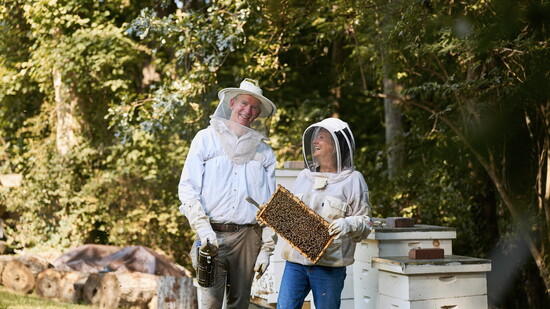
Neighbors in South Charlotte’s Mountainbrook stroll past yards with the typical blue hydrangeas in springtime, or an array of pink azaleas, sure. But if they pass the neatly manicured front lawn of Rachel and Clark Humphries, they’ll see a wide variety of flowering plants.
There’s butterfly bush, salvia, fireweed, Shasta daisies and more. And this year, Clark tried his hand at growing chamomile—as in tea.
So what do those species have in common?
“Bees love them,” Rachel Humphries says.
(They’re deer-resistant, too, Clark points out, which helps.)
What the Humphries’ neighbors can’t see from the street is the row of beehives, five of them, stacked along the back edge of their backyard. That’s their apiary, and along with the pollinating plants throughout their yard, that is how they help support the health and prosperity of North Carolina’s state insect: the honeybee. At any given moment, the Humphries are taking care of several hundred thousand of them.
The now-retired parents, grandparents—and at the moment dogless duo—have joined forces with the more than 15,000 North Carolinians who have taken up beekeeping as a hobby and a cause.
That’s the most beekeepers per capita of any state in the country, according to Homegrown, N.C. State’s College of Agriculture and Life Sciences publication.
North Carolina’s beekeeping foundation has more than 4,000 members. In Mecklenburg County, over 600 beekeepers gather regularly to educate and commiserate. A common fight unites them: counteracting the environmental, climate and industrial forces threatening honeybees—and with them, everything from local agriculture to backyard gardens.
At the very least, once a week, and more often than not, the Humphries can be found covered from head to foot, tending to their bees. They open the hives to ensure the queens are thriving, prevent swarms from leaving, and separate colonies as needed, all while Rachel keeps track of the populations with copious audio notes.
In the spring, they harvest honey multiple times and share it with anyone who will take some. They also keep a handful of hives at a Pineville farm, where the bees pollinate an acre of vegetables harvested and donated to The Bulb, a nonprofit serving local families.
They wear veils to keep their faces and necks covered, and gloves over their hands, but they know even a layer of clothing can’t always prevent stings. Calm can. So does a blast of smoke from a canister of burning pine needles they use to control the bees’ pheromones and, therefore, excitement level.
“These bees are so docile,” says Rachel, who has suited up grandchildren as young as 3 and neighbors as young as 5. “We have very happy bees and very healthy bees.”
She credits a mentor they found through the Mecklenburg County Beekeepers Association. Having one-on-one instruction to rely on, they say, has made all the difference.
Clark Humphries was still working in medical software sales and gardening on the side 10 years ago when he first decided to try raising bees on his own to help his zucchini and tomatoes grow.
“It was amazing how the production of my vegetables had this crazy increase,” Clark says. “And we got honey, which was a plus.”
Clark says he bought a book to read and “tried to stay one chapter ahead of the bees.” It didn’t last long. Bees he’d bought in batches for $150 or $200 would either die off or fly away. After a while, he gave up. But Rachel started to miss the honey.
She wasn’t working anymore, so she volunteered to attend a class through the Mecklenburg Beekeepers. There, during a two-month program, she was paired with her mentor.
“We have so many knowledgeable beekeepers here that have been keeping bees for 50 years,” says Rachel, who still attends monthly meetings. “People from all cross sections of our community are beekeepers. There are hives all over this city. People are so interested in maintaining pollinators for all of the plants that we have, and all of the local gardens we have.”
People from all cross sections of our community are beekeepers.