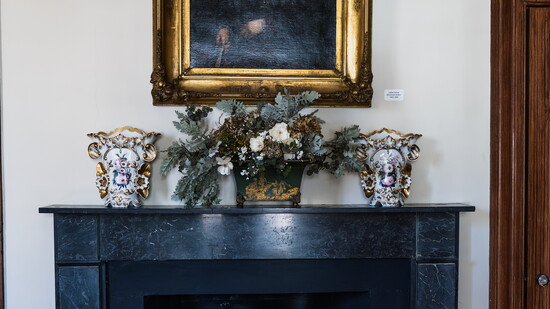
Among the busy downtown area stands a distinguished piece of architectural history. Perhaps you’ve noticed it, been curious about it, or even visited it. Nestled between W. McGee Street and W. Washington Street lies former NC Governor John Motley Morehead’s Italianate-style residence, the Blandwood Mansion and Carriage House, which dates back to the mid-1800s. Today, the nonprofit organization Preservation Greensboro Inc. (PGI) acts as the steward of the property and its cultural legacy. Visitors can experience the history, architecture, original paintings and portraiture, and examine stories of the Morehead family and the people who were once enslaved there.
At the helm at PGI is Christina Pennant, Interim Executive Director and Board Vice President. For her, historic preservation isn’t about freezing the past in time but is about continuity—how stories, spaces, and design help a community remember who it is while imagining who it might become. “Throughout my career, my work has focused on how systems and spaces shape memory, belonging, and meaning,” Christina says. “Historic preservation became a very natural extension of that.”
After moving to Greensboro six years ago to work with a legacy company, Christina found herself drawn to the city’s material history—estate sales, old furniture, architectural salvage. “What people discard and what people keep has always fascinated me,” she says. “Those decisions tell a story.” That curiosity led her to volunteer with Architectural Salvage of Greensboro (ASG), a key arm of PGI, about a year and a half ago. From there, she became involved with the organization’s board in 2025, serving first as interim secretary, then vice president, before stepping into her current leadership role. “It feels less like filling a gap and more like stewarding a transition,” she explains. “Helping the organization rediscover its voice, its relevance, and its future.”
Even when preservation isn’t possible, integrity still matters. “If we can’t preserve a structure, we can often preserve its materials, its craftsmanship, its story,” Christina explains. “That’s incredibly important.”
Preservation, Christina believes, is ultimately about people. “Every home and every city has layers of stories,” she says. “The question is: How do you hold all of those layers together?”
PGI does that through immersive, community-centered programs. The annual Tour of Historic Homes and Gardens returns this May in the Starmount neighborhood. In the fall, their Bourbon Festival connects Blandwood’s history of entertaining with contemporary regional distillers, offering another entry point into the past.
“These events aren’t about nostalgia,” Christina notes. “They’re about connection—about meeting history where people are.”
Few places embody that philosophy more fully than Blandwood itself. Saved from demolition more than 60 years ago by six local women, the mansion stands today as both a historic structure and a shared emotional anchor for Greensboro.
“It was never just about saving a building,” Christina says. “It was about preserving the stories, the craftsmanship, the sense of identity that the place held for the community.”
She’s keenly aware that historic spaces can sometimes be perceived as static or inaccessible. “History isn’t dust,” she says plainly. “It’s lived experience. Blandwood has the potential to be a place where people gather, celebrate, reflect, and feel rooted.” The Mansion is available for tours on Saturdays, and the Carriage House serves as a private rental space for weddings, corporate events, or social gatherings.
As Christina and PGI look ahead, their mission is now defined by a guiding framework: to preserve the past, guide the present, and inspire the future through advocacy, education, and programming.
Want to get involved?
Preservation Greensboro welcomes volunteers year-round and is currently seeking additional help for its Tour of Historic Homes and Gardens in May. To learn more, send a message to office@preservationgreensboro.org or visit www.preservationgreensboro.org.