From front porches to community social hours, home takes many forms as we age. Not everyone gets the choice of whether to age in place or move to older adult housing. But for those that do get to choose where they age, home becomes less about the structure itself and more about how well it supports function, comfort, dignity, and connection.
For Karen Coffey of Brighton, the idea to age in place and be proactive about it was planted while helping take care of her father. While it was ultimately a good choice for him, she noticed things about his situation that weren’t working. “His shower was too small to get a walker in, or he needed seating. There was no comfortable place for a caregiver to sit. I was thinking, what are we going to do? That just started the ball rolling,” she explains.
Aging in Place: Planning Ahead
According to the National Institute on Aging, AARP reported in 2021 that when given the choice, 77% of adults over 50 prefer to age in place. Brittany Ferri, a Rochester-based occupational therapist with a background working with older adults, says the layout of the home environment is critical to safety. “We see older adults have a much easier time remaining in one-story homes, two-story homes with at least one bedroom and bathroom on the first floor, and any other accommodation that only needs simple modifications or rearranging,” she explains.
Designing for Safety, Comfort, and Continuity
When confronted with the realities of aging in place, Coffey realized how deeply attached they were to their home of 40 years, so moving simply wasn’t an option they wanted to consider. Instead, they turned to James Kruger, owner of The Remodeling Showroom in Fairport, to help reimagine the space in a way that would support accessibility and ease of living. The remodel focused on thoughtful changes that blended with the existing character of the home, including the addition of a first-floor bedroom and a reconfiguration of surrounding spaces to improve flow and function.
Living in an older house required creative problem-solving. Doorways were widened to accommodate a wheelchair or walker, resulting in what Coffey describes as a more “open concept” feel. Part of the home’s deck was reclaimed and transformed into a new living area that includes a bathroom, walk-in closet, and seating space designed to comfortably accommodate both daily life and caregivers.
Function Without Sacrificing Beauty
But they didn’t just want it to be functional, they also wanted to continue to love the aesthetics of their home. “If I’m really sick, I want it to be pleasing so I don’t feel horrible,” Coffey explains. “I think it will pay off down the road, but I got to say doing it now instead of when we really need it, has been great because it’s beautiful. We have a ton of room now when grandkids come over. They just have so much space.”
Proactive Renovation vs. Last-Minute Decisions
For Carol Roberts and her husband, Frank Wojcik of Pittsford, the idea of aging in place came naturally. Frank had undergone multiple surgeries, most recently a knee replacement, which made long-term accessibility an important consideration. So when the couple began planning their return to the Rochester area after living in California, aging in place was already on their radar. At the same time, they knew that life along the canal in Pittsford represented their ideal lifestyle—and one they weren’t willing to give up.
According to Kruger, who also did the renovation on their home, they were being proactive. But that’s not always the case. “So often I’ve come across folks who are doing it as a last resort because something happened and they didn’t plan ahead,” he explains.
For Roberts and Wojcik, Kruger transformed a bonus room off the dining room into a first-floor bedroom, adding French doors to define the space. A nearby half-bath was expanded into a full bathroom with grab bars and a doorway wide enough to accommodate a wheelchair, while the kitchen was also designed with wheelchair accessibility in mind.
Staying Rooted, Staying Connected
Being able to age in place “is a comfort,” says Roberts, “and you don’t have the stress of establishing a new neighborhood, new neighbors, new friends. Ultimately, it’s more reasonable financially.” The couple also chose a home they love near their daughter. “So that’s another reason you just want to stay where you planted roots.”
When it comes to helping people stay in their homes, it goes beyond beautiful renovation, accessibility, and design. For Kruger, who’s at a point in his life when his own parents are aging, it’s also personal. “I was devastated when my parents sold the house I grew up with. I would love it if my kids could sleep over at grandma and grandpa's house in my bedroom. How cool would that be?” he says. “I think the need is huge to take these existing spaces and create a much more comfortable environment, and thinking about that ahead of time is definitely really important.”
Emergencies happen, and prices are only going up, notes Kruger, adding that talking to a professional who knows the ins and outs of real estate are important conversations to have as you plan for the future.
Accessibility That Preserves Independence
When it comes to making homes safer for people, Dr. Pia K. Nault has made accessibility her career. As president of Fleetwood Accessibility Services, she’s dedicated to “helping people age gracefully, whatever their situation is,” she says. “Everybody has the right to a safe environment.”
Fleetwood Accessibility provides solutions for people who are aging or living with disabilities, with the team’s most common modifications being vertical platform lifts, ramps, and stairlifts. The approach is tailored to each client’s needs, whether they’re navigating arthritis, COPD, heart conditions, or more significant mobility challenges.
“We look at the condition first, then we look at their abilities, and what is their environment?” she says. Fleetwood’s team assesses everything from floor heights and step thresholds to doorway and hallway widths for wheelchair accessibility, as well as bathing routines and overall safety needs (along with other factors) every time they evaluate a home.
Dr. Nault notes that studies have shown how independence and living under their own roof is beneficial to people as they age, not only physically but for their mental health as well. Fleetwood’s Ryan Perry echoes her sentiment: “It allows people to function in their home rather than being taken to a nursing home or assisted living facility.”
Designing Accessibility with Intention
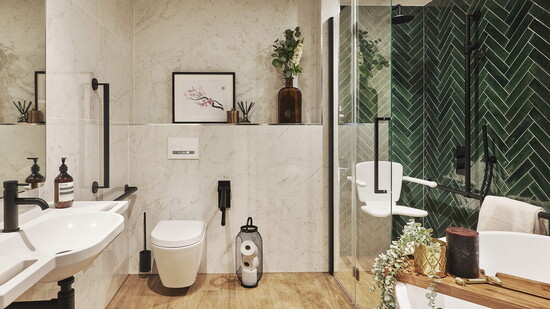
While accessibility is the primary focus of many aging-in-place renovations, it doesn’t have to come at the expense of design. Christina Walsh, owner of Coastal Tile & Stone, frequently helps homeowners update bathrooms that balance function with visual appeal. “I love being able to show our clients photos of our previous work where the designs are so beautiful, that they really have to look to find the accessibility within the design,” she says.
One of the most common accessibility features that can be made elegant without calling attention to itself is wider door openings, Walsh notes. While 32 inches is the legal limit, Walsh says they aim for 36 inches for easier maneuvering. Pocket doors or sliding barn-style doors eliminate the need for swing space. Within the bathroom itself, comfort-height toilets and bidet seats provide added ease, while floating vanities offer both a clean, modern look and the knee clearance needed for wheelchair users.
“To me, ‘aging-friendly design,’ beyond the safety aspect, means universal design—an ease to the space,” Walsh says. “There must be comfort along with that necessary safety. It means smart technology, and the space to move freely with a walker or cane, or wheelchair if necessary. It means a homeowner being able to be independent and confident in the space. And finally, it means beauty and relaxation in one of the areas in the home that should be a calming, peaceful sanctuary.”
That same commitment to comfort, independence, and beauty extends to solutions offered by Fleetwood, including a range of upholstery, color options, stainless steel trim, and alternatives such as glass or epoxy panels in place of solid metal on vertical platforms. “It makes it quite modernized,” says Dr. Nault. Once a project is underway, Perry adds, the team works closely with clients to finalize finishes and color choices that align with the rest of the home.
Finding Home in Community
Of course, not everyone ages at home, with many choosing to find community in senior housing. According to Wendy Ferrer, senior vice president of house and marketing at Jewish Home, many are drawn to older adult housing “by the promise of deeper connection, enhanced safety, and a vibrant, active lifestyle—underscored by planning for future care needs that offer peace of mind for themselves and their families,” she says.
The decision for Pat to move to The Summit Independent Living option at Jewish Home came after her husband passed away. She had been alone for 13 years, was tired of outside chores, and had watched friends pass away as well. Since joining the community, she's been exercising six days a week—something she never thought she’d do—and enjoying the activities and connection. “Home is where your heart is. I love my life here,” she says.
For Saul and Abbey Rasnick, also residents of The Summit Independent, one of the main reasons for moving was that meal preparation had become difficult due to back pain. They were also familiar with several residents and were looking for a simpler, more manageable lifestyle.
“People sometimes think senior communities limit independence, but in reality, they empower individuals to live life on their own terms and explore new interests, without being tied down by home ownership,” says Ferrer. “At The Summit, residents formed an astronomy club and enjoy stargazing together, others cultivate grapes for winemaking in the garden beds, some lead art classes and organize salons to showcase creative work, while others knit winter wear to donate to underserved youth—all examples of how independent living communities can foster personal growth at every age.”
Home Is Where the Heart Is
Whether it’s staying under your own roof or joining a community of people to continue your life journey, Ferri says any place that allows an older adult balance is ideal. “Socialization, physical activity, leisure, self-care support. Any support systems that are in place should preserve someone's dignity, which is another key for keeping an older adult happy and confident.”