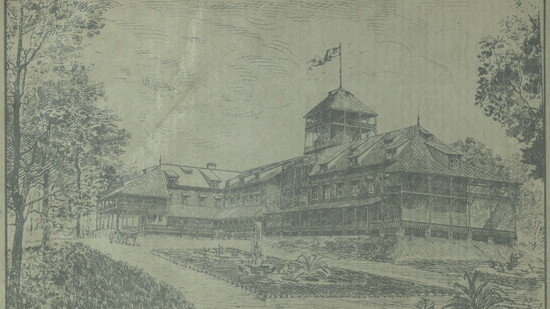
Long before Huntsville became a modern culinary destination, Jessup Whitehead placed the city on the fine-dining map as the Chef de Cuisine of the Monte Sano Hotel. Opening in 1887, the hotel catered to well-to-do Americans escaping the heat and disease of cities. Nestled on a bluff on the west side of Monte Sano Mountain, the 233-room property became a fashionable spot for families to enjoy the mountain’s fresh air and resort’s recreational activities.
But the Monte Sano Hotel was more than a mountain top retreat. It was a lynchpin in a plan developed by Huntsville business leaders to lure wealthy industrialists to Huntsville and invest in textile mills. During its thirteen-year run, the hotel hosted William Waldorf Astoria and William Kissam Vanderbilt.
With an established career as chef and cookbook author, Whitehead’s reputation attracted wealthy investors with an appetite for success. Whitehead rose to prominence just as hotels and the tourism business grew across the United States. Railroads expanded travel and knit cities together, making it easier for wealthy families and business travelers to reach resort destinations. With more guests coming in every season, hotels needed larger, more reliable kitchen staff than the old apprentice pipeline could provide. Whitehead’s success as a journalist for Chicago’s The Hotel World gave him an audience within the culinary industry. During the 1880s, he published five cookbooks: The American Pastry Cook, Steward’s Handbook, American Meat Cooking, Cooking for Profit, and The Whitehead’s Family Cook Book.
Whitehead also burnished his reputation through his practical experience in the kitchens of prominent hotels. In the early 1880s, he worked at the Teller House Hotel in Central City, Colorado. From there, he went to the Everett Hotel in Jacksonville, Florida, where he added elements of low-country cooking to his repertoire. The Sweetwater Park Hotel in Salt Spring, Georgia recruited Whitehead to their kitchen in 1887. The following year, Whitehead became the Chef de Cuisine at the Hotel Monte Sano.
By all accounts, Whitehead enjoyed a stunning debut at the hotel, and he planned to direct the kitchen for the 1889 season. Huntsville embraced Whitehead, and the Huntsville Weekly Democrat breathlessly announced that Whitehead planned to offer cooking classes to the “ladies of Huntsville.”
Sadly, Whitehead passed away in May 1889, a month before the season opening of the Monte Sano Hotel. He is buried at Maple Hill Cemetery.
The Historic Huntsville Foundation republished Whitehead’s book The Whitehead’s Family Cook Book in 1981. Here, Whitehead’s voice resonates as he dispenses advice and encouragement along with recipes. Several dishes would only appeal to the most adventurous among us. For example, calves’ head soup--a mock version of turtle soup--requires the cook to split the animal’s head and boil it in a pot along with the hooves. Other dishes, such as his lemon pie recipe, are quite tempting.
Although the Hotel Monte Sano had a limited run, the directors met their larger goal. Trevanion Dallas, a wealthy Nashville industrialist and frequent hotel guest, invested in a Huntsville cotton textile mill in 1890. When it opened in 1892, Dallas Textile Mill was one of the largest mills in the South.
The legacy began by Jessup Whitehead is now carried forward in the kitchens of Huntsville restaurateurs Jimmy Boyce, Stephanie Kennedy-Mell and Matthew Mell, Mike and Kristian Denis, and Rene Boyzo. Today, Huntsville is a city that lives, works and plays--and a place where you should plan to stay for dinner.