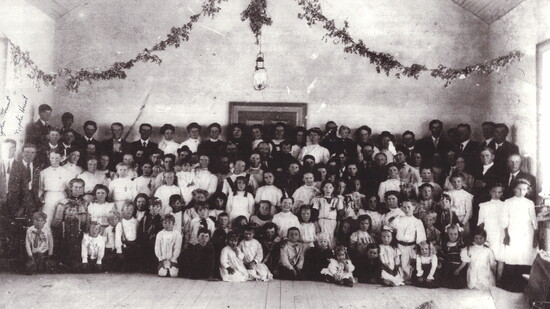
February is often a month devoted to love—between partners, families, and friends. But in Southern Utah, love has also meant something broader: neighbors caring for neighbors when survival depended on it. Few moments reveal that truth more clearly than Enterprise’s experience during the Spanish Flu pandemic of 1918–1919.
When the flu reached rural Utah near the end of World War I, it arrived quietly but spread quickly. Large numbers of soldiers killed during the war died not on the battlefield, but from the pandemic itself. As servicemen returned home, the illness followed. By November of 1918, Enterprise was effectively shut down. Schools and churches closed. Public meetings were banned. Masks were worn, with some residents spritzing their gauze with turpentine, convinced it might help keep the sickness away. Only one person was allowed in the post office at a time, and even standing in groups on the street was forbidden. Young people attempted to hold dances anyway, but health officers, often backed by parents, quickly shut them down.
For two months, the town waited. When life briefly resumed, a second wave struck in January of 1919, bringing renewed closures. According to Orson W. Huntsman’s journal, more than 300 cases were recorded in the Enterprise area, a staggering number for a small agricultural community.
Then came the losses.
In the spring of 1919, sickness moved through Enterprise with frightening speed. In less than six weeks, eleven residents were lost. The sickness did not discriminate and affected everyone. Many members of the same family were sick at the same time. So many residents were ill at once that it became difficult to find anyone well enough to offer any assistance.
And yet, the town endured.
Local accounts recall that nearly everyone who could still stand took on the work of those who could not, with local lore even holding that two Enterprise residents never fell ill at all, quietly assuming the daily chores of their neighbors, such as chopping wood, tending animals, and keeping households running until the town could breathe again.
By mid-April, the worst had passed. In May of 1919, Enterprise gathered for a memorial service honoring those lost to the flu, as well as the young men who had died overseas. When the illness returned briefly in 1922, the town complied with quarantines and fines without protest. Hard lessons had already been learned.
Enterprise survived not because it was spared hardship, but because its people refused to face it alone. In a time when fear could have divided them, local love bound them together and it remains one of the town’s quiet, enduring strengths.
Anna Lytle is a Southern Utah–based independent researcher and storyteller with a passion for uncovering the human stories behind the region’s past. She's the creator of the podcast What Once Was, where she blends research with storytelling to share the history of Southern Utah.
...when fear could have divided them, local love bound them together... it remains one of the town’s quiet, enduring strengths.